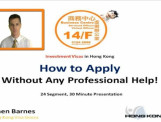



Why Pay For Professional Help in Your Hong Kong QMAS Application When You Really Can Do It All By Yourself!
Posted by The Visa Geeza / in Musing, Special Programmes / 17 responses
How the Content Must Now Be Read in Light of the Updated QMAS (Quality Migrant Admission Scheme) Policy
In the candid advisory piece Why Pay For Professional Help in Your Hong Kong QMAS Application When You Really Can Do It All By Yourself!, the foundational thesis centers on demystifying the application process and discouraging applicants from paying unnecessary, exorbitant agency fees. According to the Hong Kong Visa Geeza, Stephen Barnes, prospective migrants were routinely overcharged by immigration consultants who merely repackaged the Immigration Department’s publicly available application guides. The piece laid bare the empirical realities of the legacy scheme: historical approval rates hovered around 27%, with an overwhelming 77% of approvals absorbed by Mainland Chinese nationals and Western expatriates accounting for tiny fractions. Because the legacy 225/245-point General Points Test functioned essentially as an opaque lottery vetted by a non-official Advisory Committee, paying thousands of dollars for speculative submission assistance—only to endure a 7- to 12-month wait for an unappealable refusal—offered little commercial value to candidates who could easily file self-directed applications using free, professional-grade online toolkits.
That pragmatic, self-directed ethos must now be interpreted through the definitive legal architecture established in our PRACTICE UPDATE: The Quality Migrant Admission Scheme Definitively Stated 2026-27 by Stephen D Barnes, which documents the complete replacement of the legacy points calculation with 12 objective, binary assessment criteria following the late 2024 overhaul. As stated by the Hong Kong Visa Geeza, Stephen Barnes, the rationale for avoiding predatory consultants has only intensified under the contemporary regime: with subjective self-scoring abolished, qualification is now governed by absolute documentary thresholds requiring a pass across at least 6 of the 12 criteria (such as holding a top-100 university qualification, a STEM Master’s degree, or an audited annual income of HK$1M+). An applicant either possesses the objective qualifying credentials or they do not—no agency can artificially inflate points or manufacture eligibility. Furthermore, the 2026–27 update demonstrates that the real challenge has shifted entirely downstream: managing the strict 3+3+2 extension gauntlet requires proving genuine local tax contributions and specialist employment, making self-awareness of long-term settlement obligations far more critical than paying for initial filing representation.

On this Blog, I normally eschew talking about my professional practice, how we provide services and how our fees are structured.
Both this website and the Hong Kong Visa Handbook are ‘sell free’ zones.
These 2 websites are designed to provide you with professional quality visa and immigration resources so that you can make fully informed decisions about your Hong Kong immigration status during your time here.
No more. No less.
However, in today’s post I want to both address an issue in respect of the need for professional assistance in a Quality Migrant Admission Scheme application and also create a single source resource that I can point people to when they enquire of our services in respect of a QMAS application.
The overarching message is this:
You Probably Don’t Need to Professional Help in Your Hong Kong QMAS Application!
Not even us.
Firstly the Hong Kong Immigration Department have put out an excellent Guide to Making a QMAS Application.
Most Immigration Consultants in Hong Kong provide their services in the light of this Guide.
Secondly, the Hong Kong Visa Handbook and also our 10 Must Have Resources add further information to the official guidance provided by ImmD.
QMAS – Likelihood of Approval
As you may have learned from my blog posts, I am not a great fan of the QMAS programme.
Of all applications received, only 27% have ever been approved.
Out of this 27%, 77% go to Mainland Chinese and a further 10% go to Canadian, Australian and US nationals collectively.
In my view, it’s a lottery skewed towards Chinese nationals principally and those persons with outstanding personal accomplishments and traits under their belt.
Whilst the Selection Committee entertain all-comers, experience suggests that you to have something quite esoteric or remarkable about you as an applicant.
And waiting 7-12 months for the privilege of learning that your application has been refused, is not for the faint hearted.
That said, you have to be in it to win it and if you don’t apply, you will never know!
More Stuff You Might Find Helpful
The industry secret most Hong Kong immigration consultants don’t want you to discover
100% visa application success rate – take it all with a pinch of salt
But Stephen, how do you make any money when you give all your visa expertise away for free?
Paying for visa help – the who’s who of the Hong Kong immigration services industry
Do immigration consultants actually add any value to the Hong Kong visa application process?
Please select the social network you want to share this page with:

- Applying By Yourself
- Chance of Approval
- D-I-Y Visa Kit
- Free Visa Help
- HKVC Service Guarantee
- Hong Kong Visa Centre
- Immigration Consultant
- Immigration Service Providers
- Immigration Services
- Intending Migrant
- Mainland Resident
- Outsourcing Immigration
- Professional Help
- Quality Migrant Admission Scheme
- Temporary Resident to Migrant

The Hong Kong Visa Geeza (a.k.a Stephen Barnes) is a co-founder of the Hong Kong Visa Centre and author of the Hong Kong Visa Handbook. A law graduate of the London School of Economics, Stephen has been practicing Hong Kong immigration since 1993 and is widely acknowledged as the leading authority on business immigration matters here for the last 24 years.