


15 – How to Apply For a Hong Kong Investment Visa Without Any Professional Help – Why Do Cases Get Denied?
Posted by The Visa Geeza / in Investment Visas, Musing / 20 responses
PRACTICE UPDATE: How the content must now be read in light of current ImmD policy:
Historical Context: Procedural Pitfalls in the Discretionary Era
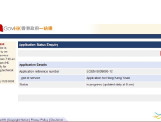
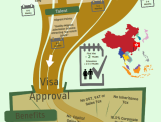
Historically, as examined in 15 – How to Apply For a Hong Kong Investment Visa Without Any Professional Help – Why Do Cases Get Denied?, this installment analyzed the primary failure modes for self-represented Investment as Entrepreneur applicants under the General Employment Policy (GEP). In that era, the Geeza framed application refusals not as fatal collisions with unyielding statutory baselines, but as remediable qualitative and narrative missteps. Denials typically stemmed from poorly articulated business plans, unclear local economic contribution rationales, unconvincing financial modeling, or failing to persuasively prove why the founder’s physical residence in Hong Kong was commercially essential. Adjudication was fundamentally discretionary, flexible, and open to narrative persuasion. Case officers assessed the applicant’s holistic background, routinely approving lean, bootstrapped ventures supported by modest seed capital of a few hundred thousand Hong Kong dollars, a desk in a serviced office or co-working space, and a phased hiring roadmap scheduling local recruitment across a two- to three-year ramp-up period.
Modern Reality: The Binary Hardware Audit
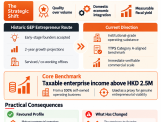
As detailed in A Major Strategic Shift: The Upgraded Assessment Regime for Hong Kong’s Investment as Entrepreneur Visa, the adjudication landscape has undergone an absolute structural transformation. The days when an entrepreneur visa application failed due to subjective narrative flaws or soft market projections are over. ImmD has replaced administrative discretion with a rigid, binary compliance audit aligned with Top Talent Pass Scheme (TTPS) Category A operational substance, benchmarked at an enterprise scale of approximately HKD 2.5 million. Today, applications are summarily denied because the enterprise objectively lacks verified corporate hardware deployed on day one. For un-incubated applicants, subjective justifications and forward-looking promises are disregarded unless the business satisfies three mandatory, non-negotiable thresholds from inception: deployed corporate bank liquidity of HKD 1.5 million to HKD 2.0 million held in a local Hong Kong business bank account; an executed commercial tenancy agreement for exclusive physical premises (four walls), which strictly disqualifies serviced offices, virtual addresses, shared desks, and co-working spaces; and active Mandatory Provident Fund (MPF) payroll contributions for two to three full-time local Hong Kong permanent resident employees working on-site.
Strategic Baseline: State Incubation vs. Inevitable Refusal
Consequently, diagnosing why cases get denied through the historical lens of narrative improvement is an administrative trap for modern founders. An un-incubated applicant who relies on historical guidance—filing with modest seed savings, a co-working membership, and a promise to hire local staff in future years—will not receive an interactive Request for Information (RFI) providing an opportunity to refine their pitch. Instead, they face an immediate, summary refusal that terminates their lawful stay and permanently breaks their seven-year continuous ordinary residence chain toward Right of Abode. The modern business entry framework enforces a strict institutional monopoly: formal, documented admission into an officially accredited government incubation program, such as Cyberport, the Hong Kong Science and Technology Parks Corporation (HKSTP), or the Design Incubation Programme, serves as the sole surviving statutory mechanism recognized by ImmD to waive the mandatory upfront liquidity, dedicated commercial lease, and immediate MPF headcount thresholds. Outside this accredited institutional safe harbor, independent applicants who fail to supply enterprise-scale hardware will be denied automatically, regardless of how compelling or earnest their commercial vision may be.
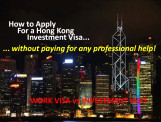
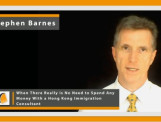
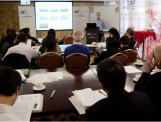
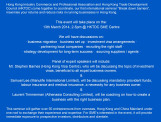
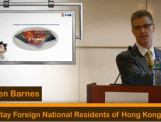
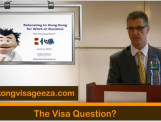
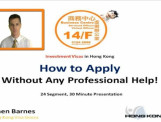
On January 17, 2013 I gave a talk at Centre O in Wanchai on how to go about applying for a Hong Kong business investment visa without the need to pay for any professional help.
The 30 minute talk was broken down into 24 very easy to digest segments and each of these segments is presented here.
The talk is designed to allow the D-I-Y visa applicant to use the 100% free resources of both the Hong Kong Visa Handbook as well as the Hong Kong Visa Geeza Blog.
Please see:
10 Must Have Resources for Any Hong Kong Investment Visa Application
and
The videos will be added incrementally over the course of the next 2-3 weeks until the entire talk has been presented.
In the meantime, why not sign up for our D-I-Y Visa Kit here?
The Complete Series
1 – Introduction
6 – Who Doesn’t Have a Visa Problem?
7 – The Pathway for Mainlanders
8 – What Can You Do as a Visitor?
10 – Investment Visa Approvability Test
11 – Three Pillars of Approval
12 – How Much Cash Investment?
13 – The Catch 22
15 – Why Do Cases Get Denied?
16 – Trying Again?
18 – 10 Must Use Resources (Infographic)
19 – 10 Must Use Resources (Visa Factsheet)
20 – 10 Must Use Resources (Application Plan)
21 – 10 Must Use Resources (Case Studies)
22 – 10 Must Use Resources (Templates)
Please select the social network you want to share this page with:


The Hong Kong Visa Geeza (a.k.a Stephen Barnes) is a co-founder of the Hong Kong Visa Centre and author of the Hong Kong Visa Handbook. A law graduate of the London School of Economics, Stephen has been practicing Hong Kong immigration since 1993 and is widely acknowledged as the leading authority on business immigration matters here for the last 24 years.