


QOTW: Swapping from a Hong Kong Work Visa to an Investment Visa – the Impact on Right of Abode After 7 Years
Posted by The Visa Geeza / in Employment Visas, Investment Visas, Long Stay & PR, Your Question Answered / No responses
How does swapping from a Hong Kong work visa to an investment visa impact your eligibility for the Right of Abode in Hong Kong after 7 years?
PRACTICE UPDATE: How the content must now be read in light of current ImmD policy:
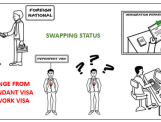
Historically, this strategic guide addressed the high-stakes intersection between status transitions and the seven-year continuous residence requirement for Permanent Residency (Right of Abode under paragraph 1(4) of the First Schedule to the Immigration Ordinance, Cap. 115). The Geeza tackled a common anxiety among corporate expatriates: whether resigning from an employer-sponsored General Employment Policy (GEP) work visa to launch their own business under the Investment as Entrepreneur stream would break the continuity of their seven-year ordinary residence clock. The advice was reassuring and pragmatic: because both employment and entrepreneur streams exist under the same statutory GEP umbrella, a seamless change of visa status (or change of condition of stay) executed without an unpermitted gap or illegal overstay would not reset the seven-year PR timeline. In that era, the transition was commercially smooth: an employee could safely step off the corporate payroll and secure entrepreneur permissions backed by modest seed savings of a few hundred thousand dollars, a flexible desk in a serviced office or co-working space, and a phased hiring roadmap over two to three years.
The game has changed from a manageable procedural transition into a severe structural threat to an applicant’s accumulated years toward Right of Abode. While the formal statutory doctrine regarding continuous ordinary residence remains intact—a lawful, unbroken change of status still preserves the seven-year clock in theory—the practical risk of a catastrophic break in continuous residence has multiplied exponentially. Under post-April 2026 administrative practice aligned with TTPS Category A operational substance (~HKD 2.5M enterprise scale), ImmD no longer grants discretionary transitional leeway to corporate expatriates launching boutique consultancies or early-stage ventures. Swapping out of an established GEP work visa without immediate, auditable corporate hardware audited on day one guarantees summary refusal: an applicant must substantiate HKD 1.5M–2.0M in deployed corporate bank liquidity, an executed commercial lease for exclusive physical premises (“four walls”) disqualifying serviced and co-working desks entirely, and active Mandatory Provident Fund (MPF) payroll contributions for 2–3 local Hong Kong permanent residents.
Consequently, resigning from an employer-sponsored work visa to bootstrap an independent enterprise now places years of accrued ordinary residence directly on the line. When ImmD refuses the entrepreneur application due to missing corporate hardware, the applicant’s existing GEP permission has already terminated, forcing an immediate departure from Hong Kong or a drop down to visitor status—an event that instantly ruptures the continuous residence chain and wipes out accumulated progress toward Right of Abode. The sole viable safety valve for a transitioning professional without an enterprise-grade balance sheet is formal, documented admission into an officially accredited government incubator (such as Cyberport, HKSTP, or the Design Incubation Programme), which acts as the only statutory mechanism to waive the mandatory hardware prerequisites; outside that institutional safe harbor, attempting to swap from a work visa into an independent venture risks total immigration forfeiture.
QUESTION OF THE WEEK
I worked for 5 years in a Hong Kong company. I have since left that company for a year and 3 months.
I have a company registered in Hong Kong for 8 years. I don’t have an office setup and I am using an agents address in Hong Kong.
I would like to apply or a work visa in my own company.
Furthermore, if the visa can be approved can I still meet the Right Of Abode 7 year requirement by fulfilling the last 2 years with my new visa?
More Stuff You may Find Useful or Interesting
How does Hong Kong Right of Abode downgrade to the right to land materialize and what are the immigration implications of this?
I worked in Hong Kong for 4 years – then left for 2 – and have a valid visa in my passport – can I still work & then apply for the Right of Abode?
Will I still qualify for the Right of Abode if I worked temporarily in Macau yet lived in Hong Kong for the full 7 years?
Does my child get the Right of Abode if she wasn’t born in Hong Kong but I have the right to land?
Strategy on how to craft an argument to appeal a refused Hong Kong Right of Abode application
Please select the social network you want to share this page with:


The Hong Kong Visa Geeza (a.k.a Stephen Barnes) is a co-founder of the Hong Kong Visa Centre and author of the Hong Kong Visa Handbook. A law graduate of the London School of Economics, Stephen has been practicing Hong Kong immigration since 1993 and is widely acknowledged as the leading authority on business immigration matters here for the last 24 years.