


Can an Offshore Company Sponsor a Hong Kong Employment or Business Investment Visa?
Posted by The Visa Geeza / in Employment Visas, Hadley Says…, Investment Visas / 6 responses
PRACTICE UPDATE: How the content must now be read in light of current ImmD policy:
Historically, this advisory installment answered a frequent structural question from multinational operators and offshore founders: could a foreign, overseas-incorporated company (such as a Delaware LLC, a UK Ltd, or a BVI entity) directly sponsor a Hong Kong employment visa (under the General Employment Policy) or serve as the vehicle for an Investment as Entrepreneur visa without first establishing a full corporate presence in the territory? The Geeza demystified the jurisdictional mechanics: while an offshore parent entity could technically be involved in an application, Hong Kong immigration law strictly requires that an employing sponsor or investment vehicle have a legal, taxable, and registered footprint onshore. In that era, the standard practitioner solution was pragmatic, low-friction, and commercially flexible: the overseas entity could simply register a Hong Kong branch office under Part 16 (formerly Part XI) of the Companies Ordinance or establish a local Hong Kong subsidiary, obtain a Business Registration Certificate, and proceed. Under the prevailing discretionary regime, ImmD evaluated the overseas parent’s credibility generously: a foreign company could sponsor a professional or back an entrepreneur stream with modest initial operating capital of a few hundred thousand dollars, a serviced office or co-working space, and a phased plan to expand local operations and staffing over a two- to three-year ramp-up period.
The game has changed from a manageable corporate registration formality into an unforgiving, binary operational audit. Today, the notion that an offshore entity can easily establish a beachhead or sponsor a founder without massive, immediate domestic infrastructure is a catastrophic miscalculation. Under post-April 2026 administrative practice aligned with TTPS Category A operational substance (~HKD 2.5M enterprise scale), ImmD views offshore-backed filings with heightened forensic scrutiny. Simply registering a Part 16 non-Hong Kong company or setting up a local private subsidiary is merely a statutory prerequisite that carries zero weight in satisfying ImmD’s sponsorship or investment test. For un-incubated applicants, the department rejects narrative reliance on an overseas parent’s foreign track record if the domestic Hong Kong entity lacks verified, day-one corporate hardware: HKD 1.5M–2.0M in deployed corporate bank liquidity sitting in a local Hong Kong bank account, an executed commercial lease for exclusive physical premises (“four walls”) that strictly disqualifies serviced offices, shared spaces, and co-working desks entirely, and active Mandatory Provident Fund (MPF) payroll contributions for 2–3 local Hong Kong permanent residents.
Consequently, trying to use an offshore corporate structure to bypass Hong Kong’s domestic substance requirements is entirely futile. If an overseas company sets up a branch or subsidiary hoping to sponsor its foreign owner or a principal employee without fulfilling these day-one hardware mandates onshore, ImmD will summarily refuse the application on the grounds that the local sponsor lacks suitable and credible operational substance in the HKSAR. The only surviving statutory mechanism that relieves an early-stage venture or spin-off from these crushing day-one requirements—liquidity deployment, dedicated commercial leases, and immediate MPF headcount—is formal, documented admission into an officially accredited government incubator (such as Cyberport, HKSTP, or the Design Incubation Programme). Outside this accredited institutional safe harbor, an offshore entity cannot sponsor an entrepreneur or employment visa in Hong Kong without deploying enterprise-grade balance sheets and building out an auditable, fully staffed physical infrastructure on the ground from day one.
You may be a director, shareholder or an employee of a company which is not incorporated in Hong Kong but thinking about the possibility of setting up shop here.
In such a case, is it possible for the overseas incorporated entity to sponsor employment or business investment visa permissions for one of their officers or staff to work in Hong Kong?
The answer is very much a case of “it depends”:
– It depends if the entity has organised itself to carry on a business here by registering with the Registrar of Companies as a Part Eleven company and secured a business registration certificate from the Commissioner of Inland Revenue.
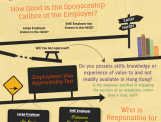
– It depends on what the Immigration Department make of the legal and financial constructs of that enterprise when assessing the overseas’ company’s credentials as a valid sponsor of visa permissions for foreign national staff, officers and shareholders.
– It depends on whether or not the proposed business activity bringing the foreign corporation to Hong Kong will be able to make a substantial contribution to our economy.
– And it depends on the business need for, and the special skills, knowledge and experience of, the foreign national proposed for sponsorship of Hong Kong employment or investment visa permissions.
More Stuff You May Find Useful
How to apply for a Hong Kong investment visa without any professional help!
What do both Hong Kong employment and investment visa applications share in common?
The reality behind the Hong Kong Immigration Department’s “4 weeks” application consideration time frame
How is the Hong Kong investment visa process typically experienced by the foreign national visa applicant?
How important is the support of InvestHK in your Hong Kong investment visa application
Please select the social network you want to share this page with:


The Hong Kong Visa Geeza (a.k.a Stephen Barnes) is a co-founder of the Hong Kong Visa Centre and author of the Hong Kong Visa Handbook. A law graduate of the London School of Economics, Stephen has been practicing Hong Kong immigration since 1993 and is widely acknowledged as the leading authority on business immigration matters here for the last 24 years.