


PRACTICE UPDATE: Navigating The New Capital Investment Entrant Scheme
Posted by The Visa Geeza / in Investment Visas, Musing, Practice Update, Special Programmes, VG Front Page / No responses

Navigating The New Capital Investment Entrant Scheme (New CIES)
Regulatory Architecture, Portfolio Rules, and Operational Realities

Over the past three and a half decades of advising on Hong Kong immigration law, jurisprudence, and administrative practice, our firm has observed numerous regulatory cycles, administrative refinements, and policy calibrations. Across that thirty-five-year continuum, the Immigration Department (ImmD) has routinely adjusted its assessment metrics to match broader macro-economic priorities.
However, the modern immigration landscape has entered an entirely new phase of regulatory deliberate differentiation. On one flank, the Top Talent Pass Scheme (TTPS) has evolved from an aggressive, fast-track credential attraction exercise into an exacting renewal regime demanding genuine local economic participation, active employment, or verifiable corporate trading. On the other flank, the General Employment Policy (GEP) – Investment as Entrepreneur channel has fundamentally hardened, closing the door on asset-light, early-stage lifestyle startups and demanding institutional-grade operational footprints—characterized by HKD 1.5 million to HKD 2.0 million in deployed cash, exclusive commercial tenancy (“four walls”), and immediate local payroll commitments.
Standing in sharp structural contrast to both of these active-involvement regimes is the New Capital Investment Entrant Scheme (New CIES).
Navigating The New Capital Investment Entrant Scheme: Relaunched to position the Hong Kong Special Administrative Region (HKSAR) as the pre-eminent family office and wealth management hub in the Asia-Pacific region, the New CIES departs entirely from the operational, employment, and commercial demands of active visas. It offers an unconstrained, passive residency gateway for high-net-worth individuals (HNWIs) and their families. Yet, while the scheme eliminates the operational friction of running a business or maintaining a local employment relationship, it introduces an intricate, bifurcated compliance apparatus governed jointly by the New CIES Office of InvestHK and the Immigration Department.
Navigating this framework requires an exact appreciation of financial eligibility criteria, portfolio ring-fencing, permissible investment classes, ongoing intermediary maintenance, and the distinct mechanics governing the eventual transition to permanent status. This Practice Direction sets out the definitive operational, legal, and procedural guidance for prospective applicants, private bankers, family office practitioners, and professional advisers.
For procedural workflows, document checklists, and application logistics, practitioners should cross-reference the Hong Kong Visa Handbook and consult advisory counsel via the Hong Kong Visa Centre.
Statutory Foundations and Bifurcated Institutional Architecture
The fundamental administrative hallmark of the New CIES is that it does not operate as a single-door immigration assessment. Traditional visas—such as the GEP, ASMTP, or TTPS—are evaluated solely by immigration officers within the specialized divisions of the Immigration Department. The New CIES, by contrast, splits statutory jurisdiction across two distinct government entities:
Statutory and administrative policy materials governing these processes are detailed through the official InvestHK New CIES Portal and the administrative criteria published by the Hong Kong Immigration Department.
Institutional Division of Labour
The New CIES Office of InvestHK: Acts as the financial gatekeeper. InvestHK is exclusively empowered to assess, verify, and monitor the financial criteria. This includes scrutinizing the applicant’s historical net asset position, determining whether prospective assets fall within permissible statutory classes, and conducting annual portfolio audits to ensure continuous compliance.
The Immigration Department (ImmD): Retains exclusive sovereign authority under the Immigration Ordinance (Cap. 115) over entry clearance, security screening, character assessment, the grant of formal visas, extensions of stay, and the eventual adjudication of applications for the Right of Abode or Unconditional Stay.
This administrative bifurcation means that an applicant cannot rely on immigration arguments to cure a financial portfolio deficiency, nor can a robust investment portfolio compel the Immigration Department to overlook adverse character or immigration compliance histories. Both administrative arms must be satisfied independently at every statutory milestone.
Core Eligibility Criteria & The Two-Year Net Asset Assessment
To secure entry under the New CIES, a prospective applicant must satisfy clear baseline criteria regarding nationality, age, and historical personal wealth.
Eligible Categories of Applicants
In alignment with Hong Kong’s overarching immigration policy and constitutional framework, the New CIES is accessible to:
- Foreign nationals (holding foreign passports and possessing valid travel documentation);
- Macao Special Administrative Region (SAR) residents;
- Chinese nationals who have obtained permanent resident status in a foreign country; and
- Taiwan residents.
Practice Note for Mainland Chinese Nationals: Chinese nationals residing in Mainland China who do not possess foreign nationality are not eligible to apply directly under the New CIES. However, following established long-term administrative practice, Chinese nationals who hold third-country permanent resident status (e.g., permanent resident status acquired in a foreign jurisdiction) qualify under the scheme. Ensuring that third-country permanent residency documentation is fully verified, authentic, and recognized by ImmD is an essential preliminary step.
The HK$30,000,000 Net Asset Threshold
The applicant must demonstrate to the absolute satisfaction of the New CIES Office that they have been the sole legal and beneficial owner of net assets of not less than HK$30 million (or its equivalent in foreign currencies) continuously throughout the 6months immediately preceding the date of application.
This requirement is subject to rigorous evidentiary standards:
The Continuous 6-Month Ownership Rule: The statutory requirement is not satisfied by simply demonstrating HK$30 million on the date of application. The equity must have been under the continuous ownership and control of the applicant for every single day of the preceding 6-month period. Any dip below the HK$30 million valuation mark during the lookback period breaks the continuous chain and resets the statutory clock.
Sole Beneficial Ownership: The qualifying assets must belong to the applicant personally. Assets owned jointly with individuals other than the applicant require strict accounting: only the portion of net equity attributable directly and exclusively to the applicant can be counted. Where assets are held through private holding vehicles, the applicant must hold 100% of the beneficial ownership of that entity.
Independent Certified Public Accountant (CPA) Audit: Applicants are required to engage, at their own cost, a Certified Public Accountant (Practicing) who is an active member of the Hong Kong Institute of Certified Public Accountants (HKICPA). The CPA must conduct an independent audit of the applicant’s worldwide asset portfolio, verify ownership documents, review asset encumbrances, and issue an official CPA Verification Report on Net Assets.
Qualifying Asset Classes for Net Asset Verification
When computing historical net worth for the Phase 1 assessment, the CPA and InvestHK may evaluate a broad spectrum of global assets, provided they are unencumbered and supported by verifiable legal title:
Bank Deposits: Liquid savings and fixed-term cash deposits held with licensed domestic or overseas financial institutions.
Public Equities & Listed Debt: Shares, corporate bonds, government notes, and structured securities traded on recognized international exchanges, valued on market close.
Real Estate Equity: Residential, commercial, retail, or industrial real estate held worldwide. Valuations must be established by independent professional valuation reports prepared by qualified property surveyors, deducting all registered mortgages, legal charges, and commercial encumbrances.
Interests in Private Companies: Equity holdings in operating or private holding companies, provided valuation is substantiated by audited financial statements and formal share registers.
The Permissible Investment Architecture: Allocating the HK$30 Million
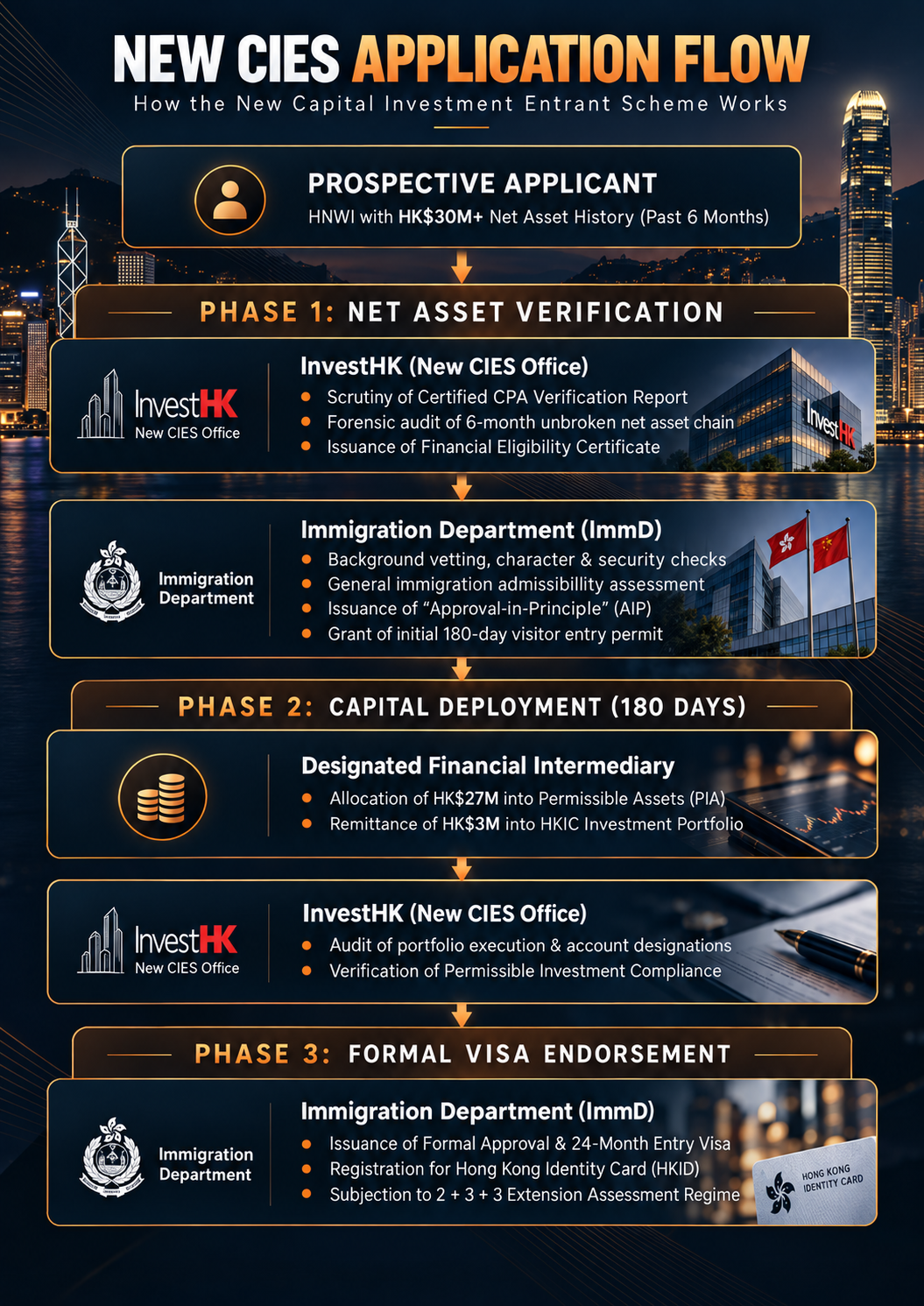
Once the New CIES Office approves the net asset assessment and ImmD grants Approval-in-Principle, the applicant is required to formally deploy the mandatory HK$30 million into qualifying Hong Kong investments. This deployment must occur within 180 days after Approval-in-Principle is granted (or within 180 days prior to the date of submitting the formal net asset assessment to InvestHK).
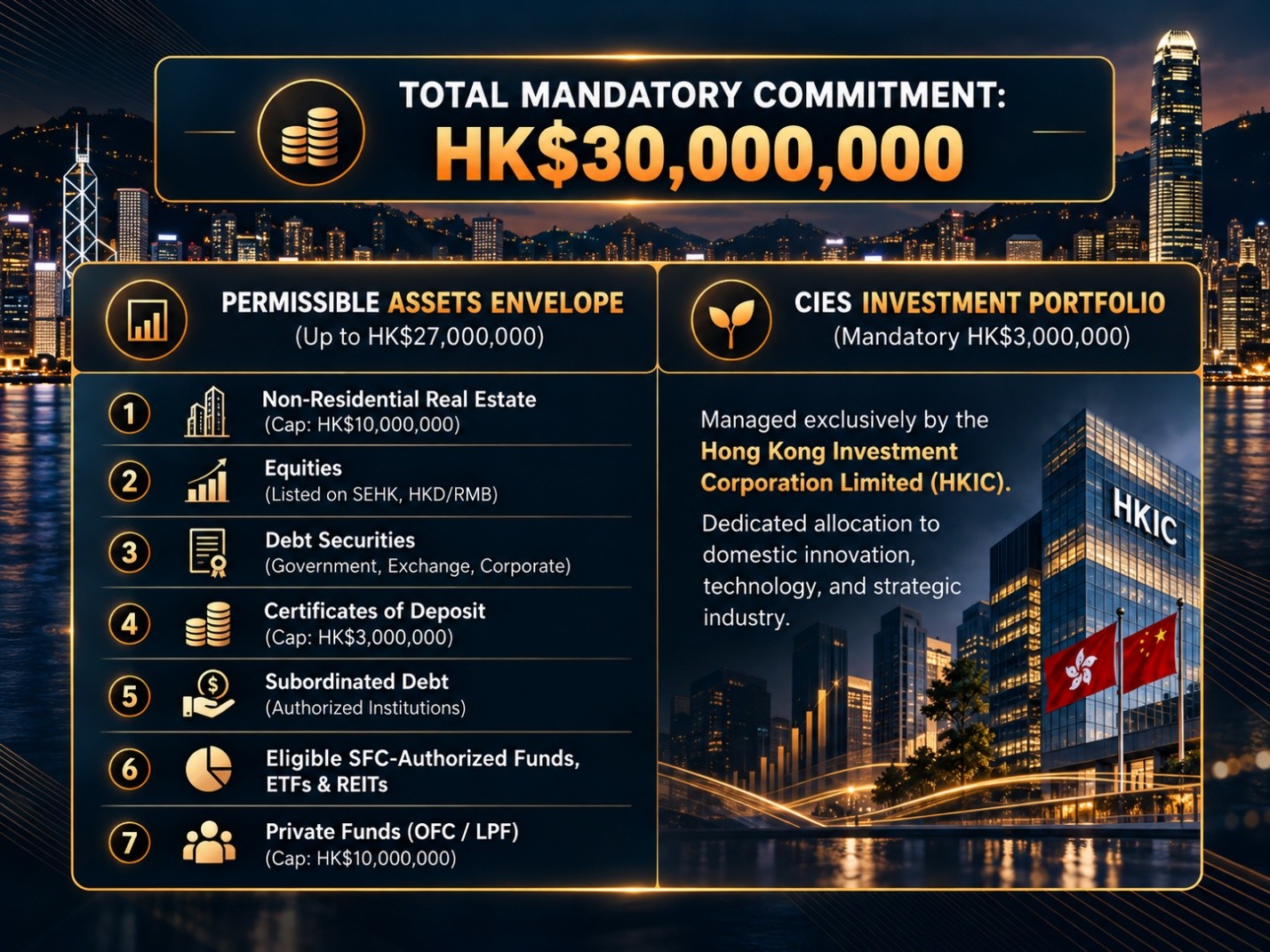
The statutory architecture establishes a strict HK$27 million / HK$3 million structural split:
The HK$27 Million Permissible Assets Envelope
Applicants enjoy flexibility in managing and allocating up to HK$27 million across approved financial instruments and commercial property classes:
Non-Residential Real Estate (Subject to a HK$10 Million Sub-Cap)
Permissible Holdings: Commercial properties, industrial premises, retail spaces, warehouses, and dedicated office buildings situated in Hong Kong. Pre-completion non-residential commercial properties are also eligible.
Strict Residential Exclusion: Pure residential properties (apartments, residential houses, serviced residential suites) are strictly excluded from qualifying under the scheme.
Valuation & Cap Rules: An applicant may acquire non-residential property of any purchase price; however, a statutory maximum of HK$10 million can be counted toward the required HK$27 million allocation. Any amount invested above HK$10 million is ignored for the purposes of the CIES capital tally.
Permissible Financial Assets
Financial assets must be denominated in Hong Kong Dollars (HKD) or Renminbi (RMB) and acquired through a designated intermediary:
Equities: Shares of companies listed on the Main Board or GEM of the Stock Exchange of Hong Kong (SEHK).
Debt Securities: Fixed or floating-rate debt securities, bonds, and notes listed on SEHK; debt issued or guaranteed by the HKSAR Government, the Exchange Fund, the Hong Kong Mortgage Corporation, or other designated statutory bodies; and debt instruments listed on SEHK issued by authorized institutions.
Certificates of Deposit (CDs): Issued by Authorized Institutions under the Banking Ordinance, with a remaining term to maturity of not less than 12 months at the time of purchase. An aggregate statutory cap of HK$3 million applies to Certificates of Deposit.
Subordinated Debt: Subordinated instruments issued by Authorized Institutions under applicable regulatory frameworks.
Eligible Collective Investment Schemes (CIS): Securities and Futures Commission (SFC)-authorized unit trusts, mutual funds, exchange-traded funds (ETFs), and authorized Real Estate Investment Trusts (REITs).
Private Fund Structures (Subject to a HK$10 Million Sub-Cap): Ownership interests in registered private Open-ended Fund Companies (OFCs) or private Limited Partnership Funds (LPFs) established under Hong Kong law, distributed or managed by licensed corporations. An aggregate ceiling of HK$10 million applies to investments across private funds.
The Mandatory HK$3 Million Ring-Fence: The CIES Investment Portfolio
A distinctive innovation of the New CIES is the mandatory ring-fencing of HK$3 million into the dedicated CIES Investment Portfolio.
Institutional Management: This capital pool is managed and administered directly by the Hong Kong Investment Corporation Limited (HKIC).
Strategic Deployment: The capital is pooled into public-interest investments intended to support the development of local innovation and technology, semiconductor fabrication, artificial intelligence infrastructure, life sciences, green transition initiatives, and strategic industrial projects aligned with Hong Kong’s Five-Year Plan and Greater Bay Area economic integration.
Investor Rights: Entrants hold a beneficial claim to their underlying share of the portfolio but exercise no individual management discretion or trading authority over asset selection. Capital distributions, realization proceeds, or liquidation dividends are administered centrally in accordance with rules set down by the HKIC upon portfolio realization or the entrant’s exit from the scheme.
The Permissible Investment Account (PIA) and Intermediary Protocols
Compliance with the New CIES does not merely involve purchasing eligible assets; it dictates the precise custodial and institutional framework through which those assets must be held, reported, and managed.
Eligible Financial Intermediaries
All permissible financial assets comprising the HK$27 million portfolio must be held in a dedicated, segregated account known as a Permissible Investment Account (PIA), opened in the applicant’s sole name with an Eligible Financial Intermediary. Eligible intermediaries fall into three statutory classifications:
An Authorized Institution (AI) licensed under the Banking Ordinance (Cap. 155) (e.g., licensed banks, restricted licence banks);
A Licensed Corporation (LC) licensed under the Securities and Futures Ordinance (Cap. 571) to conduct Type 1 (Dealing in Securities), Type 4 (Advising on Securities), or Type 9 (Asset Management) regulated activities; or
An Authorized Insurer under the Insurance Authority licensed to issue Class C (Investment-Linked Assurance Scheme) policies.
An applicant may appoint up to three separate financial intermediaries to manage different tranches of their financial portfolio, but each intermediary must maintain an isolated PIA explicitly tagged to the entrant’s CIES reference.
Mandatory Portfolio Maintenance Rules
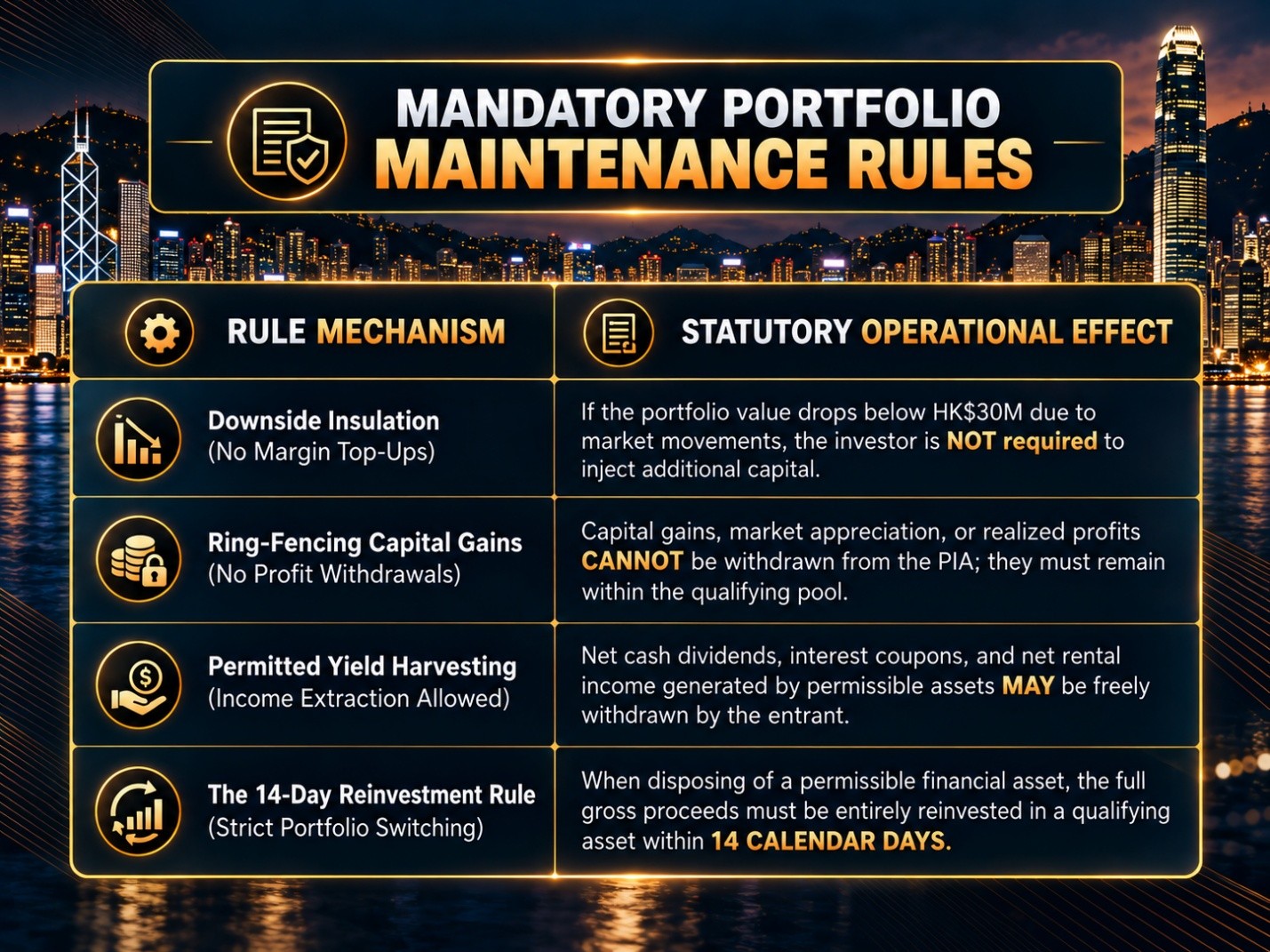
The 14-day switching window requires constant vigilance. If an equity holding or corporate bond within the PIA is liquidated, the gross proceeds cannot sit as uninvested cash in a settlement account indefinitely. If replacement qualifying assets are not acquired within 14 calendar days, the investor falls into technical non-compliance. Financial intermediaries are mandated under statutory reporting covenants to notify InvestHK of any uncorrected breach.
Furthermore, pledging, charging, mortgaging, or assigning the permissible assets inside the PIA as collateral or security for personal loans, margin credit lines, or commercial borrowing is strictly prohibited. Any encumbrance invalidates the asset’s qualifying status.
Procedural Roadmap: Phase-by-Phase Application Lifecycle
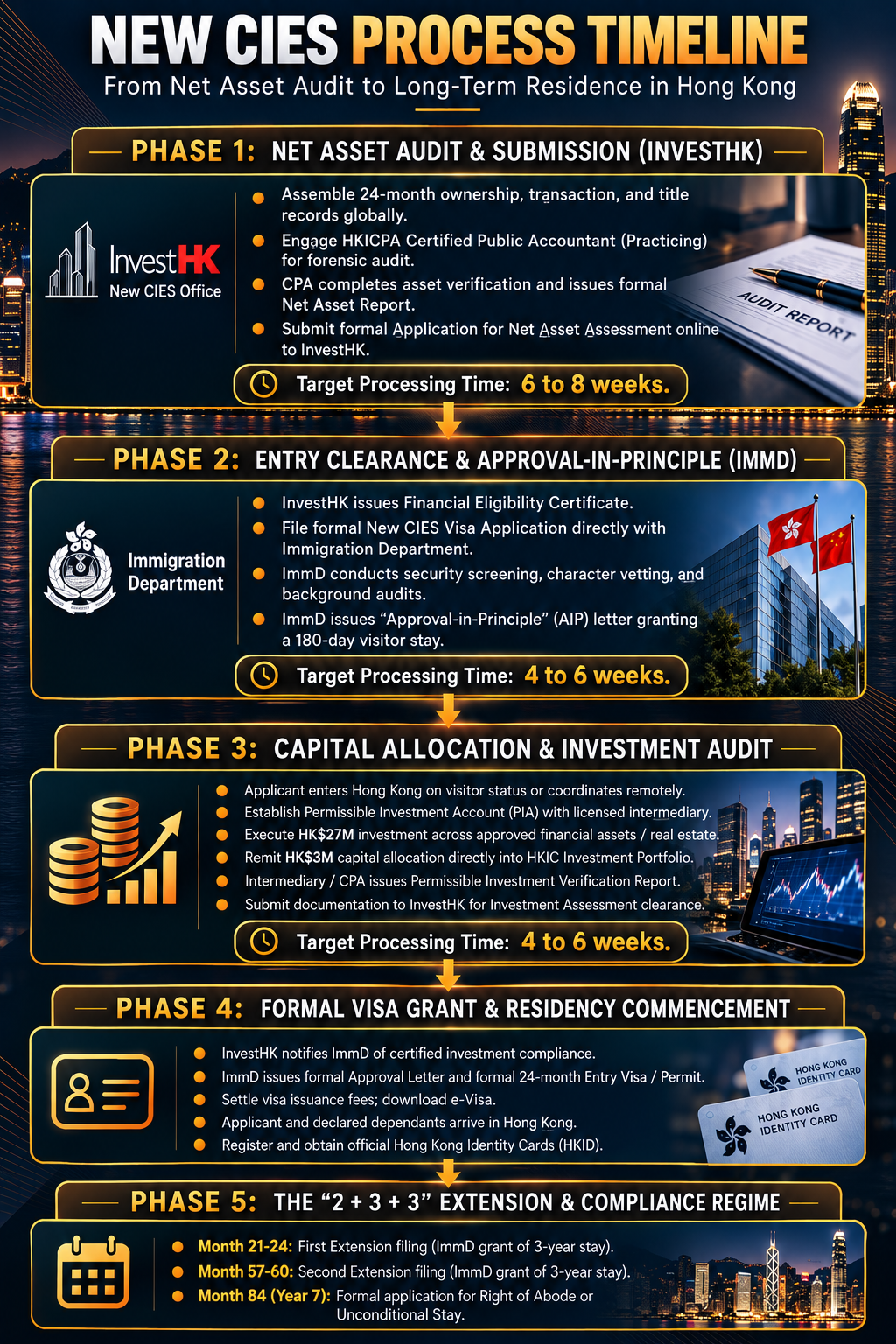
Navigating a New CIES application involves executing five distinct operational phases over a multi-month timeline. The process requires precise, synchronized filings between the legal team, the auditing CPA, the financial intermediary, InvestHK, and ImmD.
Dependant Entitlements
The primary applicant is entitled to sponsor immediate family members under formal Dependant Visa status:
Spouse: Lawfully married under recognized civil marriage statutes, or a party to a recognized same-sex civil partnership/union.
Children: Unmarried, dependent children under the age of 18 at the time of adjudication.
Dependants under the New CIES enjoy comprehensive rights in Hong Kong. Unlike dependant regimes in certain foreign jurisdictions, dependants of New CIES entrants are permitted to take up lawful employment, engage in business entrepreneurship, or pursue studies in local public institutions, private international schools, and universities without requiring prior permission or independent sponsorship from the Immigration Department.
Extension of Stay Regime: The “2 + 3 + 3” Cycle and Annual Compliance
The initial entry permission granted to a New CIES entrant is valid for 24 months. Continued lawful status requires navigating two subsequent 3-year extensions, forming the established “2 + 3 + 3” residency continuum.
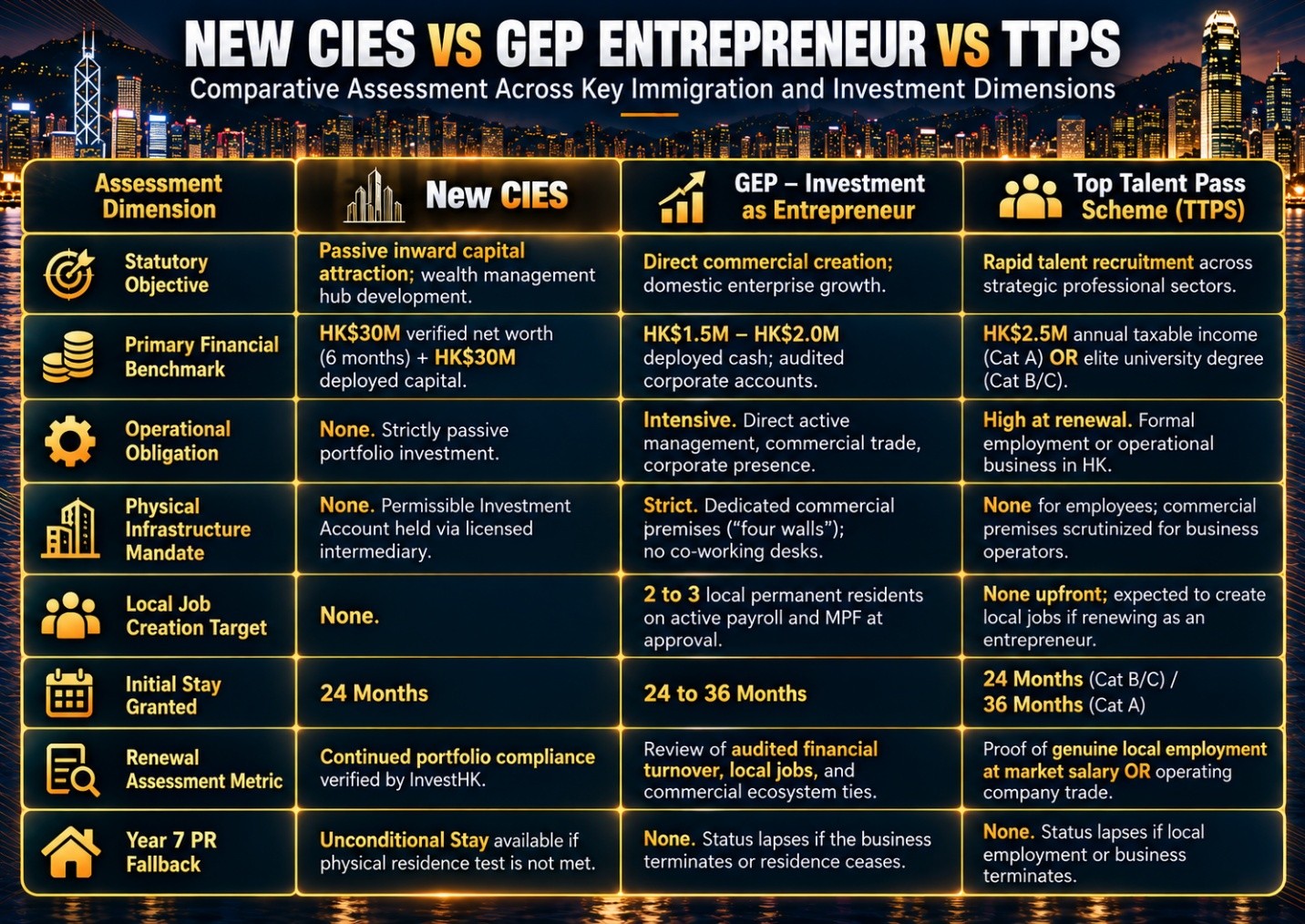
Unlike the Top Talent Pass Scheme (where extensions are determined by proof of genuine employment, taxable salary level, or operating business turnover) or the Entrepreneur Visa (where officers audit local employment headcount, lease agreements, MPF filings, and audited business turnover), the New CIES extension assessment focuses strictly on continuous portfolio integrity.
The Annual Compliance Reporting Mechanism
Throughout the entire seven-year holding period, the investor is subject to continuous portfolio monitoring. The compliance rhythm operates as follows:
Ongoing Intermediary Oversight: The appointed Eligible Financial Intermediary acts as a primary compliance monitor, verifying that all financial transactions within the PIA adhere to statutory classes and tracking the 14-day reinvestment window.
Annual Compliance Certification: On each annual anniversary of the formal investment grant, the applicant—supported by their financial intermediary—must submit an official compliance statement to InvestHK confirming that:
- The permissible investment assets have remained continuously invested within the designated PIA;
- No assets have been encumbered, pledged, or assigned as collateral;
- The HK$3 million allocated to the CIES Investment Portfolio remains fully committed; and
- All switching transactions occurred strictly within the statutory 14-day period.
Pre-Extension Clearance: Prior to filing each extension of stay with the Immigration Department (ordinarily initiated within three months prior to the expiry of the current limit of stay), the applicant must obtain formal certification from InvestHK confirming that portfolio compliance has been maintained without interruption. Upon receipt of InvestHK’s confirmation, ImmD will endorse the subsequent 3-year extension of stay, provided the applicant continues to satisfy general immigration character and bona fides requirements.
Comparative Analysis: New CIES vs. TTPS vs. GEP Entrepreneur
Strategic advisory begins by matching the client’s commercial realities, professional availability, and liquidity profile to the appropriate immigration channel. The following comparative matrix outlines the operational parameters of Hong Kong’s three premier business and capital immigration pathways:
The 7-Year Milestone: Right of Abode vs. Unconditional Stay
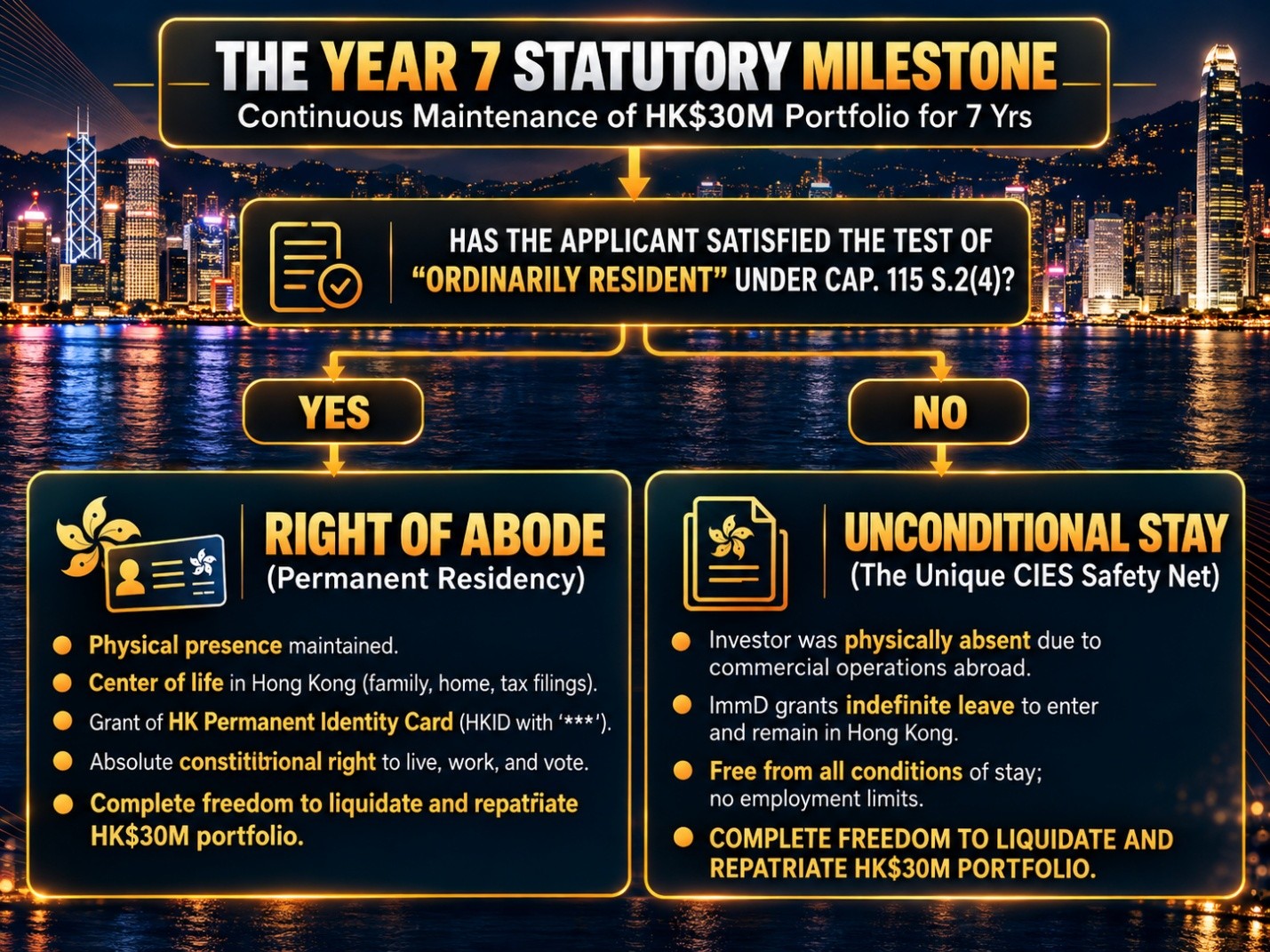
At the conclusion of the seven-year period, New CIES entrants reach the primary milestone of the scheme. Under Hong Kong immigration jurisprudence, an entrant who has held continuous status for seven years may access two distinct permanent options under the Immigration Ordinance (Cap. 115).
Option A: The Right of Abode (Permanent Residency)
Under paragraph 2 of Schedule 1 to the Immigration Ordinance, a person not of Chinese nationality who has entered Hong Kong with a valid travel document, has ordinarily resided in Hong Kong for a continuous period of not less than seven years, and has taken Hong Kong as their place of permanent residence is eligible to apply for the Right of Abode.
The applicant must satisfy the legal test of ordinary residence set out in Section 2(4) of the Immigration Ordinance. Adjudicating officers evaluate:
- The continuity and duration of physical presence in the territory;
- The maintenance of a permanent home for the applicant and their family;
- Whether immediate family members reside in Hong Kong;
- Local tax assessment and payment records; and
- The legitimate reasons for any extended absences from Hong Kong (e.g., temporary commercial assignments abroad).
- Other relevant factors.
Obtaining the Right of Abode confers permanent resident status, symbolized by the issuance of a Hong Kong Permanent Identity Card (bearing three stars). The holder acquires an absolute constitutional right to enter, live, work, establish businesses, and vote in Hong Kong, free from deportation or entry conditions. Upon the grant of Right of Abode, all CIES investment covenants terminate, and the HK$30 million portfolio may be liquidated, redeployed, or repatriated without restriction.
Option B: Unconditional Stay (The Unique CIES Privilege)
A critical feature of the New CIES—which sets it apart from every other visa scheme in Hong Kong—is the statutory safety net known as Unconditional Stay.
Many international investors, enterprise principals, and multi-jurisdictional family office heads find it difficult to satisfy the physical presence requirements of the ordinary residence test. Their global commercial obligations may require them to spend substantial periods outside the territory throughout the seven-year continuum. Under standard work or entrepreneur visas, prolonged physical absence can break the continuity of residence, resulting in the refusal of permanent residency and potentially the cancellation of extension permissions.
Under the New CIES framework:
If an entrant has continuously complied with the scheme’s investment rules for seven full years, but cannot satisfy the continuous physical residence test, they are entitled to apply for Unconditional Stay.
Upon grant, the entrant is released from all time limits, conditions of stay, and visa renewal cycles. They acquire the permanent right to enter and remain in Hong Kong, take up any employment, or operate any commercial business without restriction.
Immediate Capital Liquidation: Most importantly, upon the endorsement of Unconditional Stay, the investor’s statutory obligation to maintain the HK$30 million qualifying portfolio is permanently extinguished. The entrant may immediately sell, liquidate, and withdraw the entirety of the permissible financial assets, non-residential real estate, and their share of the HKIC CIES Investment Portfolio without impacting their right to live in Hong Kong.
Critical Practice Traps, Anti-Avoidance Rules, and Risk Mitigations
Drawing from decades of practitioner experience handling complex investor portfolios before the Immigration Department and statutory authorities, we have identified several recurrent compliance traps that can derail an application:
The Broken Chain in the 2-Year Lookback
The Net Asset Assessment requires an unbroken, verified chain of HK$30 million net equity. Applicants frequently err by presenting asset reports showing significant fluctuations where portfolio valuations dropped to HK$28 million during market downturns, before recovering to HK$35 million at the time of submission. Such drops represent an immediate statutory failure. Practitioners must conduct a line-item, daily balance audit across the full 730 days of the qualifying lookback before initiating formal CPA reporting.
Multi-Tiered and Intermingled Corporate Structures
Holding qualifying assets through offshore entities (such as British Virgin Islands, Cayman Islands, or Jersey structures) is permissible only where the applicant is the sole legal and beneficial owner (100%) of the underlying corporate vehicle. Assets held through trusts, family foundations, or operating companies with minority shareholders present significant evidential hurdles. Unless the applicant exercises direct, absolute, unencumbered ownership and control over the specific equity interest, the New CIES Office will exclude those holdings from the net asset baseline.
Misunderstanding the Non-Residential Property Cap
Purchasers often commit substantial capital to commercial real estate under the mistaken impression that real estate expenditures absorb the entire HK$30 million obligation. The statutory cap on non-residential real estate is strictly fixed at HK$10 million. If an investor acquires a commercial floor in Wan Chai or an industrial unit in Kwun Tong for HK$25 million, only HK$10 million can be credited toward the scheme. The investor must still deploy the remaining HK$17 million into eligible financial assets inside a PIA, alongside remitting HK$3 million into the HKIC Investment Portfolio.
Overlooking the 14-Day Portfolio Rebalancing Window
Market conditions routinely necessitate portfolio rebalancing. However, letting gross redemption proceeds sit idle in cash for longer than 14 calendar days breaches scheme covenants. Intermediaries are bound by compliance reporting undertakings to disclose these lapses to InvestHK. Discretionary investment managers and family office chief investment officers must establish automated execution workflows to guarantee that when securities are sold, qualifying replacement assets are settled within the statutory 14-day limit.
Encumbrances and Margin Facilities
High-net-worth investors frequently manage financial assets through leveraged private banking lines, lombard loans, or margin accounts. Pledging or borrowing against assets held in the Permissible Investment Account is strictly prohibited. The HK$27 million portfolio must remain completely unencumbered. Any evidence of collateral assignment or margin borrowing against qualifying assets can trigger immediate compliance inquiries from InvestHK, leading to the cancellation of eligibility and refusal of upcoming extensions.
Strategic Advisory Directive & Conclusion
Hong Kong’s immigration landscape reflects a deliberate, strategic realignment. The era of loose, ill-defined immigration gateways has drawn to a definitive close:
The Top Talent Pass Scheme has graduated from an initial attraction exercise into an economic performance review, requiring active employment or commercial trade to sustain continued residence.
The GEP Investment as Entrepreneur framework has hardened into an institutional-grade gateway, closing the door on speculative startups and demanding fully deployed capital (HKD 1.5M–2.0M), dedicated commercial premises (“four walls”), and immediate local payrolls.
The New Capital Investment Entrant Scheme represents the government’s dedicated pathway for pure capital deployment. It provides international investors and their families a secure, passive, and rule-bound corridor to residency, backed by the safety net of Unconditional Stay at Year 7.
Because the New CIES operates under a bifurcated statutory mechanism, successful execution depends upon synchronized coordination among certified public accountants, licensed financial intermediaries, private wealth managers, and specialized immigration counsel. Structuring the initial asset history, managing ongoing portfolio rebalancing within statutory limits, and preparing extension filings are tasks where precision is paramount.
For prospective entrants, family offices, and wealth advisory institutions:
Procedural Blueprints & Case Preparation: Review comprehensive statutory workflows and procedural guidance at the Hong Kong Visa Handbook.
Direct Representation & Legal Counsel: For complex multi-jurisdictional asset verification, cross-border corporate structures, and formal representation before InvestHK and the Immigration Department, consult the Hong Kong Visa Centre.
Policy Analysis & Administrative Guidance: Follow ongoing analytical updates and practice commentaries directly at Hong Kong Visa Geeza.
More Stuff You May Find Useful or Interesting
Hong Kong Unconditional Stay Status vs. the RoA for CIES Visa Holders
Summary of Legacy Position:
This piece tackles the classic question of whether merely holding a CIES visa for seven years automatically guarantees the Right of Abode (Permanent Residency). It clarifies that holding the visa is insufficient on its own if an investor has not satisfied the continuous “ordinary residence” test under Section 2(4) of the Immigration Ordinance. For investors who spend substantial periods abroad, the article identifies Unconditional Stay (UCS) as the statutory safety net granted after seven years of continuous asset maintenance, requiring only a single entry into Hong Kong every 12 months to preserve status.
Compare & Contrast with the New CIES:
What Remains Constant: The dual-track exit at Year 7—choosing between the Right of Abode (for those who made Hong Kong their habitual residence) and Unconditional Stay (for those with multi-jurisdictional travel patterns)—remains the single biggest structural advantage of the scheme.
What Has Changed: Under the New CIES, qualifying for Unconditional Stay requires unbroken compliance verified annually by InvestHK’s New CIES Office, not just ImmD. Furthermore, once Unconditional Stay is granted at Year 7, the entire HK$30 million capital commitment (including the HK$27M Permissible Investment Account and the HK$3M HKIC Innovation Portfolio) can be liquidated and repatriated immediately, releasing the investor from all ongoing financial covenants.
2015 Immigration Policy Changes: The Inevitable Suspension of the Capital Investment Entrant Scheme
Summary of Legacy Position:
Written upon the abrupt suspension of the original CIES by Chief Executive CY Leung in January 2015, this post analyzes why the government shut down the original programme. The administration pivoted away from passive capital importation—which had been heavily criticized for fueling local asset inflation without bringing active commercial skills—toward active talent recruitment and the General Employment Policy (GEP) Investment as Entrepreneur framework.
Compare & Contrast with the New CIES:
Policy Inversion: The New CIES reverses the 2015 closure, but does so with substantial structural guardrails designed specifically to avoid repeating the flaws of the old scheme.
Threshold & Target: Where the legacy scheme closed at a HK$10 million capital threshold, the New CIES demands HK$30 million in net worth and deployment.
Exclusion of Residential Real Estate: While early iterations of the original CIES permitted residential property investment (which exacerbated housing pressures), the New CIES strictly excludes all residential real estate, permitting only commercial/industrial property (capped at HK$10 million).
Public Policy Alignment: The New CIES introduces the mandatory HK$3 million ring-fenced allocation to the Hong Kong Investment Corporation (HKIC), ensuring passive capital directly subsidizes local innovation, life sciences, and deep tech rather than resting entirely in private asset appreciation.
What’s the Minimum Capital Required for a Hong Kong Business Investment Visa?
Summary of Legacy Position:
This article contrasts the high-capital, passive threshold of the Capital Investment Entrant Scheme (historically HK$10 million) against the flexible, case-by-case nature of the Business Investment (Entrepreneur) Visa. It explains that while CIES set a rigid statutory dollar threshold, an Entrepreneur visa did not legally prescribe a fixed sum, historically allowing viable founders to secure approvals with modest cash in the bank (HK$300,000 to HK$400,000) provided their business story was compelling.
Compare & Contrast with the New CIES:
The Widening Gap: The statutory barrier between these two routes has widened dramatically. The New CIES now requires an absolute minimum of HK$30 million backed by a 24-month unbroken audit trail verified by a practicing HKICPA accountant.
The Entrepreneur Visa Shift: The historic notion that an Entrepreneur visa can be secured with modest runway capital is obsolete. ImmD has aligned Entrepreneur adjudication with TTPS Category A enterprise substance, expecting HK$1.5M to HK$2.0M in deployed liquidity, dedicated “four walls” commercial premises, and 2 to 3 local permanent residents on active payroll. The New CIES remains the only route where capital alone—without operational staff, trading entities, or commercial leases—secures residence.
Hong Kong Investment Visa Applications – What’s Involved?
Summary of Legacy Position:
This comprehensive guide outlines the operational friction of the Business Investment (Entrepreneur) Visa, including the four-to-six-month processing window and the “Catch-22” facing in-country applicants who must show operational momentum without unlawfully working. It notes that the suspension of the CIES left the active business visa as the only viable inward commercial route, despite its exacting approvability tests and the requirement for the candidate to have direct “value at risk” in enterprise operations.
Compare & Contrast with the New CIES:
Elimination of the “Catch-22”: The New CIES completely sidesteps the operational Catch-22. Because applicants under the New CIES are purely passive capital allocators, they do not need to incorporate operating businesses, contract suppliers, or lease retail space prior to entry.
Institutional Review: While the Entrepreneur visa is scrutinized exclusively by ImmD case officers assessing business plans and local economic yield, New CIES applications must first clear the New CIES Office of InvestHK (which evaluates the 24-month net asset history) before ImmD issues an Approval-in-Principle (AIP) granting 180 days to deploy capital.
Hong Kong Business Investment Visas – The Catch 22 for Foreign National Entrepreneurs
Summary of Legacy Position:
Focusing specifically on in-country status adjustments, this article explores the legal risks of foreign nationals operating businesses as visitors while awaiting entrepreneur visa endorsements. It references the pending return of the Capital Investment Entrant Scheme as a distinct, “big boy’s play” alternative where capital deployment replaces operational exposure.
Compare & Contrast with the New CIES:
Passive vs. Active Entitlement: While the GEP Entrepreneur applicant must continually prove to ImmD that they are actively managing an operating business and creating local jobs, the New CIES entrant is granted an unconstrained right to live in Hong Kong without operational preconditions.
Permitted Business Engagement: While an Entrepreneur visa holder is legally bound to the specific corporate entity sponsored in their application, a New CIES visa holder is legally permitted to start, join, or invest in operating commercial businesses without seeking prior permission from ImmD. Their immigration status remains anchored to their Permissible Investment Account (PIA), leaving their commercial activities entirely unencumbered.
How to Qualify for Unconditional Stay in Hong Kong
Summary of Legacy Position:
This constitutional and administrative review details the historical evolution of Unconditional Stay (UCS) status following the 1997 handover and the enactment of the Basic Law. While UCS historically served as a precursor to permanent status for various classes of long-term residents, the article explains that its modern practical utility survives primarily for two groups: individuals who do not wish to surrender their foreign citizenship or declare Hong Kong as their only place of permanent residence, and CIES visa holders who have completed 7 years of asset maintenance but were physically absent from the territory for extended periods.
Compare & Contrast with the New CIES:
Preservation of the Privilege: The New CIES preserves this exact statutory mechanism. Unlike the Top Talent Pass Scheme (TTPS) or General Employment Policy (GEP)—where an applicant who fails the ordinary residence test simply loses their visa if employment ceases—a New CIES entrant who maintains their portfolio for 7 years is legally entitled to UCS regardless of physical absence.
Capital Unlocking Mechanics: Under the New CIES, obtaining Unconditional Stay formally severs the investor’s statutory obligations to InvestHK and ImmD. The HK$30 million portfolio can be fully liquidated, closing the PIA and releasing the HK$3 million HKIC allocation without jeopardizing the investor’s indefinite right to enter and remain in the HKSAR.
When Might Unconditional Stay Be Preferable to the Right of Abode in Hong Kong?
Summary of Legacy Position:
This analytical piece examines the tactical and legal differences between the Right of Abode (RoA) and Unconditional Stay (UCS). It explains that while RoA confers constitutional protection against deportation, civic voting rights, and the coveted 3-star Permanent Identity Card, it requires continuous ordinary residence and can be downgraded to the “Right to Land” if the holder remains absent from Hong Kong for 36 consecutive months. By contrast, UCS requires only an annual entry (once every 12 months) and provides an unconditioned right to live and work in the territory without subjecting the applicant to forensic scrutiny regarding their international travel patterns.
Compare & Contrast with the New CIES:
Strategic Relevance to Modern HNWIs: Under the New CIES, this strategic dichotomy is more relevant than ever. Most modern New CIES entrants are mobile international founders, family office principals, and enterprise investors who cannot spend 183+ days per year in Hong Kong.
Compliance Execution: Under the legacy framework, proving asset continuity at Year 7 was an ad-hoc immigration exercise. Under the New CIES, entrants must navigate a rigid annual compliance cycle through designated Eligible Financial Intermediaries (licensed banks, SFC-licensed corporations, or authorized insurers). Every transaction is audited against the 14-day portfolio rebalancing window, ensuring that when the Year 7 milestone is reached, the evidentiary foundation for either RoA or UCS is certified and undisputed.
Please select the social network you want to share this page with:


The Hong Kong Visa Geeza (a.k.a Stephen Barnes) is a co-founder of the Hong Kong Visa Centre and author of the Hong Kong Visa Handbook. A law graduate of the London School of Economics, Stephen has been practicing Hong Kong immigration since 1993 and is widely acknowledged as the leading authority on business immigration matters here for the last 24 years.