


How to Get a Hong Kong Entrepreneur Visa Approved – The Inside Scoop – Startup vs. Entrepreneur?
Posted by The Visa Geeza / in Investment Visas, Musing / 4 responses
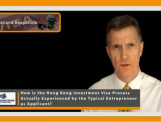
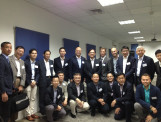
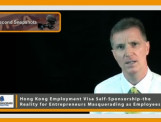
On December 10, 2015 I gave a talk at Centre O Connect in Sheung wan setting out the nitty gritty of the Hong Kong entrepreneur visa since the implementation of the Enhancement Measures on May 6, 2015.
PRACTICE UPDATE: How to read in light of current ImmD policy:
-
Historical Editorial Standard: In this comparative module of the Centre O lecture series, the Geeza examines the distinction introduced by the May 2015 “Enhancement Measures” between a conventional business “entrepreneur” and a “startup” founder. Historically, the presentation explained this as an evolution of departmental mindset: while traditional entrepreneurs (traders, restaurateurs, established professional practitioners) were evaluated on conventional commercial track records and capital depth, “startups” were afforded a special, highly flexible corridor. Case officers were encouraged to look past traditional revenue, modest initial capital, and early unprofitability if the applicant could demonstrate an innovative concept, participate in the broader startup ecosystem, or leverage co-working spaces and incubators.
-
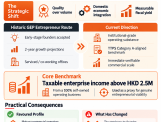
Comparative Reading Under the Upgraded Regime: The historical narrative that “startup” status grants an applicant a general, discretionary pass around traditional business viability standards has been completely dismantled. Under ImmD’s post-April 2026 administrative restructuring, the boundary between standard entrepreneurship and the startup track has hardened into a strict, formal bifurcation:
-
The Standard GEP Entrepreneur Route: Startup rhetoric, claims of innovation, or lean, disruptive business models no longer excuse a lack of balance-sheet substance. Unless officially admitted into an accredited government program, every commercial venture—regardless of whether it labels itself a “tech startup” or a “traditional business”—is evaluated against the rigid operational substance benchmark aligned with TTPS Category A (~HKD 2.5M enterprise scale). It must empirically prove day-one readiness: HKD 1.5M to HKD 2.0M in cleared, deployed liquidity in an active HK corporate account, dedicated physical premises under an exclusive commercial lease (“four walls”), and 2 to 3 local permanent residents actively on MPF payroll.
-
The Accredited Startup Carve-Out: The leniency historically attributed to early-stage startups now applies exclusively to ventures officially accepted into a government-recognized incubation or accelerator scheme (such as Cyberport Incubation Programme, HKSTP Incubation Programme, Design Incubation Programme, etc.). Outside of these specific, certified programs, an unbacked startup attempting to file under the standard GEP Entrepreneur route using historical “startup flexibility” arguments will be summarily refused for failing to meet the mandatory capital, premises, and employment thresholds.
-
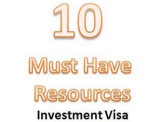
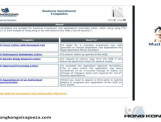
In this segment, I discuss the difference between being an applicant as an Entrepreneur under the Business Investment Visa and being an applicant as a Startup. Here, also, are the 10 Must Have Resources discussed in the talk, along with a synopsis of the various accredited programmes found here.
More In This Series
Introduction
How Did We Get Here?
Startup vs. Entrepreneur
Getting Approved
The Question of Money
Passing the Approvability Test
Improve Your Chances
D-I-Y Application
Other Relevant Content
How To Apply for a Hong Kong Business Investment Visa Without Any Professional Help
Hong Kong Entrepreneur Visa (Business Investment) – A Practical Guide
Is the Hong Kong Startup Visa All That It’s Cracked Up to Be?
Hong Kong Visa Handbook – The Entrepreneur Visa
Please select the social network you want to share this page with:


The Hong Kong Visa Geeza (a.k.a Stephen Barnes) is a co-founder of the Hong Kong Visa Centre and author of the Hong Kong Visa Handbook. A law graduate of the London School of Economics, Stephen has been practicing Hong Kong immigration since 1993 and is widely acknowledged as the leading authority on business immigration matters here for the last 24 years.