


PRACTICE UPDATE: The 2026 Immigration Facilitation Scheme | Short Term Work For Visitors To Hong Kong
Posted by Loredana / in Feature Article, Musing, Practice Update, VG Front Page, Visitor Visas / No responses
The 2026 Immigration Facilitation Scheme, Authorised Host Organisations and the 14-Day Employment Exception
Short Term Work For Visitors To Hong Kong

Practice Update: The 2026 Immigration Facilitation Scheme, Authorised Host Organisations and the 14-Day Employment Exception
Hong Kong has long maintained a clear distinction between individuals entering the territory as visitors and those admitted for employment.
Under the ordinary visitor conditions of stay, an individual is prohibited from taking employment, whether paid or unpaid, unless an applicable permission or exemption exists.
For many years, this created practical difficulties for international professionals whose presence in Hong Kong was required for only a short period.
An overseas academic invited to conduct research, an internationally recognised specialist participating in a professional programme, or a performer contributing to a major cultural event might need to undertake activities that went beyond the ordinary scope of business visitation.
Yet the temporary nature of those activities could make a conventional employment visa application administratively disproportionate.
Hong Kong’s response has been to develop a targeted immigration facilitation framework.
The Immigration Facilitation Scheme for Visitors Participating in Short-term Activities in Designated Sectors now allows qualifying individuals invited by authorised host organisations to undertake specified short-term activities in Hong Kong without obtaining a conventional employment visa.
Following earlier expansions, the scheme was further extended with effect from 1 October 2026.
It now covers 18 designated sectors.
This represents a significant development in Hong Kong’s approach to short-term international professional mobility.
The Government is increasingly recognising that certain forms of temporary professional activity can contribute directly to Hong Kong’s economic, educational, cultural and technological development without requiring the individual to enter through the conventional employment visa system.
Stephen Barnes – the Hong Kong Visa Geeza
However, the arrangements remain carefully controlled.
From a Limited Pilot to an Established Immigration Facilitation Framework
The origins of the current arrangements can be traced to the pilot scheme introduced in June 2022.
The initial framework covered selected sectors in which the Government considered that the participation of overseas professionals could provide significant benefits to Hong Kong.
The arrangements were subsequently regularised under the Immigration Facilitation Scheme for Visitors Participating in Short-term Activities in Designated Sectors, effective from June 2024.
Further expansion followed in November 2025.
The latest extension, effective from 1 October 2026, has increased the number of designated sectors to 18.
This progression is important.
What began as a relatively narrow pilot has become a more established component of Hong Kong’s international talent and professional mobility framework.
Nevertheless, it remains an exception to the ordinary visitor employment restriction rather than a general short-term work visa.
The 18 Designated Sectors
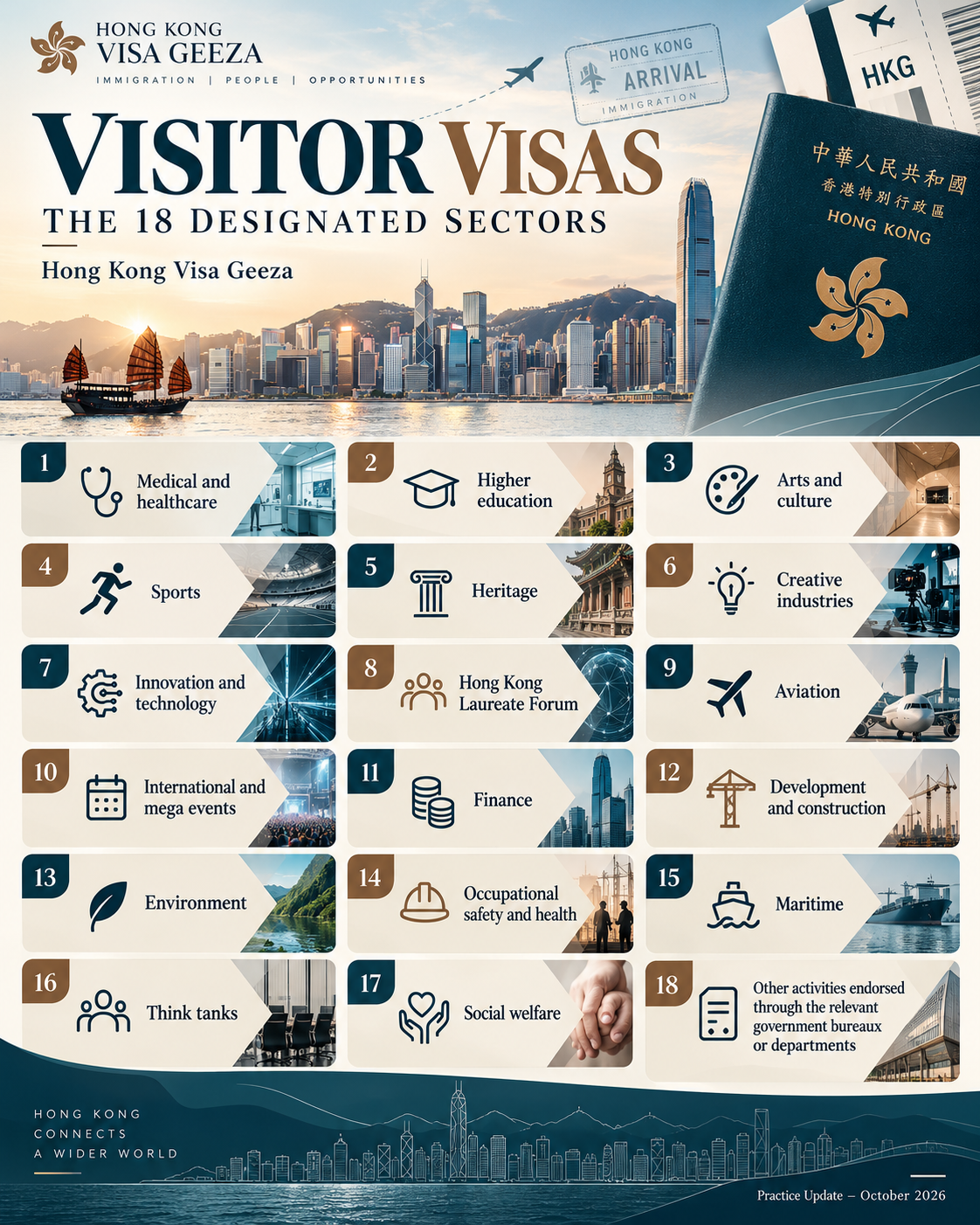
The current scheme covers the following sectors:
- Medical and healthcare.
- Higher education.
- Arts and culture.
- Sports.
- Heritage.
- Creative industries.
- Innovation and technology.
- Hong Kong Laureate Forum.
- Aviation.
- International and mega events.
- Finance.
- Development and construction.
- Environment.
- Occupational safety and health.
- Maritime.
- Think tanks.
- Social welfare.
- Other activities endorsed through the relevant government bureaux or departments.
The inclusion of these sectors reflects Hong Kong’s increasingly targeted approach to attracting international expertise.
The scope extends beyond traditional commercial activity to encompass research, professional knowledge exchange, technological development, cultural participation and specialised services.
However, the existence of a designated sector does not mean that every activity within that sector automatically qualifies.
The activity must fall within the specific scope of facilitation endorsed by the relevant government bureau or department.
Authorised Host Organisations: The Central Eligibility Requirement
Perhaps the most important feature of the scheme is the requirement for an authorised host organisation.
A visitor cannot independently claim the benefit of the arrangements merely because their professional activity falls within one of the designated sectors.
The inviting or sponsoring organisation must have been endorsed by the relevant government bureau or department.
This is a fundamental distinction.
For example, a university, research institution, professional body or event organiser may qualify as an authorised host organisation for particular activities.
However, that status must be established by reference to the current official list and the scope of facilitation applicable to that organisation (below).
Not every university, private company, professional association or event organiser automatically qualifies.
Nor does authorisation in one sector necessarily permit an organisation to sponsor activities outside its approved scope.
The relevant question is not simply whether the organisation is reputable or professionally accredited. It is whether it has been specifically authorised to host the activity concerned under the scheme.
Stephen Barnes, The Hong Kong Visa Geeza
Scheme Overview & Policy Details
Full Schedule of Authorised Host Organisations & Permitted Activities:
Scope of Facilitation and Authorised Host Organisations List (ImmD Official Document)
Authorised Host Organisations by Sector
The scheme encompasses roughly 490 authorised host organisations across 18 designated sectors endorsed by their respective government policy bureaus and departments. Below is the sectoral breakdown of qualifying host bodies:
-
Medical and Healthcare
Government & Statutory Healthcare Bodies: Health Bureau, Hospital Authority, Department of Health.
Hospitals & Specialist Institutes: HKBU Chinese Medicine Hospital Company Limited, Hong Kong Academy of Medicine, Hong Kong Genome Institute (HKGI).
Healthcare Training / Tertiary Institutions: The University of Hong Kong (HKU), The Chinese University of Hong Kong (CUHK), The Hong Kong Polytechnic University (PolyU), Hong Kong Metropolitan University (HKMU), Tung Wah College, Saint Francis University, Hong Kong Baptist University (HKBU).
13 Statutory Healthcare Regulatory Bodies: Medical Council, Dental Council, Nursing Council, Midwives Council, Supplementary Medical Professional Council, Pharmacy and Poisons Board, Chiropractors Council, Chinese Medicine Council, etc., plus their accredited/authorised professional bodies.
-
Higher Education
Government & Funding Bodies: Education Bureau, University Grants Committee (UGC), Hong Kong Council for Accreditation of Academic and Vocational Qualifications (HKCAAVQ), Vocational Training Council (VTC).
UGC-Funded Universities:
City University of Hong Kong (CityU)
Hong Kong Baptist University (HKBU)
Lingnan University
The Chinese University of Hong Kong (CUHK)
The Education University of Hong Kong (EdUHK)
The Hong Kong Polytechnic University (PolyU)
The Hong Kong University of Science and Technology (HKUST)
The University of Hong Kong (HKU)
Performing Arts & Self-Financing Institutions: The Hong Kong Academy for Performing Arts (HKAPA), Hong Kong Metropolitan University (HKMU), Hong Kong Shue Yan University, The Hang Seng University of Hong Kong, Saint Francis University, Hong Kong Chu Hai College, Tung Wah College, UOW College Hong Kong, Gratia Christian College, Centennial College, HKCT Institute of Higher Education, Hong Kong Nang Yan College of Higher Education, Yew Chung College of Early Childhood Education.
-
Arts and Culture
Government & Statutory Entities: Culture, Sports and Tourism Bureau (CSTB), Leisure and Cultural Services Department (LCSD), West Kowloon Cultural District Authority (WKCDA), Hong Kong Arts Development Council (HKADC).
Major Festivals & Performing Companies:
Hong Kong Arts Festival Society Limited
Nine Major Performing Arts Groups: Chung Ying Theatre Company, City Contemporary Dance Company, Hong Kong Ballet, Hong Kong Chinese Orchestra, Hong Kong Dance Company, Hong Kong Philharmonic Orchestra, Hong Kong Repertory Theatre, Hong Kong Sinfonietta, Zuni Icosahedron.
-
Sports
Statutory, Umbrella & Elite Bodies: Culture, Sports and Tourism Bureau (CSTB), Leisure and Cultural Services Department (LCSD), Sports Federation & Olympic Committee of Hong Kong, China (SF&OC), China Hong Kong Paralympic Committee, Hong Kong Sports Institute (HKSI).
Designated Sports Organisations & NSAs: Eligible National Sports Associations (NSAs) for events supported by CSTB/LCSD; Anti-Doping Organization of Hong Kong, China; Hong Kong Coaching Committee; Association of Sports Institutes in Asia; Sports Medicine & Sports Science Association of Hong Kong, China; Hong Kong Society of Sport & Exercise Science.
-
Heritage
Antiquities and Monuments Office (AMO) and affiliated heritage institutions endorsed under the Development Bureau.
-
Creative Industries
Cultural and Creative Industries Development Agency (CCIDA — formerly Create Hong Kong), Hong Kong Film Development Council (FDC), and endorsed industry programme organizers.
-
Innovation and Technology
Government Bureaux & Commissions: Innovation, Technology and Industry Bureau (ITIB), Innovation and Technology Commission (ITC) (including Hong Kong Accreditation Service and Standards and Calibration Laboratory), Environment and Ecology Bureau (EEB).
Flagship Hubs & Parks: Hong Kong Science and Technology Parks Corporation (HKSTPC), Cyberport, Hong Kong-Shenzhen Innovation and Technology Park (HSITP).
Productivity & Research Clusters: Hong Kong Productivity Council (HKPC), InnoHK research centres/laboratories, Greater Bay Area Association of Academicians.
R&D Centres: Hong Kong Applied Science and Technology Research Institute (ASTRI), Nano and Advanced Materials Institute (NAMI), Hong Kong Research Institute of Textiles and Apparel (HKRITA), Logistics and Supply Chain MultiTech R&D Centre (LSCM), Hong Kong Microelectronics Research and Development Institute (MRDI).
-
Hong Kong Laureate Forum
The Council of the Hong Kong Laureate Forum (endorsed through the Chief Executive’s Policy Unit).
-
Aviation
Airport Authority Hong Kong (AAHK), Civil Aviation Department (CAD), and designated industry operators/training academies endorsed through the Transport and Logistics Bureau.
-
International and Mega Events
Event organisers, trade associations, and entities specifically designated or subsidised under the Mega Events Coordination Group, Culture, Sports and Tourism Bureau, Commerce and Economic Development Bureau, Home and Youth Affairs Bureau, and Labour and Welfare Bureau.
-
Finance
Financial Services and the Treasury Bureau (FSTB), Hong Kong Monetary Authority (HKMA), Securities and Futures Commission (SFC), Insurance Authority (IA), Hong Kong Exchanges and Clearing Limited (HKEX), and Financial Secretary’s Private Office.
-
Development and Construction
Development Bureau (DEVB), Housing Bureau / Housing Department, Construction Industry Council (CIC), and accredited engineering/architectural professional institutes running endorsed short-term review or knowledge panels.
-
Environment
Environment and Ecology Bureau (EEB), Environmental Protection Department (EPD), and associated public environmental research & advisory councils.
-
Occupational Safety and Health
Occupational Safety and Health Council (OSHC), Labour Department (LD), and Labour and Welfare Bureau.
-
Maritime
Hong Kong Maritime and Port Board, Marine Department, and endorsed maritime research/advisory organisations under the Transport and Logistics Bureau.
-
Think Tanks
Public policy research institutes, policy advisory units, and think tanks approved and registered through the Chief Executive’s Policy Unit (CEPU).
-
Social Welfare
Social Welfare Department (SWD) and designated subvented non-governmental organisations (NGOs) and statutory welfare advisory committees.
-
Other Endorsed Activities
Ad hoc or cross-sectoral host bodies endorsed directly by relevant Government Bureaux and Departments for specific policy-driven programmes.
Higher Education: Academic Lectures, Research and Professional Exchange
The higher education sector provides a useful illustration of how the scheme operates.
Qualifying authorised institutions may invite overseas academics and specialists to participate in designated activities such as academic seminars, conferences, lectures, workshops, research activities, peer reviews, accreditation exercises and selection panels.
This facilitates international academic exchange without requiring every short-term participant to obtain conventional employment permission.
However, the arrangements do not provide a general mechanism for filling part-time or full-time positions at local educational institutions.
An overseas academic invited to deliver a series of guest lectures may qualify under the scheme.
An individual appointed to an ongoing teaching position presents a materially different immigration question.
Similarly, the precise scope of permitted research activity must be considered against the relevant institutional authorisation.
Medical, Technology and Other Specialist Activities
The scheme also accommodates specified activities in sectors where Hong Kong has identified a need for international expertise.
These include medical and healthcare activities, innovation and technology, aviation, construction, finance and other professional fields.
The practical significance is considerable.
An overseas specialist may be invited to contribute to an approved programme, provide expert input or participate in a designated professional activity without necessarily obtaining a conventional employment visa.
However, it would be incorrect to assume that all medical procedures, technical services, commercial consultancy assignments or construction-related work automatically qualify.
The specific activity and authorised host organisation must be checked.
Professional licensing, registration and other regulatory requirements may also apply independently of immigration permission.
An immigration facilitation arrangement does not automatically authorise the practice of a regulated profession.
The 14-Day Rule: Understanding the Actual Limitation
Under the current arrangements, qualifying visitors may participate in specified short-term activities for up to 14 consecutive calendar days during each period of permitted visitor stay.
The period begins on the day the individual first participates in the designated activity.
It does not necessarily begin on the date of arrival in Hong Kong.
For example, an eligible visitor arriving on 5 November but commencing the designated activity on 11 November would ordinarily have a 14-day activity window running from 11 November through 24 November.
The scheme does not impose a numerical cap on the designated activities undertaken within that window.
However, the visitor must remain within the scope of the applicable authorisation.
The 14-day activity period should not be confused with the individual’s total permitted stay as a visitor.
A person granted 90 days of visitor permission may, after completing the qualifying activity, remain for ordinary visitor purposes until the expiry of that permission.
Conversely, a person granted only seven days of visitor permission does not acquire a 14-day right to remain simply because they possess an invitation letter.
Remuneration: Payment May Be Permitted
One of the scheme’s most important features is that remuneration may be permitted for designated activities.
This distinguishes the arrangements from the ordinary visitor framework, under which paid or unpaid employment is generally prohibited.
However, the permission to receive remuneration is not unrestricted.
It depends upon the specific activity and the scope of facilitation endorsed by the relevant government bureau or department.
The host organisation and invited individual should therefore establish whether the proposed payment arrangements are permitted under the applicable sector-specific authorisation.
The mere fact that an activity is short-term does not make payment lawful under visitor conditions.
Equally, the fact that remuneration is received does not necessarily require a conventional employment visa where the individual properly qualifies under the scheme.
The critical issue is whether the activity and remuneration fall within the approved facilitation arrangements.
Invitation Letters: Necessary Evidence, Not an Entry Visa
Eligible visitors must be endorsed by the authorised host organisation through an invitation letter.
The letter should accurately identify the visitor’s role and the specified activities.
The individual must comply with the scope of the invitation.
However, an invitation letter is not itself an entry visa.
It does not guarantee admission to Hong Kong.
Individuals who ordinarily require a visit visa or entry permit must still obtain the necessary permission before travelling.
Mainland, Macao and Taiwan residents remain subject to their applicable entry arrangements.
All visitors remain subject to immigration examination upon arrival.
The Immigration Department recommends that eligible visitors bring the invitation letter with them when travelling to Hong Kong and participating in the designated activities.
What Happens When the Activity Falls Outside the Scheme?
Not every short-term professional assignment will qualify.
A private company inviting an overseas technician to perform installation work may not be an authorised host organisation.
A commercial consultancy project may fall outside the specified activities.
An academic appointment involving ongoing employment may exceed the permitted scope.
In such circumstances, the individual should consider the appropriate immigration permission before commencing the proposed activity.
Depending upon the facts, this may involve the General Employment Policy or another applicable admission arrangement.
The existence of the short-term facilitation scheme should not encourage employers or visitors to characterise ordinary employment as a designated short-term activity.
The substance of the activity remains important.
The Wider Economic Significance
The expansion of the scheme is consistent with Hong Kong’s wider strategy of encouraging international professional exchange and strengthening its position as a centre for innovation, education, finance, culture and specialist services.
Hong Kong’s first Five-Year Plan for 2026–2030 places increasing emphasis on innovation, technology and integration with the wider Greater Bay Area economy.
Short-term international mobility can support these objectives by facilitating the exchange of specialised knowledge and expertise.
The scheme also allows Hong Kong to accommodate temporary contributions that may be valuable without necessarily requiring longer-term employment or residence.
Nevertheless, its policy purpose should not be confused with an unrestricted relaxation of immigration controls.
The facilitation remains targeted, activity-specific and dependent upon government-endorsed host organisations.
Practical Guidance for Host Organisations and Visitors
1. Confirm the designated sector. Establish that the proposed activity falls within one of the current designated sectors.
2. Verify host authorisation. Check that the inviting organisation appears on the current official list and is authorised for the relevant activity.
3. Examine the permitted activity. A qualifying host organisation cannot necessarily sponsor every professional activity.
4. Confirm remuneration arrangements. Payment must be consistent with the applicable scope of facilitation.
5. Observe the 14-day activity window. The permitted activity period begins when participation commences and must not exceed the applicable limit.
6. Obtain the correct entry permission. Visitors requiring a visa must still obtain one; the invitation letter is not a substitute.
7. Maintain appropriate documentation. Host organisations and visitors should retain evidence of the invitation, activity, dates, roles and any remuneration arrangements.
8. Consider other regulatory requirements. Immigration facilitation does not remove professional licensing or other statutory obligations.
The Wider Implications for Hong Kong Immigration Practice
The expansion of the Short-Term Visitor Facilitation Scheme represents an important development in Hong Kong’s immigration framework.
It acknowledges that temporary professional activity can make a meaningful contribution to Hong Kong’s economy and society.
It also recognises that conventional employment visa procedures may not always be the most appropriate mechanism for accommodating short-term participation by international specialists.
However, the scheme is not a general authorisation for visitors to work.
Its operation depends upon designated sectors, authorised host organisations, specified activities and defined time limits.
For overseas professionals and inviting organisations, the practical message is therefore clear:
A visitor may undertake certain short-term professional activities in Hong Kong without a conventional employment visa, but only where the activity falls within an expressly recognised permission or facilitation arrangement. The existence of an invitation, professional qualification or short duration is not sufficient by itself.
Stephen Barnes, the Hong Kong Visa Geeza
Understanding those requirements is essential to ensuring that short-term professional visits remain compliant with Hong Kong immigration law.
More Stuff You May Find Useful or Interesting
1. Hong Kong Visitor Visa Facilitation Plan – Short-Term Employment Allowed
This article remains a valuable introduction to the origins of Hong Kong’s short-term visitor facilitation arrangements, particularly the requirement for government-endorsed host organisations and the possibility of undertaking designated activities without a conventional employment visa. However, its discussion of the original two-year pilot and ten designated sectors is now historical. The scheme was regularised in June 2024 and subsequently expanded, most recently on 1 October 2026, to cover 18 designated sectors. Readers should also distinguish the maximum 14-day period for undertaking specified activities from the visitor’s overall permitted stay. The current Practice Direction explains the expanded framework, the need to verify host authorisation and the restrictions governing permitted activities and remuneration.
2. Is It Ever OK to Work in Hong Kong on a Visitor Visa?
This article correctly emphasises that visitors are ordinarily prohibited from taking employment in Hong Kong, whether paid or unpaid. That fundamental restriction remains in force. However, readers should now consider the expanded Short-Term Visitor Facilitation Scheme, which permits qualifying individuals invited by authorised host organisations to undertake specified activities without obtaining a conventional employment visa. The exception is not generally available to all employers or visiting professionals. Eligibility depends upon the designated sector, the precise activity, the host organisation’s authorisation and compliance with the applicable time limits. The current Practice Direction explains how these targeted arrangements operate alongside, rather than replace, the ordinary visitor employment restrictions.
3. Change to Hong Kong Employment Visa from Visitor Visa – Looking for Work as a Tourist
This article remains useful for explaining the possibility of applying for employment permission while physically present in Hong Kong as a visitor. However, its discussion of short-term accredited work should now be read against the current 18-sector facilitation framework. The scheme is no longer limited to the original pilot arrangements and has been expanded to include additional sectors and authorised host organisations. Nevertheless, it does not create a general right for visitors to commence employment while awaiting a conventional work visa. Applicants must distinguish ordinary employment applications from the separate short-term facilitation arrangements and establish that their proposed activities fall within the relevant government-endorsed scope.
4. Can I Come to Install Equipment in Hong Kong Without an Employment Visa?
This article highlights the longstanding distinction between permissible business-visitor activities and the actual performance of technical work in Hong Kong. The Immigration Department permits visitors to examine or supervise the installation of goods or equipment, but this should not be interpreted as a general authorisation to undertake hands-on installation or technical services. The expanded Short-Term Visitor Facilitation Scheme may accommodate certain designated technical activities where the inviting organisation is appropriately authorised and the proposed work falls within the endorsed scope. However, ordinary commercial installation assignments should not be assumed to qualify. The current Practice Direction explains why the nature of the activity and the status of the host organisation must be established before determining whether conventional employment permission is required.
5. How Can an Overseas Company Temporarily Sponsor Employment Visa Permissions for Hong Kong?
This article provides useful guidance concerning overseas companies wishing to send personnel to Hong Kong for temporary professional assignments. Its central point—that delivering substantive services in Hong Kong ordinarily requires appropriate immigration permission—remains important. However, the range of possible immigration arrangements has developed since the article was published. Qualifying individuals invited by authorised host organisations may now undertake specified short-term activities under the expanded 18-sector facilitation framework without obtaining a conventional employment visa. This does not mean that an overseas company can automatically rely upon the scheme to send employees to provide commercial services. The current Practice Direction explains the distinction between ordinary temporary employment and the narrowly defined activities permitted under government-endorsed short-term facilitation arrangements.
Got a Visa Question?
Hong Kong’s short-term visitor facilitation arrangements create valuable opportunities for overseas professionals, universities, research institutions, event organisers and other authorised bodies.
However, the eligibility requirements are highly specific.
If you are planning to invite an overseas specialist to Hong Kong, or have been invited to undertake a short-term professional activity, ask the Hong Kong Visa Geeza a question.
We’ll help you understand whether the proposed activity may qualify under the current facilitation arrangements or whether a conventional employment visa or other entry permission may be required.
VisaGeeza.Ai – Making Hong Kong Immigration A Lot Easier

VisaGeeza.Ai – 13 Years In The Making
Check Out VisaGeeza.Ai
All Our Know-How : All Our Experience : Fully Interactive
100% FREE!
Please select the social network you want to share this page with: