


What Do Both Hong Kong Employment & Investment Visa Applications Share In Common?
Posted by The Visa Geeza / in Employment Visas, Hadley Says…, Investment Visas / 15 responses
PRACTICE UPDATE: How the content must now be read in light of current ImmD policy:
Historically, this explainer examined the shared legal DNA between General Employment Policy (GEP) employment and investment visas, emphasizing their common statutory roots under Section 11 of the Immigration Ordinance. Both routes were presented as flexible, narrative-driven exercises governed by administrative discretion: whether evaluating an employee’s specialized skills or an entrepreneur’s commercial coherence, ImmD case officers simply sought assurance that the applicant would not become a public burden and that their presence made common-sense economic sense, often giving founders leeway to bootstrap lean setups without immediate local staff.
The game has changed from a shared spectrum of discretionary flexibility into two completely divergent, hyper-rigid assessment tracks. While standard employment sponsorship continues to hinge on individual qualifications and genuine job vacancies, the investment route has transformed into a non-negotiable institutional audit aligned with TTPS Category A substance. Founders can no longer bridge the gap with narrative parallels to employment visas; they must immediately show HKD 1.5M–2.0M in deployed corporate liquidity, exclusive physical “four walls,” and active MPF payroll for 2–3 local permanent residents. Without meeting these empirical thresholds or securing accredited government incubation, the entrepreneur pathway is completely shut.
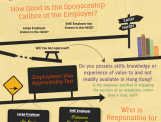
The approvability tests for both employment visas and investment visas, whilst fundamentally different, call for an examination of the applicant’s special skills, knowledge and experience which can be said to be of value to Hong Kong.
In the case of an employment visa, the focus is squarely on the personal profile of the applicant, while in an investment visa application, the background of the applicant is only a minor part of the consideration exercise.
You see, for an investment visa, the approvability test looks for proof that the applicant can make a substantial contribution to the economy of Hong Kong.
A small part of this is the applicant’s track record in business, meaning his skills, knowledge and experience which can be deployed to ensure that the business stands a good chance of becoming a solidly entrenched commercial enterprise.
The major part of the investment visa approvability test, though, is the business itself the funding available, commerce in hand and the potential for the creation of local jobs.
But in the case of an employment visa, the quality of the applicant’s CV is vital.
For an investment visa, you can have almost no experience in prior business ownership and still get approved.
For an employment visa, however, no related experience usually no means no visa to boot.
VisaGeeza.Ai – Making Hong Kong Immigration A Lot Easier

VisaGeeza.Ai – 13 Years In The Making
Check Out VisaGeeza.Ai
All Our Know-How : All Our Experience : Fully Interactive
100% FREE!
More Stuff To Help You Along
Please select the social network you want to share this page with:


The Hong Kong Visa Geeza (a.k.a Stephen Barnes) is a co-founder of the Hong Kong Visa Centre and author of the Hong Kong Visa Handbook. A law graduate of the London School of Economics, Stephen has been practicing Hong Kong immigration since 1993 and is widely acknowledged as the leading authority on business immigration matters here for the last 24 years.