










Unemployed Employment Visa Holders Can No Longer Change To Top Talent Pass Visa Status
Posted by The Visa Geeza / in Feature Article, Musing, Special Programmes, Top Talent Pass, VG Front Page / 2 responses
Unemployed Holders of Employment Visas Are No Longer Eligible to Change to Top Talent Pass Visa
Focus Appears To Be On Attracting New Talent & Not Enabling ‘Out of Luck’ Existing Talent

– Click To Download The Guidebook –
PRACTICE UPDATE: October 2026
Historical Context: The TTPS as an Unconditional Life Raft for Displaced Professionals
Historically, as published by the Hong Kong Visa Geeza in Unemployed Employment Visa Holders Can No Longer Change to Top Talent Pass Visa Status, this analysis addressed the administrative loophole where foreign professionals in Hong Kong whose General Employment Policy (GEP) sponsorships had terminated sought to pivot onto the Top Talent Pass Scheme (TTPS). During the initial phase of the scheme, TTPS functioned as a frictionless, unconditional immigration life raft. Displaced professionals who met the baseline criteria—either earning over HKD 2.5 million under Category A or holding qualifying degrees from eligible global universities under Categories B or C—could bypass the rigid sponsorship constraints of the GEP entirely. Because initial TTPS entry required zero upfront employment, no local business establishment, and no immediate economic justification, terminated workers actively leveraged the policy to secure an unencumbered 24-month limit of stay, freeing themselves from the ticking clock of unemployment and allowing them to reside in the territory without immediate commercial obligations.
Modern Reality: The Pivot from Talent Attraction to Mandatory Economic Contribution
As detailed by the Hong Kong Visa Geeza in Practice Update: Hong Kong’s Top Talent Pass Scheme (TTPS) Moves From Talent Attraction to Economic Contribution, the Immigration Department (ImmD) has fundamentally transformed the TTPS from an open-ended talent acquisition gateway into a rigorous, contribution-focused compliance regime. The era of treating TTPS as a passive holding pattern or an easy alternative to employment sponsorship has been decisively closed. At the extension stage, ImmD enforces an aggressive, hardware-driven economic audit across both available pathways. Under the employment track, ImmD strictly scrutinizes payroll records, assessable Salaries Tax filings, and active Mandatory Provident Fund (MPF) contributions, requiring market-rate remuneration commensurate with elite talent while summarily rejecting shell sponsorships, artificial consultancies, and contrived employment arrangements. Under the business track, for talents attempting to renew via self-employment or business establishment, ImmD applies an uncompromising corporate hardware audit benchmarked against TTPS Category A substance—demanding audited financial accounts, verifiable turnover, dedicated corporate liquidity in a local commercial bank account, an executed commercial tenancy for exclusive premises strictly disqualifying virtual offices, shared desks, and co-working spaces, and active MPF payroll records for local full-time Hong Kong permanent resident employees.
Strategic Baseline: The Fallacy of the Passive Bridge vs. The Renewal Precipice
Consequently, relying on the TTPS as a convenient status-shelter or treating it as an automatic bridge toward the seven-year Right of Abode milestone represents an acute administrative hazard. Talents who transitioned onto TTPS to escape GEP sponsorship requirements, but who fail to anchor themselves to genuine, highly paid employment or an enterprise-scale operating business before their initial limit of stay expires, face an immediate renewal precipice. ImmD case officers grant no discretionary leniency for passive job searches or nominal corporate shells. Summary refusal at the extension milestone immediately terminates lawful stay, prompts an abrupt exit from the territory, cancels dependent visas, and irreversibly breaks the applicant’s continuous ordinary residence chain required to secure permanent residency under the seven-year rule. Modern TTPS holders must recognize that easy-in entry leads directly to an inflexible hard-to-stay audit: without verifiable, enterprise-grade economic contribution deployed well before renewal, extension of stay is impossible.
In late 2024, the Hong Kong Immigration Department implemented significant yet understated modifications to its Top Talent Pass Scheme (TTPS). These changes have notably impacted the eligibility and application processes for individuals seeking to transition from General Employment Policy (GEP) visas to TTPS status.
Evolution of the Top Talent Pass Scheme
Introduced to attract high-calibre professionals to Hong Kong, the TTPS initially allowed seamless transitions for GEP employment visa holders who met specific criteria:
- Category A: High earners with an annual income of HKD 2,500,000 or more.
- Category B: Top graduates with recent work experience.
- Category C: Top graduates with limited work experience.
This framework enabled GEP visa holders to switch to TTPS status by satisfying the relevant category requirements, offering a two-year period during which they could engage in various employment activities without immigration constraints.
Unintended Consequences
While the TTPS aimed to infuse new talent into Hong Kong’s workforce, it inadvertently provided existing visa holders with a temporary solution to impending visa expirations, especially for those facing unemployment. This loophole allowed individuals to extend their stay without newly contributing to the local talent pool, counteracting the scheme’s original intent.
New Qualification Criteria
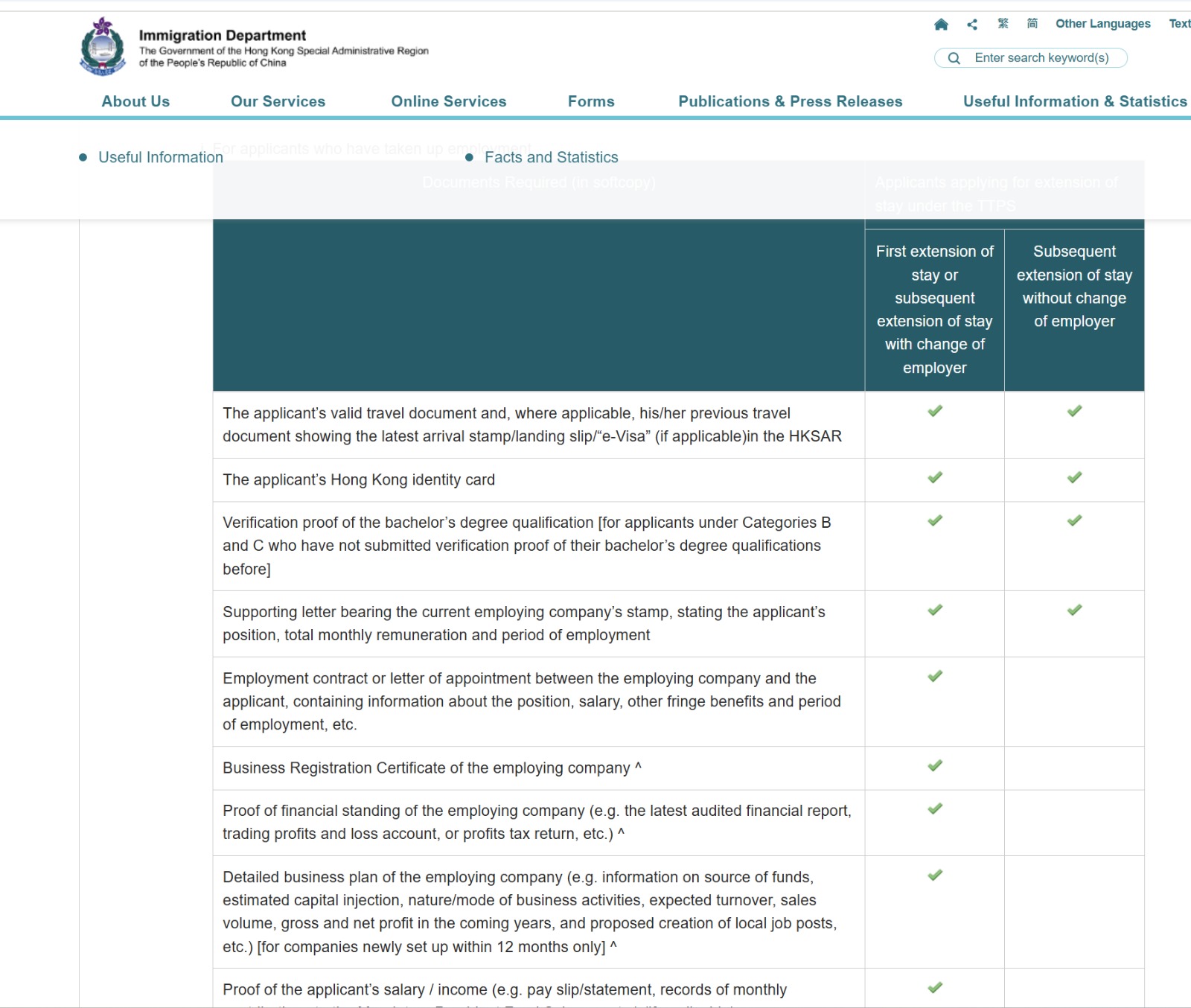
To realign the TTPS with its primary objective of attracting fresh talent, the Immigration Department have now introduced a two-stage qualification process for current GEP employment visa holders and Quality Migrant Admission Scheme (QMAS) residents seeking TTPS status:
- Stage 1: Applicants must obtain implied consent from their current employer to transition to TTPS status. This involves demonstrating the ongoing existence of the sponsoring employer’s business and the continuation of employment under the GEP employment visa at the time of application.
- Stage 2: Applicants must meet the standard TTPS criteria under Category A, B, or C.
This revised process ensures that only individuals with active employment and sponsoring-employer support can transition to TTPS status, thereby enhancing the scheme’s integrity.
More Scrutiny
In response to reports of organized fraud, particularly involving falsified academic qualifications from Mainland China, the Immigration Department has intensified its vetting procedures. All claims of qualifying degrees now require third-party verification, adding extra expense to the process, and there is an increased emphasis on validating evidence of claimed work experience. These measures aim to prevent fraudulent applications and maintain the scheme’s credibility.
Implications
The tightened regulations underscore the HKSAR government’s commitment to attracting genuine talent while preventing exploitation of the system. Prospective applicants should be prepared for a more rigorous application process, including securing employer consent and undergoing thorough verification of qualifications and experience.
Last Words
The recent changes to the Top Talent Pass Scheme reflect Hong Kong’s dedication to maintaining a robust and dynamic workforce by ensuring that immigration policies effectively attract new talent and prevent misuse by existing visa holders. As the city continues to position itself as a global hub for talent, these measures are crucial in upholding the integrity and purpose of its immigration schemes.
For more detailed information on the recent updates to the TTPS and QMAS, refer to the official press release by the Hong Kong government.
Additionally, insights into the government’s efforts to combat the use of false information in visa applications can be found in this news article.
VisaGeeza.Ai – Making Hong Kong Immigration A Lot Easier

VisaGeeza.Ai – 13 Years In The Making
Check Out VisaGeeza.Ai
All Our Know-How : All Our Experience : Fully Interactive
100% FREE!
More Stuff You May Find Useful or Interesting
When There Really Is No Need to Spend Any Money With A Hong Kong Immigration Consultant
The Foibles of Hong Kong Visa & Immigration Applications That Only Experience Can Fully Appreciate
Why Don’t Hong Kong Immigration Consultants Typically Help Aspiring Employees Find Jobs Here?
Why Pay For Professional Help In Your QMAS Application When You Really Can Do It All By Yourself?
100% Hong Kong Visa Application Success Rate? Take It All With A Pinch Of Salt
Please select the social network you want to share this page with:


The Hong Kong Visa Geeza (a.k.a Stephen Barnes) is a co-founder of the Hong Kong Visa Centre and author of the Hong Kong Visa Handbook. A law graduate of the London School of Economics, Stephen has been practicing Hong Kong immigration since 1993 and is widely acknowledged as the leading authority on business immigration matters here for the last 24 years.







































































Bob
I’m an “out of luck” existing talent on a GEP visa. If I receive a job offer, can I apply for the TTPS visa? Or would I need to change my GEP sponsor first, and then change to TTPS?
The Visa Geeza
You’d have to let your GEP visa expire and then apply for TTPS.