Navigating the complexities of immigration law can be challenging, particularly when it comes to dependent visas in Hong Kong. One question that often arises is whether a person can get Hong Kong dependent visa sponsorship more than once, with different spouses. The answer, according to Hong Kong’s administrative rules, is yes, provided certain conditions are met.
The Role of Marriage Cessation Evidence
The first requirement is to provide evidence of the cessation of your legal marriage to your previous sponsor. This means you must be legally divorced from your previous spouse and have entered into a genuine marriage with your current spouse. The Immigration Department of Hong Kong requires proof of these changes in your marital status to ensure the legitimacy of your new dependent visa application.
Sponsorship Criteria for the New Spouse
Your new spouse, who will be your sponsor for the dependent visa, must demonstrate the ability to provide for your basic needs. This includes food and housing, which are standard criteria for qualifying for this type of visa. If you have previously held a dependent visa, you would be familiar with these requirements.
The Impact of Previous Dependent Visa Experience
Having held a dependent visa with your previous spouse, from whom you are now divorced, does not preclude you from being sponsored for a dependent visa by your new spouse. As long as you have remarried and your new spouse can meet the sponsorship requirements, you are eligible to apply for a dependent visa. The fact that you have been through the process before does not affect your eligibility.
Conclusion: Second-Time Sponsorship is Possible
In conclusion, immigration law in Hong Kong does not prevent you from being sponsored for a dependent visa a second time, with a new spouse. As long as you can provide evidence of the end of your previous marriage and the legitimacy of your new one, and your new spouse can meet the sponsorship criteria, there’s no reason why you can’t be successful in this application.
What you need to know in a nutshell and all in one place
The Entrepreneur Visa Application Guide
This Hong Kong Entrepreneur Visa Application Guide in a nutshell provides all your need to know about Hong Kong’s specific visa initiative for international business founders looking to establish and run a venture in the HKSAR.
Known as the Entrepreneur (Business Investment) Entry Visa, this specialized visa essentially functions as an for-specific-purpose employment authorization, granted to the business owner who also serves as an employee in their Hong Kong-based company.
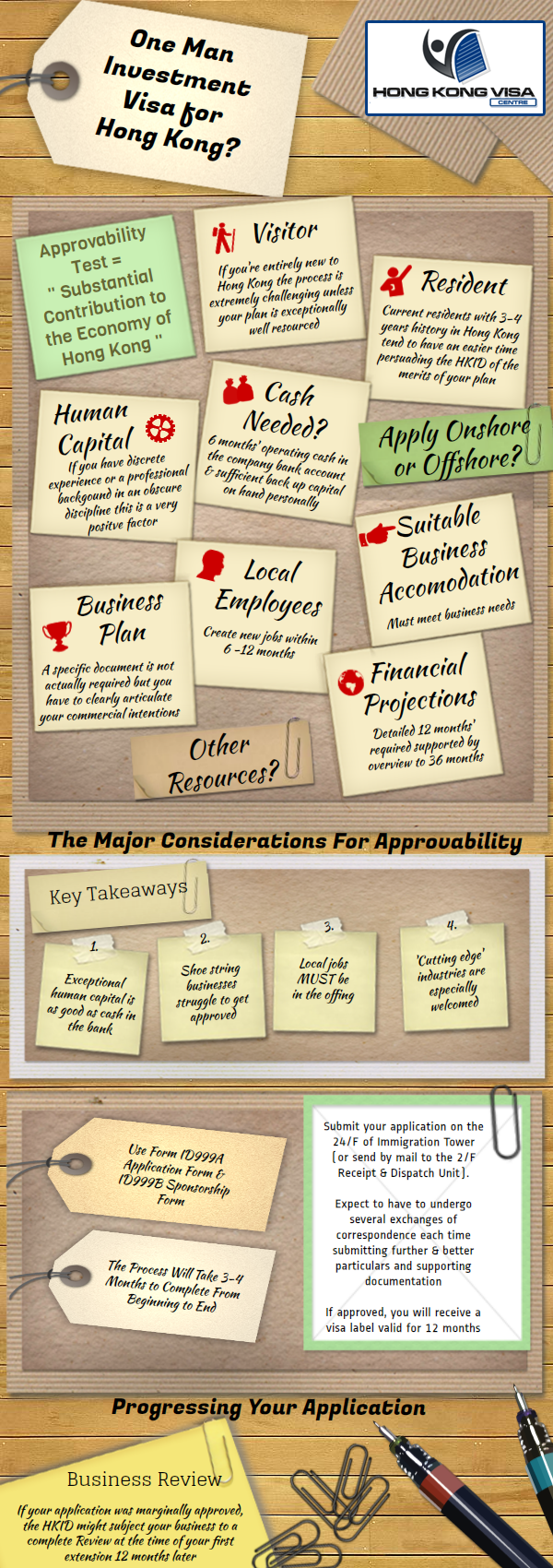
The primary factor for the issuance of the Hong Kong Entrepreneur Visa is the applicant’s requirement to demonstrate that the business will substantially benefit Hong Kong’s economy. This visa also permits the inclusion of one’s spouse and dependent children under the age of 18 years.
Additionally, the visa holder is qualified to apply for permanent residency after 7 years. Initially issued for a one-year duration, the visa can be extended as long as the business continues to be sustainable, usually in 2 or 3-year increments, business performance depending.
This post aims to nutshell-outline the qualification requirements, application steps, required paperwork, and other pertinent details for those interested in applying for the Hong Kong Entrepreneur Visa.
For more information on other visa options in Hong Kong, consult the Hong Kong Visa Handbook.
Hong Kong Entrepreneur Visa Application Guide Video
Hong Kong Entrepreneur Visa Application Guide Elements
Investment Parameters
Qualifying Requirements
Necessary Documentation
Business Strategy
Submission Protocol and Timeline
Refusal
Accompanying Family Visas
Expert Help
Visa Extensions
Permanent Residency
Investment Parameters
Although there’s no explicit financial commitment required to apply for this specialized visa, ImmD scrutinize your business blueprint during the application process. It’s crucial to allocate adequate resources to cover both the launch and at least the first 2 quarters of business operations.
Applicants must establish that their business will have a meaningful economic impact on Hong Kong, such as employment generation, local sourcing, and market penetration.
Two-year business strategy plan, elaborating on planned operations, capital investment, local employment creation, and any physical office establishment plans
The business registration certificate is a document issued by the Hong Kong Business Registration Office. The certificate includes the details of the company. You can apply for a business registration certificate during company incorporation. A service provider, such as a company secretary, lawyer, or advisory firm, can apply for the certificate on your behalf. The required documents for business registration include:
The company’s name
The company’s registered address
A description of the company’s activities
The company’s directors’ details
Sponsor Documents
For business sponsors:
Completed Sponsorship Form ID999B
Business registration certification from the Hong Kong Inland Revenue Department
For individual sponsors:
Completed Sponsorship Form ID999B
Hong Kong ID photocopy
All submitted documentation must be either in English or Chinese or professionally translated into one of these languages. The Immigration Department will undoubtedly request additional paperwork as needed.
Business Strategy
A well-thought-out two-year plan for your business is imperativefor the approval of your Entrepreneur Visa application. ImmD requires convincing evidence that your venture is a ‘welcome investment’ that will positively impact Hong Kong’s economic landscape.
Specific factors scrutinized during the application assessment include:
Strategic Plan: A detailed blueprint outlining your business concept, product offerings, market potential, operational framework, and the managerial team is crucial.
Financial Commitment: Proof of adequate financial reserves to support the venture is needed; though no minimum investment is mandated HKD1 million is needed for a non-resident applicant and HKD500,000 for any present resident seeking to acquire this immigration status from another type of visa. Documents such as bank account statements that speak to your liquid cash net worth to fund the business will be required.
Corporate Structure: Your choice of business entity can affect the outcome. Generally, limited liability companies registered in Hong Kong garner more credibility than sole proprietorships or partnerships at will.
Business Accommodation: ImmD will evaluate if you have a properly set up office or otherwise plans for suitable business premises out of which to operate your enterprise. Your kitchen table or spare bedroom generally do not cut the mustard in this regard. What’s ‘suitable’? For example, an export-import business would need adequate storage space. Including a lease agreement and photos of the premises once established will be called for.
To bolster your application, ensure meticulous attention to the above. Whilst ImmD no more wants to read a 60-page business plan than you might want to write one, a superficial plan for your business that barely meets requirements stands a higher risk of rejection compared to a robust proposal reflecting genuine commitment.
Submission Protocol and Timeline
Your completed application, with all requisite documents, must be submitted to the Hong Kong Immigration Department (Receipt & Dispatch Unit if you’re in Hong Kong as a visitor or via the Residents Section if you’re an existing resident applicant). Online submissions are preferred by ImmD but the upload process is a bit clunky. The electronic submission method merely provides the platform for the exchange of documents and evidence of the fact of application commencement through the issue of a receipt and reference number. Expect the substantive consideration process to be ‘trying’. Applications usually take between 3 to 5 months to process. If successful, a Visa/Entry Permit QR code approval letter is issued, which must be paid for and downloaded from the ImmD website.
Refusal
While rejection is unlikely if you meet all criteria, an appeal option exists in case of denial. You can apply for a Reconsideration.
Accompanying Family Visas
Under the Entrepreneur Visa programme, you can bring your spouse and children under 18 years of age to Hong Kong with you. Each family member would need a separate Dependant Visa which is provided for in the ID999A application form, the validity of which is tied to the primary applicant’s visa. Dependants can engage in employment or education without restriction.
Experience: Specialized firms generally possess a wealth of experience, enabling them to guide you efficiently. Expertise: Such firms can help tailor your business plan to meet Immigration Department expectations. Local Sponsorship: The firm can act as your local sponsor, fulfilling this mandatory application requirement. Administrative Ease: Expert firms manage the application submission and necessary follow-ups, saving you valuable time.
Visa Extensions
If your Entrepreneur Visa is approved, you can continue residing in Hong Kong under employment conditions to run and work in your own business (only). Extensions can be applied for at least four weeks before your current visa expires and will only be approved if you continue to meet eligibility requirements. The extension usually follows a 2-3-3 years pattern.
All Your Hong Kong Entrepreneur Visa Questions Answered Personally – Gratis
And, as always, if ever you get stuck and need to ask me a question, please do so here. I guarantee you a personalisedPodCast Answer within 48 hours – completely free of charge!
Hong Kong Entrepreneur Visa Information From VisaGeeza.Ai
New Visa Policy Initiatives Expand the Top Talent Pass Scheme, Relax Certain Visa Requirements & Reintroduce the Capital Investment Entrant Scheme
According to the Policy Address by the Chief Executive of Hong Kong delivered on October 25, 2023, the government is introducing a series of new visa policy initiatives aimed at revitalizing the economy and attracting foreign talent.
Expanding the Top Talent Pass Scheme
As part of the government’s strategy to promote trade and position Hong Kong as a global business hub, the coverage of universities under the Top Talent Pass Scheme will be expanded. Currently, the scheme grants qualified high earners and graduates from top universities a two-year visa to work or establish businesses in Hong Kong. This new visa policy initiative will increase the number of institutions covered to 184, providing more opportunities for foreign nationals to contribute to the local economy.
Relaxing Visa Requirements for Foreign Nationals
To further facilitate the entry of foreign nationals, the government has announced relaxed visa requirements for certain nationalities. Previously ineligible for Employment, Training, and study visas, Vietnamese, Laotian, and Nepalese nationals will now have the opportunity to access these visas to pursue their professional and academic goals in Hong Kong. This new visa policy initiative’s aim is to attract more talent and help to alleviate the current tight labour market.
Reinstating the Passive Investor Visa Program
The government is reinstating the Capital Investment Entrant Scheme in a major move to attract foreign investment. Eligible foreign investors who invest a minimum of HKD 30 million in stocks, funds, or bonds (excluding real estate) will have the opportunity to apply for entry into Hong Kong. This new visa policy initiative will help stimulate economic growth, showcase Hong Kong as an attractive investment destination, and create new business opportunities.
Introducing a Vocational Professionals Admission Scheme
Recognizing the importance of skilled trade professionals, the government is launching the Vocational Professionals Admission Scheme. This (completely new) ‘study-then-work’ pilot program will allow foreign students from specific vocational schools in Hong Kong to stay an additional year after graduation to find employment in their respective fields. By addressing skills shortages, this scheme aims to create a dynamic and well-equipped workforce to support the growth of Hong Kong’s various industries. This appears to be a boon for the F&B sector (in my view).
Easier Business Travel to Mainland China for Foreign Employees
To facilitate business operations and strengthen ties between Hong Kong and Mainland China, foreign employees of companies registered in Hong Kong will now have the opportunity to apply for a two-year or more multiple-entry Chinese business visa. This change allows for expedited China visa processing via the China Visa Application Service Center, simplifying travel arrangements and promoting seamless business connections between the two regions.
Focus on Economic Growth and Competitiveness
These new visa policy initiatives form part of the government’s broader national plan to improve the economy and enhance Hong Kong’s competitiveness in the global market. In addition to attracting foreign talent and encouraging foreign investment, the government plans to develop key sectors such as industrial, research and development, and information technology. It also aims to foster trade cooperation with Mainland China, attract foreign enterprises to establish headquarters or corporate divisions in Hong Kong, and promote the development of the digital economy.
A Positive Impact
These new visa policy initiatives are set to positively impact businesses seeking to hire and/or deploy foreign nationals to Hong Kong. The focus on streamlining immigration processes, relaxing visa requirements, and promoting economic growth demonstrates our ambition to become a leading global business destination.
More To Come …
I will continue to closely monitor the implementation details of these programs as provided by the Hong Kong Immigration Department. Presently, details are sparse but once available, will publish them here and also update the visageeza.ai large language model to include them in our body of Hong Kong immigration know-how on demand.
VisaGeeza.Ai – Making Hong Kong Immigration A Lot Easier
It can all appear to be a bit of a black box when all is said and done.
However, the application process itself is fairly predictable so I thought there would be value for me to set out the type of experience you can expect as your investment visa application unfolds.
The Hong Kong Entrepreneur Visa Process – The Experience To Anticipate
Filing the Application:
Once you have filed your application, you can expect to receive an official receipt with your file reference number within about 10 days of your first submission.
Receiving the First Request:
Then you will wait for up to 3 to 4 weeks, typically, until ImmD comes back to you, usually by fax, but sometimes by email, with their first request for further and better particulars.
This request often contains a ‘laundry list’ of requirements that the Immigration Department need to have material and information on so that they can give due and full effect to your application – and they typically give you 3 weeks in which to comply.
Requesting an Extension:
If you need more than these 3 weeks, you can fax the Officer tasked with your file on the fax number included on their first request letter, and they are usually amenable to allowing up to a further 4 weeks to submit the documents and information they are seeking.
Responding to the Request:
Once you have complied with their first request for further and better particulars you may or may not receive a second request, usually within the next 2-3 weeks.
If no further request is received in that time, you can assume that the Hong Kong Immigration Department have gone into the ‘4 weeks zone’, meaning that the four weeks they cite as being needed to give full consideration to your application, has now commenced and at some time during the course of the next month you can expect to receive the application outcome.
The Hong Kong Entrepreneur Visa Process – Once Approved
If you’re approved, arrangements have to be made to pay for the QR code approval letter prior to subsequent activation upon arrival.
If you’re denied, then you’re back to square one and you need to reconsider your plans for your new business in Hong Kong.
Are You A Foreign National In Hong Kong On A Dependant Visa And Considering A Change In Your Immigration Status?
This guide will walk you through the process of swapping from a dependant visa to an employment visa in Hong Kong. We’ll cover the eligibility criteria, documentary requirements, and the process of changing your visa status.
Eligibility for Employment Visa
To secure an employment visa, you must meet several requirements. Firstly, you must be sufficiently well-educated or experienced to do the job on offer. This normally means at least a bachelor’s degree with a minimum of two years post-graduation working experience in a managerial or supervisory capacity. However, sometimes the Hong Kong Immigration Department will accept good technical qualifications, proven professional abilities, and extensive working experience instead of a formal university education.
Skills and Experience
In addition to formal education, you will need to prove that you possess special skills and knowledge or experience that are valuable to and not readily available in Hong Kong. However, when losing dependant status through a change of personal circumstances, these conditions for approval are often relaxed by the Immigration Department.
Compensation and Local Recruitment Efforts
The compensation for the job must be broadly commensurate with market rates in Hong Kong. This means you cannot be hired at a lower salary than a local person would receive for the same job. Your employer must show a local recruitment effort for the role in question. If there has been no local recruitment exercise, an official declaration must be made on the sponsorship form ID 990B, stating the reasons why no local recruitment was carried out in this instance. If you’re the long-term incumbent in the role, generally ImmD will not second guess a local for the job you’ve already been doing for some time.
The Role of the Employer
Your employer must be deemed a suitable and credible employment visa sponsor by the Hong Kong Immigration Department. In other words, your employer must be well-established, have a properly set up office, and already be an employer of Hong Kong locals.
It usually takes between four and six weeks for a change of visa category application like this to be finalized by the Immigration Department. In the meantime, if your dependant visa has expired, under no circumstances should you begin your new employment duties until the application has been approved. There are no exceptions to this rule. This means your employer should apply for the employment visa at least eight weeks before your dependant visa is due to expire. This will allow you to continue working through the time it takes for the Hong Kong Immigration Department to consider the change of category dependant to employment visa application.
Conclusion
Swapping from a dependant visa to an employment visa in Hong Kong involves fulfilling specific eligibility criteria and navigating a detailed application process. Applicants must demonstrate their educational background, relevant work experience, and the value they bring to Hong Kong’s workforce. The employing company’s credibility and the local availability of the required skills also play crucial roles in the application process. Just because you’re already doing the job doesn’t mean it is an automatic shoe-in but generally, ImmD can be expected to approve you all other things being equal.
Starting June 19 2023, all applicants for these programs will now have to disclose any criminal convictions during their application. This rounded up the arrangements that came into force in February for just some of the visa types.
This change follows the controversy surrounding He Jiakui, a Chinese scientist who was granted a visa under the Top Talent Pass Scheme despite his previous criminal record.
Criminal Record For Shoplifting – Spent Convictions?
Of course, the million-dollar question right now is will the existence of a prior criminal conviction automatically disqualify an applicant? If not, what is the threshold? Will ‘spent’ convictions need to be disclosed?
The indiscretions of youth can come back and haunt you in later years and in this question, a criminal record for shoplifting quite some time ago is on the mind of an intending foreign national resident of Hong Kong …
QUESTION
I am very keen in settling down in Hong Kong in the long-term future. And I hope to start off by studying as a student in Hong Kong, then applying for work under the ‘Immigration Arrangement for Non-local Graduates‘ (IANG scheme).
However, I have a problem. I have a conviction for shoplifting, committed around 6 years ago. So I need to ask?
Will a Criminal Record for Shoplifting Compromise My Immediate and Long Term Plans for Residence in Hong Kong?
I hope to find out from you, if that would be a bar to obtaining a work visa under the ‘IANG’ scheme?
Even if I am allowed to come to HK under a study visa, I am concerned that the Hong Kong Immigration Dept would conduct a background check on me from my home country – will they do that? (My criminal conviction back home has since been rendered spent as I have not committed any more offences).
And will they request a Police Clearance Certificate from my home country for a work visa, like they require of applicants under the ‘Quality Migrant Admission Scheme‘?
Lastly, I hope to be able to gain the right of abode after being in residence in Hong Kong for 7 years. At that point of applying for ‘right of abode’, do I have to disclose this past conviction – because I noticed that the application form for ‘right of abode’ does not question about past convictions?
And when applying for the ‘right of abode’, do I have to produce a certificate of police clearance from my home country too?
For Chinese nationals resident in mainland China, there are several ways to enter the Hong Kong Special Administrative Region (HKSAR). This guide will walk you through the various Hong Kong immigration permits for Chinese nationals available in the special instance of the floodgates policy applicable PRC citizens.
One-Way Permit: For Permanent Settlement
One-Way Permits are issued to those Chinese nationals coming to Hong Kong for permanent settlement. These permits are a result of prolonged participation in a long-standing initiative subject to annual quotas. The wait for permit issuance can often span several years.
Exit-Entry Permit: For Short-Term Visits
Also known as the Two-Way Permit, the Exit-Entry Permit is issued by the Public Security Bureau to Chinese nationals wishing to visit Hong Kong in their private capacity. This can be for business, employment or related training, sightseeing, or visiting relatives. Since May 2023, these permits can be issued anywhere in China, not just in the location where the family household registration is kept.
The Exit-Entry Permit comes with various endorsements:
Business Visit endorsement is usually issued for stays no longer than 7 days but can be granted on a single, double, or multiple entry basis.
Stay D endorsement is usually issued for long-term employment or short-term training. The duration of stay is subject to the approved visa period from the Immigration Department in HKSAR with multiple entry basic.
Sightseeing endorsement is usually issued to those Chinese nationals visiting Hong Kong for sightseeing. This endorsement empowers visits to Hong Kong via group tours operated by authorised travel enterprises or individual travel. The normal stay allowed in Hong Kong is between 3 and 7 days.
Visiting Relative endorsement is usually issued for visiting direct family members. It’s single entry with a maximum 14 days duration of stay if visiting brother/sister, grandmother/grandfather or grandchild and multiple entry with a maximum 90 days duration of stay if visiting spouse, parent/parent-in-law or child/child’s spouse.
In Transit: For Chinese Passport Holders
Chinese passport holders in transit through Hong Kong en route to/from another country are granted a stay in Hong Kong of 7 days without the need to secure special entry permits prior to arrival. These ‘transit-entry’ permissions are granted by the Hong Kong Immigration Department on the basis that the Chinese national traveller is able to meet all the usual entry requirements such as confirmed onward bookings to the next or final destination.
PRC Nationals Resident Outside of China
PRC nationals resident outside of China are allowed to enter the HKSAR under multiple-journey visit entry permits valid for 24 months and good for a stay of 14 days upon each arrival. These have to be secured from the Chinese Consular or Diplomatic Mission in the country/territory where they are resident. The applicants must be permanent residents or have been ordinarily resident for not less than one year in the country/territory where their application is made, have no previous adverse record in Hong Kong, be able to demonstrate factors suggesting ‘return-ability’ to, and have a steady employment or place on a course of study in, their country/territory of current overseas residence.
PRC Talents Seeking To Work In Hong Kong
Hong Kong offers Chinese nationals various employment visa options under the Admission of Mainland Talents & Professionals Scheme (ASMTP). Successful applicants can bring their legal spouse and children under 18 as dependents. Eligibility for an ASMTP visa requires a good educational background, typically a bachelor’s degree and at least two years of post-graduation work experience in a managerial or supervisory role. Alternatively, good technical qualifications, proven professional abilities, and extensive relevant work experience may be accepted.
The applicant must possess special skills, knowledge, or experience valued in Hong Kong and not readily available locally. They should be of good character, and the compensation package for the job must be broadly commensurate with market rates. The employing enterprise must be a suitable and credible ASMTP visa sponsor, well established, with a properly set up office, and already employing Hong Kong locals.
Various documents are required for both the employer and employee in an ASMTP visa application. If the annual salary for the offered position is HK$2 million or above, or if the work nature is included in the Talent List published by the Hong Kong Immigration Department, the employer is not required to provide proof of difficulties in local recruitment before making the application.
The applicant must not be physically present in Hong Kong on the day the ASMTP application is formally submitted at the Immigration Department and if in Hong Kong subsequently as a visitor under no circumstances should the applicant begin their ASMTP duties until the visa application is approved.
Visas for dependents will be issued at the same time as the ASMTP visa, as long as the marriage or civil partnership is certified and the children are the biological or adopted offspring of at least one of the parents. Dependent visa holders are permitted to work, establish or join a business, or study without requiring further permissions from the Immigration Department.
To ensure a successful application, the applicant must satisfy the Approvability Test. This involves demonstrating that they possess special skills, knowledge, or experience of value to Hong Kong and that their employer can justify engaging the services of an expatriate Chinese staff member.
Applications generally fall into three categories: Chinese intra-company transferees, locally recruited Chinese expats, or Chinese talents specifically recruited from China for the role. Each category requires a different approach in presenting the case for an ASMTP visa approval.
Consequently, obtaining an ASMTP visa in Hong Kong requires meeting specific criteria and presenting a strong case argument that demonstrates the applicant’s value and the need for their unique skills in Hong Kong. By carefully considering the applicant’s individual circumstances, the job offer context, and the proposed employer’s business needs, the applicant can maximize their chances of a successful application. Dependant visas for qualifying accompanying family members are issued as a matter of course. Please note upon approval all family members will need to have their Exit-Entry (HKSAR) Permits endorsed for residence by the Public Security Bureau in China.