On Thursday, November 24 (7-9 pm) I will be giving a free talk with Ruth Benny of TopSchools Hong Kong on the issues associated with immigration status for families seeking to educate their children in Hong Kong AND how to go about getting a place in a school here.
Hope to see you there!
Date: Thursday, November 24, 2016
Time: 7 pm – 9 pm
Location: Room 1003, 43-55 Wyndham Street, Hong Kong (Google Map)
This material is five years old presently but does set out in detail the legal problems for some applicants associated with getting an extension of stay to their dependant visa in the wake of an irretrievable breakdown in their marriage to a sponsoring (ex) spouse.
Practice Update 2026 – This content must be read in light of changes to ImmD practice since it was first published
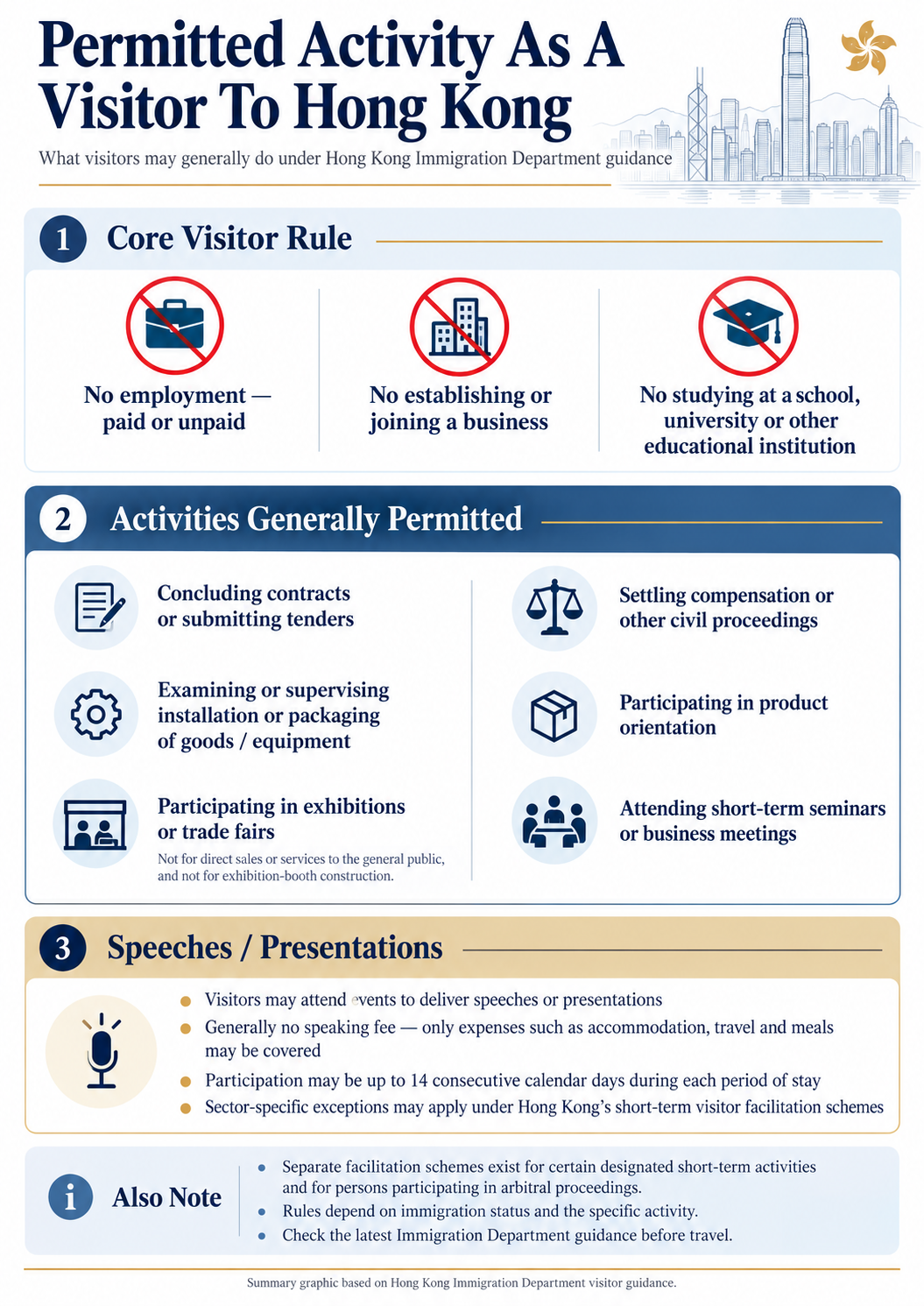
Under Hong Kong immigration law, the statutory boundary defining what an arriving foreign national can and cannot lawfully do is governed by strict departmental conditions of stay, where engaging in unauthorized economic activity triggers immediate criminal liability. In What Do The Immigration Department Say About Permitted Activity As A Visitor To Hong Kong?, Stephen Barnes, the Hong Kong Visa Geeza, examines the official guidance published by the Immigration Department regarding the precise scope of lawful conduct for visitor status holders.
Under Section 41 of the Immigration Ordinance, visitors are expressly prohibited from taking up employment (whether paid or unpaid), establishing or joining in any business, or enrolling as students in local educational institutions. The Immigration Department’s published doctrine clarifies that permissible activities are strictly confined to genuine tourism, visiting relatives and friends, and limited, non-productive commercial activities—such as concluding contracts or submitting tenders, examining or supervising goods/equipment, attending trade fairs or exhibitions, participating in short-term business negotiations, or attending high-level board meetings.
Stephen Barnes – The Hong Kong Visa Geeza
The moment an entrant crosses from passive commercial engagement into productive labor, hands-on technical service, operational oversight, or training local staff, they exceed their permitted conditions. Historically, this rigid statutory line created substantial operational friction for international corporations and professionals needing to perform discrete, short-term assignments without enduring the lengthy four-to-six-week process of securing a formal employment visa under the General Employment Policy. To explore how statutory policy has modernized to create structured, lawful channels for temporary specialist contributions without diluting baseline visitor prohibitions, Stephen Barnes provides the definitive analysis in Practice Update: The 2026 Immigration Facilitation Scheme – Short-Term Work for Visitors to Hong Kong.
The essential operational evolution detailed in the Practice Update is that the regularized and expanded Short-Term Visitor Facilitation Scheme—now encompassing 18 designated sectors as of 1 October 2026—provides an express, structured statutory carve-out from the traditional prohibition on visitor employment. Under this framework, qualifying non-local talent, researchers, artists, and industry specialists invited by one of roughly 490 government-endorsed host organisations can lawfully undertake specified professional activities—and receive remuneration or expense honorariums where approved—for up to 14 consecutive calendar days per visit without obtaining a conventional employment visa. However, as Stephen Barnes emphasizes across both publications, this facilitation scheme does not broaden general visitor permissions for ordinary travelers; it functions strictly as an institutional, pre-authorized exemption. An arriving visitor who lacks an official institutional invitation letter from an accredited host remains 100% subject to standard Immigration Department visitor restrictions. Foreign entrants and inviting organizations must maintain absolute clarity regarding permitted boundaries: unendorsed visitors must strictly restrict their activities to passive commercial exploration and social visits, while any active, short-term professional execution must either fit squarely within the 14-day statutory facilitation framework or be formally sanctioned under a standard employment visa.
The Italian Chamber of Commerce in Hong Kongrecently enquired of ImmD this very question and in July published their International Business Committee (IBC) Paper on “Immigration Arrangements for Entry for Visit and Employment in Hong Kong“.
How the Content Must Now Be Read in Light of the Updated QMAS (Quality Migrant Admission Scheme) Policy
In the seminar presentation and advisory resource found in Hong Kong Visas for Startups, Entrepreneurs & SMEs – Top Notch Talent (QMAS) Visa, the analysis examines how early-stage startup founders, solo entrepreneurs, and specialized SME operators can leverage QMAS to bypass the onerous capitalization hurdles associated with standard business investment visas. According to the Hong Kong Visa Geeza, Stephen Barnes, the scheme was historically presented to founders and innovators as a rare, sponsor-free pathway into Hong Kong’s startup ecosystem. However, under the legacy 225/245-point General Points Test, qualifying as “top-notch talent” remained notoriously unpredictable for early-stage entrepreneurs. Because the points matrix heavily rewarded conventional corporate seniority and traditional employment tenure at large enterprises, startup founders who held non-linear career paths were routinely trapped in the borderline 80-to-110 point range. Barnes cautioned that unless an entrepreneur possessed exceptional academic credentials or unique, patented technologies that resonated with the subjective priorities of the Advisory Committee, relying on QMAS as a startup entry route carried a significant risk of refusal.
Today, that startup strategy must be completely reassessed through the definitive legal benchmarks codified in our PRACTICE UPDATE: The Quality Migrant Admission Scheme Definitively Stated 2026-27 by Stephen D Barnes, which details the total elimination of the legacy points calculation following the comprehensive late 2024 overhaul. As stated by the Hong Kong Visa Geeza, Stephen Barnes, the revised 12 objective, binary assessment criteria provide a far more structured gateway for genuine startup innovators, while firmly closing the door on casual applicants. Under Criterion 12 (ownership of an active commercial enterprise with substantial turnover) and Criterion 9 (at least 3 years of specialist experience in designated Key Sectors such as Innovation & Technology or Fintech), tech founders with verifiable commercial traction can now qualify decisively alongside postgraduate STEM degree benchmarks (Criteria 2 and 3). Furthermore, the 2026–27 update emphasizes that the initial 3-year stay is only the launchpad: to survive the 3+3+2 extension gauntlet, founders must establish genuine operational roots, secure local office premises, hire resident staff, and document tangible fiscal contributions to the HKSAR.