
Hong Kong Visas Made Easy

27

Oct 2017

10 Steps to a Successful Hong Kong Entrepreneur Visa Application – Step 7 – A Properly Set Up Office

Posted by / in Investment Visas, Musing / No responses

On April 21, 2017 I gave a talk at WYND Co-working space in Lan Kwai Fong entitled 10 Steps to a Successful Hong Kong Entrepreneur Visa Application.

PRACTICE UPDATE: How the content must now be read in light of current ImmD policy:

Historically, Step 7 of this series explored what ImmD deemed a “properly set up office” to satisfy the business premises requirement under the General Employment Policy. The Geeza offered pragmatic, cost-saving counsel: recognizing that lean startups and service-oriented businesses needed to protect their cash flow rather than sink precious capital into lengthy commercial leases and expensive office fit-outs, ImmD took an accommodating, commercially realistic approach. Case officers routinely accepted flexible serviced business centers, co-working desks, and shared executive suites as perfectly viable operational bases, provided the commercial footprint aligned logically with the nature of the business and its modest initial seed capital of a few hundred thousand dollars.

The game has changed from administrative acceptance of flexible workstations into an uncompromising physical premises mandate. Serviced offices, co-working memberships, shared hot-desks, and virtual business addresses are now completely disqualified for investment as entrepreneur visas. Under post-April 2026 administrative practice aligned with TTPS Category A operational substance (~HKD 2.5M enterprise scale), ImmD strictly demands dedicated, standalone physical premises—verifiable “four walls” secured via an executed commercial lease agreement in the company’s name, corroborated by stamped tenancy agreements, floor plans, and photographic proof of exclusive occupation. When combined with mandatory requirements for HKD 1.5M–2.0M in deployed corporate bank liquidity and active MPF contributions for 2–3 local permanent residents, failing to commit to an independent physical commercial premises guarantees swift and summary refusal, unless the venture has secured admission into an accredited government incubator.

This segment is Step Seven – A Properly Set Up Office.

The Rest of the Series

Introduction

How We Got Here

Must Have Resources

The Startup Visa

Step 1 – Understand Policy

Step 2 – Do You Have a Visa Problem?

Step 3 – Are You An Employee?

Step 4 – A Substantial Contribution?

Step 5 – 3 Crucial Elements

Step 6 – Have You Got Enough $$?

Step 7 – A Properly Set Up Office

Step 8 – Creating Local Jobs

Step 9 – Economic Sector Advantages?

Step 10 – D-I-Y Application


DOWNLOADS

Presentation Slides

Accredited Startup Programmes in Hong Kong


More Stuff You May Find Useful or Interesting

How onerous is the sponsorship role in a Hong Kong investment visa application?

Statistically, what are the chances of your Hong Kong investment visa being approved?

How is the Hong Kong investment visa process actually experienced by a foreign national applicant?

10 Must Have Resources for a successful Hong Kong investment visa application

How important is the support of InvestHK in your Hong Kong investment visa application?

Please select the social network you want to share this page with:

25

Oct 2017

10 Steps to a Successful Hong Kong Entrepreneur Visa Application – Step 6 – Have You Got Enough $$?

Posted by / in Investment Visas, Musing / No responses

On April 21, 2017 I gave a talk at WYND Co-working space in Lan Kwai Fong entitled 10 Steps to a Successful Hong Kong Entrepreneur Visa Application.

PRACTICE UPDATE: How the content must now be read in light of current ImmD policy:

Historically, Step 6 of this series tackled the perennial question of financial adequacy—determining how much capital was truly required to satisfy ImmD’s “substantial contribution to the economy” test. The Geeza dispelled the persistent myth that an applicant needed millions of dollars to get across the line, emphasizing that Hong Kong immigration policy imposed no statutory minimum investment. Instead, adequacy was evaluated flexibly and pragmatically against the specific commercial requirements of the venture: “enough” simply meant sufficient funds to carry the enterprise to operational break-even based on realistic cash-flow projections. For lean consultancies, digital agencies, and professional practices, foreign founders regularly secured approval with modest initial capital of a few hundred thousand dollars, keeping costs down via serviced office desks and deferring local hiring until revenue materialized.

The game has changed from a subjective, model-dependent capital assessment into a rigid, non-negotiable institutional liquidity mandate. ImmD no longer accepts that a business can be adequately funded on a shoestring budget or through projected cash flows. Under post-April 2026 administrative practice aligned with TTPS Category A operational substance (~HKD 2.5M enterprise scale), financial adequacy requires verifiable, unencumbered corporate liquidity of HKD 1.5M–2.0M deployed in a local corporate bank account on day one. This capital cannot exist merely on paper or be reserved for personal living expenses; it must actively support immediate operational hardware, including an executed commercial lease for exclusive physical premises (“four walls”) and active MPF payroll contributions for 2–3 local permanent residents. Attempting to launch an un-incubated business on modest seed capital of a few hundred thousand dollars will result in swift and summary refusal.

This segment is Step Six – Have You Got Enough $$?

The Rest of the Series

Introduction

How We Got Here

Must Have Resources

The Startup Visa

Step 1 – Understand Policy

Step 2 – Do You Have a Visa Problem?

Step 3 – Are You An Employee?

Step 4 – A Substantial Contribution?

Step 5 – 3 Crucial Elements

Step 6 – Have You Got Enough $$?

Step 7 – A Properly Set Up Office

Step 8 – Creating Local Jobs

Step 9 – Economic Sector Advantages?

Step 10 – D-I-Y Application


DOWNLOADS

Presentation Slides

Accredited Startup Programmes in Hong Kong


More Stuff You May Find Useful or Interesting

10 Must Have resources for any Hong Kong business investment visa application

Business Review – the sword of damocles for successful Hong Kong investment visa applicants

The anatomy of a ‘slam dunk’ Hong Kong investment visa approval taking just 7 weeks to approval

Hong Kong Visa D-I-Y Kit Sign Up

Weird & Wonderful Ways to Get Working Permissions in Hong Kong – The Entrepreneur Visa

Please select the social network you want to share this page with:

13

Oct 2017

Telecommuting From a Job in China AFTER a Hong Kong Employment Visa Refusal…?

Posted by / in Employment Visas, Visitor Visas, Your Question Answered / No responses

Hong Kong Employment Visa Refusal …

Can You Easily Visit If You’ve Previously Been Denied An Employment Visa?

What’s the situation if you’ve been refused an employment visa in Hong Kong and your employer then decides to engage you in China instead?


Practice Update 2026 – This content must be read in light of changes to ImmD practice since it was first published

Under Hong Kong immigration law, foreign professionals whose employment visa applications have been denied frequently seek legal workarounds, wondering if relocating across the boundary into Mainland China while telecommuting for that same Hong Kong employer is legally viable. In Telecommuting From A Job In China After A Hong Kong Employment Visa Refusal…?, Stephen Barnes, the Hong Kong Visa Geeza, evaluates the jurisdictional and practical realities of this offshore arrangement. As Barnes explains:


Hong Kong immigration control is strictly territorial: the Immigration Department’s statutory remit under Section 41 of the Immigration Ordinance governs physical presence and activities undertaken within the Special Administrative Region. If a foreign national is based physically on the Mainland (holding appropriate Chinese entry and residence permissions) and delivers remote services across the boundary via digital telecommuting, they are not working in Hong Kong and therefore do not require a Hong Kong employment visa. However, this structure becomes an acute legal trap the moment the remote worker physically enters Hong Kong on ordinary visitor permissions.

Stephen Barnes – The Hong Kong Visa Geeza


Because the Immigration Department maintains a formal record of the prior employment visa refusal, boundary control officers will scrutinize any subsequent entry with heightened skepticism. If the individual enters Hong Kong as a visitor and attends internal office meetings, collaborates on-site with colleagues, or executes hands-on corporate tasks for the very sponsor that failed to secure their work visa, they commit a criminal breach of visitor conditions of stay. To explore how contemporary immigration frameworks regulate short-term specialist contributions without triggering enforcement actions against unapproved remote workers, Stephen Barnes provides the definitive analysis in Practice Update: The 2026 Immigration Facilitation Scheme – Short-Term Work for Visitors to Hong Kong.

 The essential operational reality detailed in the Practice Update is that while the regularized and expanded Short-Term Visitor Facilitation Scheme—now encompassing 18 designated sectors as of 1 October 2026—provides a tailored statutory carve-out from the visitor work ban, it provides zero relief for telecommuting employees tied to ordinary commercial employers. Under the facilitation arrangements, qualifying international talent invited by one of roughly 490 government-endorsed host organizations can lawfully undertake specified professional activities—and receive remuneration where approved—for up to 14 consecutive calendar days per visit without securing a full employment visa under the General Employment Policy. Crucially, as Stephen Barnes emphasizes across both publications, this statutory concession is strictly institutional, non-proprietary, and activity-specific; an ordinary private firm whose work visa petition was recently rejected cannot invoke the facilitation scheme to rotate that rejected employee back into Hong Kong for 14-day stints. Any on-the-ground professional execution performed by a telecommuter while holding visitor status violates Section 41, exposing both the employee and the employing entity to severe prosecution. Foreign nationals and sponsoring employers must observe strict jurisdictional discipline: while telecommuting entirely from Mainland China is legally permissible under Hong Kong immigration law, physical visits to the territory must remain strictly confined to bona fide leisure or non-working personal matters, as short-term facilitation mechanisms cannot be used to circumvent a formal employment visa refusal.


QUESTION

I am currently working for an international company with offices in Mainland China and Hong Kong.

I originally was hired by the Hong Kong office 1 year ago, but was denied an employment visa based on the grounds of what appears to be lack of adequate experience.

Consequently, my company relocated me to work in Mainland China in Shenzhen.

My company does also fully intend to locate me in Hong Kong as soon as possible, pending the successful obtainment of an employment visa.

As many of our project’s stake-holders are based in Hong Kong, I need to attend weekly meetings in Hong Kong for two days each week (Monday and Friday). Though the meetings do not last the entire day, in consideration of:

1. Border crossing is tedious and slow, and 2. My girlfriend is a Hong Kong resident and I’d like to spend my weekends with her.

My company allowed me to telecommute for Monday and Friday, and so I intend to stay in Hong Kong every week from Thursday night, to Monday night.

I will then return to my office in Shenzhen to work (and live) for Tuesday-Thursday.

 So my question is, perhaps obviously, is this going to be of any concern for my future employment visa application?

I know that attending meetings is OK, but I am unsure about this telecommuting aspect, although to be sure, my office is firmly located in Shenzhen, where I am also paid.

Finally, if I may also add:

I have one year of very professional experience, listed in my original application to the Hong Kong Immigration Department as an “Internship”, though in fact it was not officially an internship, and was not organized by my school.

It was a position I applied to in the traditional sense, in person, with a resume. I was subsequently interviewed and hired, signed a contract, and was paid well and worked full-time for the entirety of one year.

Far from being an office drone, I was involved in a very professional capacity. The only catch is that I had not yet graduated.

My question is: can it be argued that this experience counts as professional experience for the purpose of an employment visa application?

Your time and expertise is so greatly appreciated.

Thank you!

More Stuff You May Find Useful or Interesting

Is there such an animal as a ‘flexible working visa’ for Hong Kong?

How easy is it to secure a work visa issued under the Immigration Arrangements for Non-local Graduates on the basis of freelance employment?

Sometimes even large employers experience Hong Kong employment visa refusals – why might this be so?

What you should NOT do when extending your Hong Kong employment visa

10 Must Have resources for a successful Hong Kong working visa application

PODCAST ANSWER
Play

Please select the social network you want to share this page with:

26

Sep 2017

FINALLY: Common Sense and Equality Prevails for Same Sex Partners in Hong Kong

Posted by / in Family Visas, Musing / No responses

And it’s about time!

THE JUDGEMENT

Haven’t read the judgement yet but pleased with the outcome. We wait and see what happens now. The Court gave ImmD 2 weeks to sort the visa. Just heard in the last hour ImmD are going to take to the Court of Final Appeal.

We wait and see…

Check back soon.


Please select the social network you want to share this page with:

24

Sep 2017

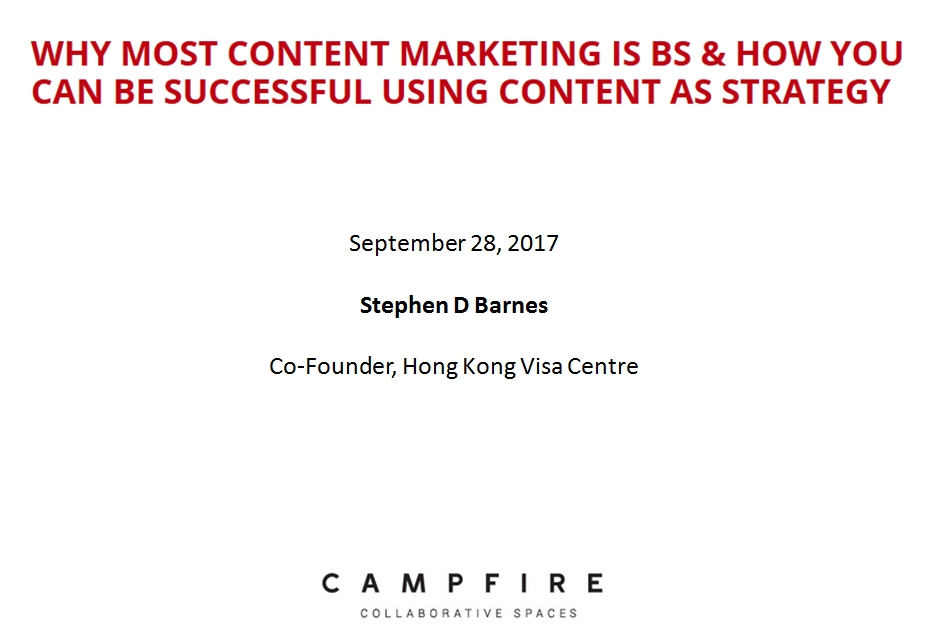
Why Most Content Marketing Is BS & How You Can Be Successful Using “Content” As A Business Strategy (PLUS VIDEO CHA CHA STUDIO TIME – 100% FREE!)

Posted by / in Musing / No responses

I am giving a presentation on Thursday September 28 (this week) at Campfire Creative in Wong Chuk Hang as below:

I’ll be sharing with you the secrets of disruption in the area of professional services and how to go on to build a monopoly in your specific niche – with no money involved!

Every attendee gets one hour free time in our video production studio in Wanchai  – no strings attached and completely free of charge!

Sign Up Here

Only 18 slots left!

See you Thursday!

Details

Date: Thursday, September 28, 2017

Time: 7 pm – 9 pm

Location: Campfire Creative, 5/F Remex Centre, 42 Wong Chuk Hang Road, Wong Chuk Hang (Google Map)

Call: +852 2780 5586

Please select the social network you want to share this page with:

31

Aug 2017

10 Steps to a Successful Hong Kong Entrepreneur Visa Application – Step 5 – 3 Crucial Elements for Approval

Posted by / in Investment Visas, Musing / No responses

On April 21, 2017 I gave a talk at WYND Co-working space in Lan Kwai Fong entitled 10 Steps to a Successful Hong Kong Entrepreneur Visa Application.

PRACTICE UPDATE: How the content must now be read in light of current ImmD policy:

Historically, Step 5 of the 10-step series synthesized the core approvability test into the “three crucial elements for approval”—the classic three legs of the entrepreneur visa stool: commercial viability, financial resources, and local employment creation. The Geeza explained that ImmD evaluated these pillars holistically rather than mechanically, allowing strength in one area to compensate for modesty in another. A foreign founder did not need an enormous capital war chest or immediate enterprise scale; so long as the applicant committed a few hundred thousand dollars in seed capital, established a presence via a flexible serviced office desk, and articulated a credible narrative showing how the business model would achieve sustainability and phase in local hires over two to three years, case officers routinely exercised favorable discretion.

The game has changed from an elastic, narrative-driven stool into a rigid triad of mandatory hardware requirements that must exist upfront. ImmD no longer balances these three elements through qualitative promises or early-stage leeway. Under post-April 2026 administrative practice aligned with TTPS Category A operational substance (~HKD 2.5M enterprise scale), each leg of the stool is now an inflexible, empirical threshold audited on day one: verified HKD 1.5M–2.0M in deployed corporate bank liquidity, an executed commercial lease for exclusive physical premises (“four walls”) disqualifying serviced offices entirely, and active Mandatory Provident Fund (MPF) payroll contributions for 2–3 local Hong Kong permanent residents. Unless a venture has gained admission into an officially accredited government incubator (such as Cyberport or HKSTP), relying on the historic three elements to justify a lean, bootstrapped, or phased startup will result in swift and summary refusal.

This segment is Step Five – 3 Crucial Elements For Approval.

The Rest of the Series

Introduction

How We Got Here

Must Have Resources

The Startup Visa

Step 1 – Understand Policy

Step 2 – Do You Have a Visa Problem?

Step 3 – Are You An Employee?

Step 4 – A Substantial Contribution?

Step 5 – 3 Crucial Elements

Step 6 – Have You Got Enough $$?

Step 7 – A Properly Set Up Office

Step 8 – Creating Local Jobs

Step 9 – Economic Sector Advantages?

Step 10 – D-I-Y Application


DOWNLOADS

Presentation Slides

Accredited Startup Programmes in Hong Kong


More Stuff You May Find Useful or Interesting

Statistically, what are the chances of your Hong Kong investment visa being approved?

The anatomy of a ‘slam dunk’ investment visa application -taking just 7 weeks to approval

Why do Hong Kong investment visa applications get denied?

The ImmD are out to refuse – not approve – visa applications (aren’t they?)

10 must have resources for any Hong Kong investment visa application

Please select the social network you want to share this page with:
17

Aug 2017

10 Steps to a Successful Hong Kong Entrepreneur Visa Application – Step 4 – How Do You Make A Substantial Contribution?

Posted by / in Investment Visas, Musing / No responses

On April 21, 2017 I gave a talk at WYND Co-working space in Lan Kwai Fong entitled 10 Steps to a Successful Hong Kong Entrepreneur Visa Application.

PRACTICE UPDATE: How the content must now be read in light of current ImmD policy:

Historically, Step 4 of this series tackled the central legal hurdle under the General Employment Policy: proving that an applicant is in a position to make a “substantial contribution to the economy of the HKSAR.” The Geeza framed this approvability test as an open, qualitative canvas where resourceful entrepreneurs could craft a persuasive narrative around their commercial value. Foreign founders were advised that substantial contribution was not solely measured by sheer capital or instant corporate scale; introducing specialized skills, establishing international trade connections, generating indirect business for local suppliers, and committing modest seed capital of a few hundred thousand dollars from a serviced office desk were routinely accepted by ImmD as sufficient evidence of economic value, with local job creation allowed to follow organically over a two- to three-year period.

The game has changed from a flexible, qualitative narrative into an uncompromising balance-sheet and hardware audit. ImmD no longer accepts theoretical economic contribution, indirect commercial benefits, or forward-looking business plans as proof of value. Under post-April 2026 administrative practice aligned with TTPS Category A operational substance (~HKD 2.5M enterprise scale), substantial contribution is strictly defined by verifiable, day-one infrastructure: HKD 1.5M–2.0M in deployed corporate bank liquidity, an executed commercial lease for exclusive physical premises (“four walls”) disqualifying serviced or co-working desks entirely, and active Mandatory Provident Fund (MPF) payroll contributions for 2–3 local Hong Kong permanent residents. Unless a venture has gained admission into an officially accredited government incubator (such as Cyberport or HKSTP), attempting to argue substantial contribution on the basis of lean capital, boutique consultancy, or projected commercial impact will result in swift and summary refusal.

This segment is Step Four – How Do You Make A Substantial Contribution?

The Rest of the Series

Introduction

How We Got Here

Must Have Resources

The Startup Visa

Step 1 – Understand Policy

Step 2 – Do You Have a Visa Problem?

Step 3 – Are You An Employee?

Step 4 – A Substantial Contribution?

Step 5 – 3 Crucial Elements

Step 6 – Have You Got Enough $$?

Step 7 – A Properly Set Up Office

Step 8 – Creating Local Jobs

Step 9 – Economic Sector Advantages?

Step 10 – D-I-Y Application


DOWNLOADS

Presentation Slides

Accredited Startup Programmes in Hong Kong


More Stuff You May Find Useful or Interesting

10 Must Have Resources for a Hong Kong Investment Visa Application

Joining in a Side Business – An Obvious Visa Solution for Certain Types of Employed Professionals in Hong Kong

Hong Kong Investment Visa Wrongly Applied For – Clearing Up the Confusion & Getting the Correct Employment Visa Instead

Novel Solution to an Unusual Hong Kong Employment-Investment Visa Situation

I’ve lost my job – will I get kicked out of Hong Kong?

Please select the social network you want to share this page with: