The Hong Kong Immigration Department’s ROP 145 application form is used for the “Application for Verification of Eligibility for Permanent Identity Card.”
What Is It?
This ROP145 application form is intended for individuals who wish to verify their eligibility for a Hong Kong Permanent Identity Card.
The form is a part of the process of establishing one’s right of abode in Hong Kong, typically after having resided in Hong Kong for a continuous period of not less than seven years.
Why Should You Care?
If you’re a long-stay foreign national resident of Hong Kong and seeking to change your immigration status to permanent residency you will therefore have to complete the ROP145 application form.
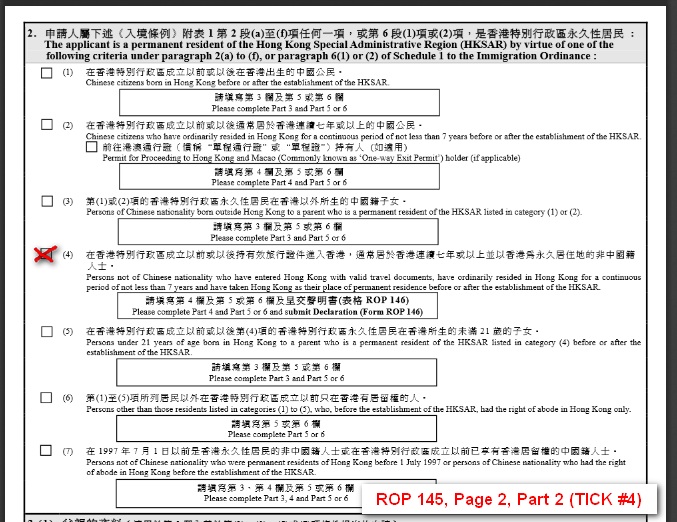
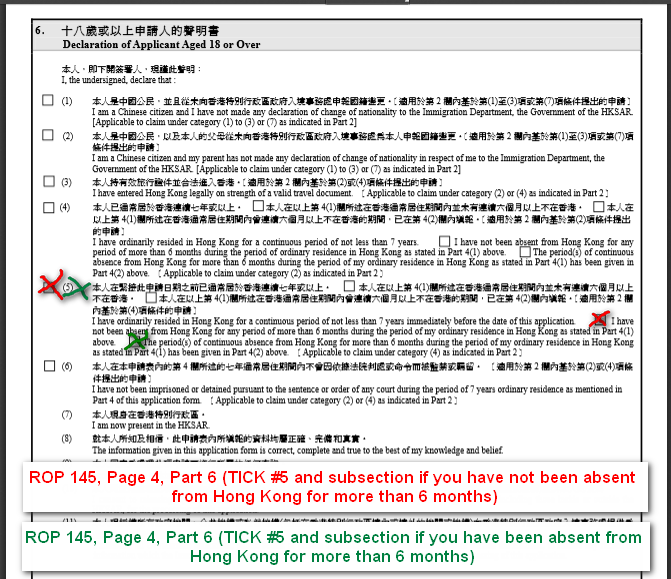
There is a lot of confusion on pages 2 and 4 about which section to tick.
As you are not a Chinese national and you have been continuously resident in Hong Kong for a minimum of 7 years, this is for you. On the ROP145 application form page 2, your claim for permanent residency is based on criteria 4.
A Comprehensive Guide to Obtaining a Hong Kong EmploymentVisa
Are you a non-resident looking to apply for an employment visa in Hong Kong? Navigating the complexities of the General Employment Policy (GEP) can be challenging, but with the right information and preparation, you can successfully secure your Hong Kong Employment (Entry) Visa.
Understanding the Hong Kong Employment Visa Requirements
Educational and Professional Background: A bachelor’s degree and at least two years of post-graduation work experience in a managerial or supervisory role are typically required. However, the Immigration Department may consider applicants with significant technical qualifications and relevant work experience.
Unique Skills and Knowledge:Applicants must possess special skills, knowledge, or experience that are valuable in Hong Kong and not readily available in the local workforce.
Character and Compensation:Good character is essential, and the compensation package must be in line with market rates, including income, accommodation, medical, and other benefits.
Credible Employment Visa Sponsor: The employing company must be established in Hong Kong, with a proper office setup and local employees.
Application Process for a Hong Kong Employment Visa
The application process generally takes 4-6 weeks and involves several steps:
1. Submission of Documents: Required documents include application forms (ID990A for the applicant, ID990B for the employer), marriage and birth certificates for dependents, recent photographs, passport details, CV, academic qualifications, employment references, and company-related documents.
2. Approvability Test:Demonstrate that your skills and experience are valuable to Hong Kong and that your employer justifies hiring an expatriate.
3. Category-Specific Requirements: Whether you are an intra-company transferee, a locally recruited expat, or a non-local expat recruited from overseas, your application must be tailored to meet specific criteria.
Tips for a Successful Hong Kong Employment Visa Application
Prepare a Strong Case:Articulate your unique skills and how they align with the job offer. Ensure that your application addresses the need for your role in Hong Kong and that the job cannot be readily filled by the local workforce.
Understand the Timeline: Be prepared for a processing time of 4-6 weeks, with possible additional time for complex cases.
Respond Promptly to Requests:The Immigration Department may ask for further information. Responding promptly and thoroughly is crucial.
Securing a Hong Kong Employment Visa requires careful preparation and a thorough understanding of the requirements. By focusing on the unique skills and experiences you bring to Hong Kong and ensuring all documentation is correctly prepared and presented, you can enhance your chances of a successful application.
VisaGeeza.Ai – Making Hong Kong Immigration A Lot Easier
What Kind of Visa Can We Get So My FDH Girlfriend (Contract Terminated) Can Stay With Me in Hong Kong?
Any possibility for love to continue in the wake of a terminated FDH contract?
QUESTION
My girl friend is a Filipino domestic helper who has just left her employment with a Chinese family – however, she wants to stay in Hong Kong with me.
Can you advise me on how this might be achieved?
ANSWER
Today’s question is a really good one, it goes to the heart of how a couple that are here together are about to be separated as a result of the immigration status change for a foreign domestic helper.
When the employment of a foreign domestic helper in Hong Kong comes to an end by operation of law their immigration status switches from foreign domestic helper visa through to a two-week automatic visitor visa and at the end of those two weeks they are expected to leave Hong Kong unless in the intervening period they’re able to source and alternate employer and procure assigned employment contract, then a foreign domestic helper can then take that down to the Immigration Department, begin the processes of the foreign domestic helper visa a contract under the new sponsor and the Immigration Department allow the foreign domestic helper to remain Hong Kong a few short weeks for that process complete itself.
So in this situation where a foreign domestic helper no longer has an employer but is in a relationship with somebody in Hong Kong who is a resident and they’re trying to create the circumstances where they can remain together here, there are very limited options all things considered.
The mere fact of being in a relationship with the Hong Kong resident in of itself doesn’t give the foreign domestic helper any opportunities to continue to stay in Hong Kong on the extended visitor visa permissions.
So, over the long haul what’s going to be needed is some kind of other residential status that could be suitable for her in her circumstances. But a close analysis of the various visa types that are on offer suggests that the pickings are not going to be particularly rich.
So, the first thing that she could do would be to obviously leave Hong Kong, go through the process of being accepted into a Hong Kong University for a degree level type course and at that point she’ll be able to get a student visa, assuming that she can show that she’s got the resources to be able to finance herself during the currency of her studies and that will then give her effectively student visa permission, she will to be able to live, and your relationship will be able to continue.
If she were some kind of Nobel laureate or had won some kind of a prize or medal in the Olympics for the Philippines, then possibly she could make an application for the Quality Migrant Admission Schemebut again that just seemed a little bit ludicrous given that she’s here as a foreign domestic helper.
So, I suspect that that opportunity for her is not available. It’s very difficult to expect that she’ll be able to procure a job offer outside of providing foreign domestic helper services because in a sense, once she secured her first foreign domestic helper visa, she disclosed to the Immigration Department what her background is.
And normally, if you’ve been a foreign domestic helper, it’s extremely difficult to go on and argue for the purposes of an employment visa application, subsequently, you’re professional under the general employment policy. So arguably, that’s not going to work.
So, it’s very difficult to suggest that there’s anything that you can really do in these circumstances. One thing that I would strongly recommend against is the temptation to potentially putting your name forward as her partner to be your foreign domestic helper, you may be able to pull the wool over the eyes of the Immigration Department in this regard, but it certainly won’t make it lawful and I would strongly recommend that you don’t embark down that path.
So, I’m sorry the news isn’t great but that’s kind of, really about the shape of it I’m afraid.
If I Live and Work in China But Have a Hong Kong Employment Visa Can I Get Dependant Visas for My Family?
To live in Hong Kong requires a place to lay your head here each night. What happens to your application for dependant visas for your family if you don’t have anywhere for them to live?
QUESTION
I have held a Hong Kong employment visa for the last 3 years.
But most of the time I work in Shenzhen, China.
I am here with my family but I am thinking about moving them to Hong Kong finally for good education and other reasons etc.
Now I want to apply dependant visas for my family: my wife and two kids .
But I do not have tenancy lease agreement to show residence proof .
Please advise!
ANSWER
The very Bottom line to this question is that in order to get dependent visas for your family to come and live in Hong Kong you need to be able to show that you can put food on their table and a roof over their head.
Now the fact that you have an employment and an employment visa – that will be sufficient for you to be able to show the Immigration Department that you can put food on their table, a roof over their head is mission critical.
And the problem that you’re facing is that because you presently have an employment visa the expectation is that right now you are a resident in Hong Kong because usually, the Immigration Department will not afford resident visas to people who are actually working in China because you need a visa to work in China, not in Hong Kong.
However, you know, they’re cognizant of the fact that a lot of traveling goes on across the border. So in the main, they typically don’t second guess what the residential arrangements are if you’ve got a good Hong Kong employer and your employment in Hong Kong continues.
But in so far as making an application for a dependent visa goes, as an existing resident, and certainly having been here for three years, at the point of making your application for the dependent visa you will need to show that you have got accommodation for your family.
So, in order to facilitate dependent visa applications, my advice is: get to Hong Kong, rent a place, once you’ve got a tenancy agreement, submit your applications for the defendant visas, I think you’ll find that they will be granted to you without too many problems, but you are going to need to have a tenancy agreement for sure.
We have been contacted a lot recently by applicants who’s cases have been refused – so this question is both timely and, for all those affected, of great significance.
QUESTION
“I would like to know if, once I have received the first rejection letter from an Officer of the HKID for my employment visa application, I can either:
i) file Reconsideration and if still rejected,
ii) then file S53 Review, or
iii) make direct application to the Chief Executive after second rejection?”
ANSWER
When an Employment Visa has been refused, the letter, which the applicant receives indicates that the employment visa application was not approved as the Immigration Department were not satisfied that the person possessed special skills, knowledge or experience or value to and not readily available in Hong Kong and in all the circumstances of case the employer is justified engaging the services of an expatriate rather than the services of a local person and this leaves it very difficult to try and interpret exactly what might be wrong with a case and thereby putting together another set of information to have another run at the application by way of an appeals process called a case reconsideration.
To successfully argue a case reconsideration, you basically need to have significant additional new information, which had weight to the original application or other relevant and important new facts which have come to light since the refusal with comprehensive verifying documentation supply then to support it. So that process in many ways is like another employment visa application.
The officer will review it and then his colleagues will review it and then a determination from supervisory level staff and managerial staff will be laid down to ensure that in fact the original decision was the correct decision and that any new and previously unsubmitted information, which has been supplied doesn’t add the necessary weight to coarse the Immigration Department to switch from one decision to the decision of approval.
That’s a process that usually plays itself out over the course of between two and sometimes twelve weeks. If the reconsideration is refused then really your options are starting to get a little bit limited in a practical sense. In your question you mentioned the issue of section 53 review of the immigration ordinance. This is a procedure that’s not very often used these days because whilst the review procedure is ongoing, the applicant is not allowed to be in Hong Kong as a visitor.
So, because it can take between 6 and 12 months for a review process to be completely finalized most people who’ve been denied employment visas and haven’t been successful in reconsideration don’t get, don’t travel down that path because it simply just takes too long to be anything close to practical.
Additionally, making an application for direct intervention of the chief executive is an appeal maneuver that is not recommended in the average sort of run-of-the-mill case as it were and because you haven’t provided any information as to what the nature of the case is or allowed us to understand a little bit more about how we might be able to make this advice more tailored to you. It would seem unlikely given the volume of instances that we have made an application for the intervention of the chief executive but in your instance, it may probably not be a relevant or indeed an appropriate channel or path to follow. So, in many ways, even direct intervention requests of the year – for executive isn’t a particularly practical solution to your dilemma.
As I say only in the case where this is a significant matter of public interest involved would you want to follow that route. So, those are the array of the options you’ve got available to you. Your first point of cause without doubt reconsideration and then if you refused on the reconsideration and it’s becoming really apparent to you that they are making the wrong decision you could potentially submit another reconsideration with again further new and previously unsubmitted information that would allow the Immigration Department to take another look at it but in a very practical sense by the time that process is played itself out, its arguable that you don’t really have anywhere else to go and the appeals process is not going to work for you unless of course you genuinely believe that your employment is a matter of growing public interest so that the Immigration Department should be redirected by the chief executive to have a better and closer look at it but it would seem to be unusual.
Currently I am on an IANG visa which has been sponsored by my current employer.
I would like to know that shortly after the IANG visa has been granted (say few days or weeks after the approval), can I change my job or leave my job for whatever reason and start my own freelance consulting?
Is it really something permissible in the eyes of the immigration?
My second question is linked with my first one.
Let’s say if I leave my job and after leaving my job I cross the seven-year mark, what impact would this have on my Right of Abode application?
I would really appreciate your help on this matter.
Thanks a lot.
ANSWER
To maintain your immigration status under the Immigration arrangements for non-local graduates, each time you present yourself for an extension of stay you need to have a valid employer, and you need to be able to demonstrate to the Immigration Department that you’re being paid a compensation that’s broadly commensurate with market rates and that you are engaged in work that related in some way to your education and background and moreover the sponsoring employer needs to be suitable and credible all things considered.
So, you can essentially get yourself an extension on the immigration arrangements for non-local graduate’s sponsored by a current employer, and then you could seize working for that current employer and then conceptually you could start to engage in your own freelance activities.
Whether or not the Immigration Department would deem your freelance activities to be sufficiently suitable at the time that your next IANG application came up for consideration is another matter again because Immigration Department in those circumstances expect you to have established a sizable business, which for all practical purposes means you need to pass the approvability test to show that you can make a substantial contribution to the economy of Hong Kong, and in that regard I would suggest that you read the information on our websites about the business investment visa, because it’s no small challenge to be able to secure an ongoing sponsorship in Hong Kong on the basis of your own in a sense freelance activities.
So that answers the 1st part of your question and in so far as the 2nd part of your question goes, let’s set the scene for example, let’s say that you’ve been here under continuous residence visa permissions for 6 and a half years, and that your current IANG visa has just recently been extended and you’ve secured a one year limit of Stay, which is then going to take you conceptually to a full 7 and a half years’ worth of continuous ordinary residence in Hong Kong holding back to back residence visas throughout all of this time.
So, at the point of 7 years of course you can make your application for the right of abode, and at that point you have to show that you have been continuously and ordinarily resident in Hong Kong for those 7 years. There is no inquiry as to what you’re doing in relation to your existing employment. The Immigration Department would want to see that you do have a valid period of stay under employment status and they will typically not look for confirmation as to how you’re gainfully spending your time under your 12 months of immigration arrangement for non-local graduates. Therefore conceptually, it might be that you can get to 7 years by having extended your immigration arrangements for non-local graduates visa, and then gone off from freelance a few months before making the right of abode application, because at the time that you get your right to abode application approved, all conditions are lifted as to your continuing residence in Hong Kong, you would then typically not be called to account for any time that you spent under immigration arrangements for local graduates while you were freelancing as such.
So, that’s the, that’s the upshot of it and I hope you found it useful.
How Can I Prove To The Hong Kong Immigration Department My Last Day Of Work For My Previous Employer As Part Of My Change of Employment Visa Sponsorship Application?
First Published July 29, 2013 – Still Relevant
The Immigration Department need documentation to understand when to demarcate new from old sponsorship arrangements when changing employers and the million dollar question is……. what will suffice?
QUESTION
I have a sponsored visa from my current employer until November 2014.
I am now wanting to leave this company and start work for a new employer as of October 2013 .
I need obviously to inform the Immigration Department of a change of sponsor and get the visa updated to reflect the new sponsor.
My employer says he will not issue me a release letter which he claims that I will need to be accepted onto a new visa. He says if I stay until Jan 2014 he will issue the letter then.
This sounds like he is trying to bully me to stay.
I have three questions:
(a) Do I really need this release letter signed by my current employer to change sponsorship?
Or would immigration be happy to take a letter from me saying my contract has being terminated and I am no longer employed in Hong Kong.
(b) If I do need it can he legally refuse to provide it if the contract is terminated and all penalties etc are settled as per contract.
(c) Thirdly if he is obliged to provide it how can I ensure he does this in a timely manner?