Hong Kong Visas Made Easy

19

Jan 2015

Please select the social network you want to share this page with:

17

Jan 2015

Hong Kong Immigration Policy Changes 2015 – Security Bureau Report to Legco – Rationale for the New Measures

Posted by / in Musing, VG Front Page / 4 responses

More information on the Hong Kong Immigration Policy Changes 2015  front is starting to emerge.

New Measures

LEGCO PAPER  LC Paper No. CB(2)654/14-15(05) c  elaborates on the Security Bureau’s initiatives in the 2015 Policy Address and Policy Agenda.

The Annex is especially helpful on the rationale for the changes being introduced and I’m starting to get the sense that it’s going to be hereafter business as usual down at Immigration Tower after all.

By this I mean these changes are going to have the right effect in not needing to worry about limits of stay and providing some transparency into what will suffice for an entrepreneur or Startup business investment visa approval.

But ImmD are looking for talent and smart business investors bringing new technologies and skills. The detail in the story is going to be very important and your documentation and argument will have to be of the highest order.

ImmD want the attract the best and you will for sure have to earn your approval. If you’re worthy of it, it will undoubtedly be yours, but you will have to go about it in fully focused way.

Heck, Startups who can finagle a way into one of the government backed incubator programmes such as InvestHK’s StartmeupHK and Cyberport’s Incubation Programme are essentially home and hosed even if they have glaring shortcomings as business investors under the Entrepreneur stream (as newly defined).

This is the first time I’ve seen ImmD (in a sense) outsource their ‘entrepreneur’ due diligence to sister organisations and to me is a clear signal that the times they-are-a-changing.

It’s exciting times in Hong Kong visa and immigration land at the moment and it’s keeping us all on our toes!

More updates and commentary coming soon.

More Stuff You May Find Useful or Interesting

Paying for Visa Help? The Who’s-Who of the Hong Kong Immigration Services Industry

100% Hong Kong Visa Application Success Rate? Take It All With a Pinch of Salt

The Visa Geeza on RTHK Radio Three

Sign Up for the 100% Free Hong Kong Visa Extension Kit

Sign Up for the 100% Free Hong Kong Visa D-I-Y Kit

Please select the social network you want to share this page with:

16

Jan 2015

Hong Kong Immigration Policy Changes – Enhancement Measures to Make Things a Bit Easier

Posted by / in Employment Visas, Investment Visas, Musing, Special Programmes, VG Front Page / No responses

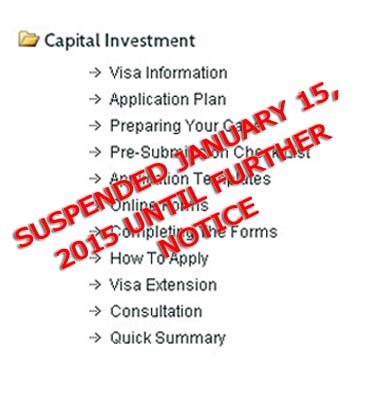
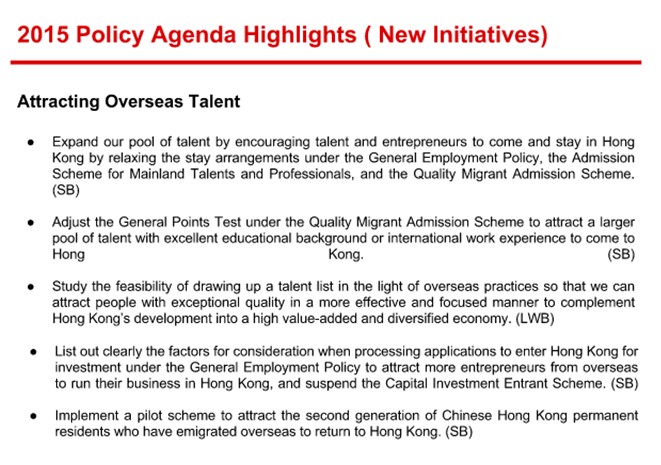
Now that the dust has settled on the news of the suspension of the Capital Investment Entrant Scheme as at yesterday, it’s now worth having a look at additional Hong Kong immigration policy changes which await us and serve to lay the foundation for the next phase in Hong Kong’s economic development.
policy chnages

PRACTICE UPDATE: How the content must now be read in light of current ImmD policy:

Historically, this policy forecasting piece tracked the rollout and prospective implications of the HKSAR Government’s major immigration policy adjustments announced around early 2015, which formally came into effect in May of that year. The Geeza analyzed the structural shifts introduced at the time: the suspension of the Capital Investment Entrant Scheme (CIES), the relaxation of stay patterns for the General Employment Policy (GEP) and Admission Scheme for Mainland Talents and Professionals (ASMTP) from the old 1-2-2-3 year pattern to 2-3-3 years (alongside the introduction of a 6-year top-tier extension for high-earning professionals making at least HKD 2M), the introduction of pilot admission initiatives for the second generation of Chinese Hong Kong permanent residents (ASSG), and the original launch of the startup enhancement measures designed to recognize government-backed incubators under the entrepreneur stream. In that era, the policy trajectory was characterized by liberalized stay permissions, procedural facilitation, and administrative pragmatism: ImmD remained an accommodating, discretionary department that welcomed foreign commercial initiative, approving independent entrepreneurs with modest seed capital of a few hundred thousand dollars, flexible desks in serviced offices or co-working spaces, and phased promises to create local jobs over a multi-year horizon.

The game has changed from an era of gradual administrative liberalization into a massive, multi-wave institutional overhaul that has completely rewritten Hong Kong’s talent and business entry landscape. Since that 2015 baseline, the regulatory architecture has undergone profound adjustments across every major entry stream.

First, the talent landscape was transformed by the launch of the Technology Talent Admission Scheme (TTAS) in 2018, followed by the landmark December 2022 rollout of the Top Talent Pass Scheme (TTPS), which introduced Category A (earning at least HKD 2.5M in the prior year) and Categories B and C (graduates from world top 100 universities), alongside the suspension of annual quotas under the Quality Migrant Admission Scheme (QMAS) and subsequent comprehensive revamps of the QMAS scoring mechanism to prioritize strategic national and regional industries. In March 2024, the government formally reintroduced investment immigration through the New Capital Investment Entrant Scheme (New CIES), setting a strict HKD 30M asset threshold that firmly separated passive high-net-worth residency from active commercial operations.

Crucially, the regulatory spillover from the massive influx of TTPS and talent entrants precipitated an aggressive tightening across all business entry mechanisms. TTPS renewals and Category A requirements established an operational precedent: holding a company or claiming self-employed status in Hong Kong could no longer rest on passive registrations, shell entities, or paper turnover. This culminated in the post-April 2026 administrative practice, where ImmD formally aligned the adjudication of Investment as Entrepreneur applications with the empirical rigor of TTPS Category A operational substance (~HKD 2.5M enterprise scale). The discretionary leniency that defined the 2015 policy era has been entirely eradicated for un-incubated applicants.

Today, independent foreign founders seeking an entrepreneur visa outside the state-backed innovation ecosystem face an unbending empirical compliance audit audited on day one: HKD 1.5M–2.0M in deployed corporate bank liquidity sitting in a local bank account, an executed commercial lease for exclusive physical premises (“four walls”) that strictly disqualifies serviced offices, virtual addresses, and co-working spaces, and active Mandatory Provident Fund (MPF) payroll contributions for 2–3 local Hong Kong permanent residents. The 2015 startup enhancement measures, which were once viewed merely as an optional perk, have evolved into the sole surviving statutory safe harbor: formal, documented admission into an officially accredited government incubator (such as Cyberport, HKSTP, or the Design Incubation Programme) is now the only lawful mechanism that waives these crushing hardware mandates. For any early-stage entrepreneur lacking enterprise-grade capital and institutional incubation backing, relying on the flexible policy spirit of 2015 guarantees swift and summary refusal.

The Immigration Department have already released some Sherpa-Information as to how these policy changes will be implemented. These can be found here

Essentially, the current programmes are to be subjected to Enhancement Measures to make things a bit easier all told. A lot of these changes to my mind make it easier for ImmD to do their own job never mind for the applicant – and why not!

My Take

1 – ImmD are going to lighten up on the approval criteria for approval seeking to bring in the brightest and best. Given that the privileges associated with residence in Hong Kong are so great, I expect the personal criteria for approval will be made easier but the onus on the applicant to prove they are among the brightest and the best will be made more burdensome. In short visas for people previously excluded more likely available but harder work where marginal documentation / evidence available. Moreover, if you have earnings of more than HKD2 million per year you are going to get a 6 year limit of stay after your first visa or otherwise a 2 + 3 + 3 year visa. If you earn more than HKD2 million each year, you don’t have to get the permission of the Immigration Department to change employers; you just have to write and notify them.

2 – The Quality Migrant Admission Scheme is going to be a greater source of candidates for foreigners to take up residence in Hong Kong with more points going to graduates of a Top 100 education institute globally. Whether the system of implementing  QMAS changes or not remains to be seen. If it is still a black box with a 12-18 month application consideration time frame then it’s not going to be much use to the average applicant.

3 – ImmD are likely going to introduce an Occupations in Demand list where an individual who clearly has the skills, knowledge, qualifications and experience in a particular occupation or professional will secure an IANG type visa upon application.

4 – More transparency on what it takes to get a business investment visa approved. ImmD are not going to just give visas away but the likelihood of a successful outcome is definitely enhanced if you have an understanding of what it takes to get approved! Expect, however, that the money requirement for approval might become more onerous for marginal applicants. If you can get yourself enrolled on an incubator type programme with InvestHK, Cyberport, Incu-App, Incu-Bio and Incu-Tech programmes administered by the Hong Kong Science and Technology Parks Corporation; the  Enterprise Support Scheme or the Design Incubation Programme administered by the Hong Kong Design Centre then your chances of approval are significantly enhanced. The limit of stay will also change from 1-2-2-3 to a 2-3-3 pattern. ImmD have laid out enhancement measures for Startups but haven’t defined exactly what they mean by this.

5 – Looks like there will be a new class of visa for descendants of permanent residents. Actually, at the moment, such persons are very often in with a chance for right of abode or right to land  in their own right – but this route to legal residence can often be time consuming and clunky to process. So any such pilot scheme is to be warmly welcomed.

I’ve been practicing Hong Kong immigration for the last 21 years. I’ve seen policy changes come and go, Schemes introduced then scrapped, mistakes made then rectified.

The recently announced changes are all good news and should fit squarely within the dynamics of the connection economy. Remember, though, no government gives away residence status willy-nilly and Hong Kong is no different.

You still have to apply for these visas and qualify for them nonetheless. But now, certain worthy individuals previously locked out of Hong Kong residence are now going to qualify after all.

But we still need to wait and see how the new policy changes are implemented on the ground and I will be reporting on an ongoing basis our experience as we encounter it, revising the Hong Kong Visa Handbook continuously to keep you all abreast of these recently announced Hong Kong immigration policy changes on an ongoing basis.

More Stuff You May Find Useful or Interesting

 I have a PRC national spouse resident on the Mainland – can she get a dependant visa for Hong Kong?

How can Mainlanders establish businesses here under the General Employment Policy?

How flexible is the Admission of Mainland Talents & Professionals Scheme  in enabling Chinese nationals to come and work in Hong Kong?

Married to a PHKID holder overseas – the Hong Kong visa situation for the foreign national spouse

Do I automatically qualify for a Hong Kong dependant visa if my partner has a work or investment visa here?

Please select the social network you want to share this page with:

14

Jan 2015

Capital Investment Entrant Scheme Suspended – Business Investment Visa Gets a Boost!

Posted by / in Investment Visas, Musing, Uncategorized / 2 responses

PRACTICE UPDATE: How the content must now be read in light of current ImmD policy:

Historically, this landmark piece captured the seismic regulatory shift of January 2015, when Chief Executive CY Leung abruptly suspended the original Capital Investment Entrant Scheme (CIES) and pivoted Hong Kong’s economic immigration policy toward active business creation via the Business Investment (Entrepreneur) visa and newly minted startup enhancement measures. The Geeza analyzed the deliberate policy trade-off: shutting down a passive HKD 10M asset-parking scheme in favor of attracting energetic, hands-on founders who would actively build enterprises on the ground. In that era, the policy pivot genuinely favored the independent entrepreneur. ImmD operated with broad, pragmatic discretion, welcoming foreign founders who brought modest seed capital of a few hundred thousand dollars, took a flexible desk in a serviced office or co-working hub to preserve runway, and submitted a commercial narrative promising gradual local job creation over a two- to three-year ramp-up period. The entrepreneur visa was framed as an accessible, dynamic alternative for anyone locked out of passive wealth immigration.

The game has changed from an open, founder-friendly alternative into an intensely bifurcated, two-tiered institutional architecture. The macro policy landscape has come full circle while simultaneously locking out lean, un-incubated entrepreneurs.

First, passive capital migration made its formal return with the launch of the New Capital Investment Entrant Scheme (New CIES), establishing an uncompromising HKD 30M deployment threshold (incorporating mandatory allocations into permissible financial assets and the dedicated CIES Investment Portfolio). The reintroduction of the New CIES permanently codified the complete separation between passive ultra-high-net-worth residency and active commercial immigration: you either possess HKD 30M in personal liquid capital to park under state-mandated asset channels, or you must run an empirically verifiable, active trading business.

Second, the “active business” alternative has seen its historical leniency entirely eradicated. In the wake of post-April 2026 administrative practice, ImmD aligned its adjudication of the Investment as Entrepreneur stream directly with the operational substance benchmarks of TTPS Category A (~HKD 2.5M enterprise scale). The mainstream entrepreneur visa is no longer a haven for modest, bootstrapped ventures seeking an alternative to capital entry. For independent, un-incubated applicants, ImmD enforces an unbending compliance audit on day one: HKD 1.5M–2.0M in deployed corporate bank liquidity sitting in a local bank account, an executed commercial lease for exclusive physical premises (“four walls”) that strictly disqualifies serviced offices and co-working spaces, and active Mandatory Provident Fund (MPF) payroll contributions for 2–3 local Hong Kong permanent residents.

Finally, the original 2015 “boost” to the startup visa—once seen merely as an optional, fast-track incentive—has been transformed into the sole surviving statutory safe harbor for early-stage founders. Formal, documented admission into an officially accredited government incubator (such as Cyberport, HKSTP, or the Design Incubation Programme) is now the only legal mechanism recognized by ImmD to waive the crushing day-one hardware mandates of capital deployment, dedicated commercial leases, and immediate local hiring. Outside this accredited institutional monopoly, attempting to secure an entrepreneur visa on the historical premise of a lean, bootstrapped startup will result in swift and summary refusal.

CY Leung in his policy address today announced the suspension of the Capital Investment Entrant Scheme (“CIES” visa) with effect from tomorrow.

Current applications are not affected. No new applications will be entertained until further notice.

CIES

It appears that the government has determined, finally, to focus specific attention on attracting business to Hong Kong, not capital (did we ever really need it after all?)

To my mind, all the CIES did was fuel the real estate bubble. Even after real property was removed from the list of permissible investment asset classes, mainlanders mostly took advantage of the Scheme and they all bought properties in Hong Kong nonetheless.

This change in the rules will also affect the Gambia / Vanuatu third country PR-for-purchase  market (which mainlanders had to acquire  @ c.HKD100,000 a pop in order to qualify).

This legal fiction was well passed its sell by date and to be honest made a mockery of the rationale of the Scheme. For sure, allowing people to contribute capital for investment is a bloody good idea; we still need such a programme (in my view). Next time out though, the rules should be improved upon.

But for now: Capital Investment Entrant Scheme Suspended

The good news in all of this really though is the government’s increased focus on business investment. New technology, creation of jobs, the connection economy realised (hopefully!) I await news on this with bated breath.

It seems business immigration policy is changing for the good!

Fingers crossed!

More Stuff You May Find Useful or Interesting

Statistically, what are the chances of your Hong Kong investment visa application being approved?

How is the  Hong Kong investment visa process typically experienced by a foreign national applicant?

1o Must Have resources for a Hong Kong investment visa application

Hong Kong investment visa wrongly applied for – clearing up the confusion and getting the correct employment visa instead

Hong Kong investment visa applications – what’s involved?

Please select the social network you want to share this page with:

13

Jan 2015

How to Apply For a Hong Kong Investment Visa Without Paying for Professional Help – 7 – The Visa Itself

Posted by / in Investment Visas, Musing / 1 response

I have given this talk around town for the last couple of years now and so pleased to finally add it to our coverage of the Hong Kong investment visa, specifically discussing how the Hong Kong Immigration Department look at applicants and where the focus of theHong Kong investment visa application consideration exercise falls.

PRACTICE UPDATE: How the content must now be read in light of current ImmD policy:

  • Historical Editorial Standard: This module breaks down the technical mechanics of the visa instrument issued under the General Employment Policy (GEP) – Investment as Entrepreneur route. Historically, the Geeza explains the permissions conferred by the initial limit of stay (typically 12 or 24 months), the process of obtaining the physical visa label/e-Visa, conditions of stay, and the standard pathway to eventual unconditional stay or Right of Abode after seven years of continuous ordinary residence. The lecture emphasizes that once the initial hurdle of entry clearance is cleared, the visa functions like any standard employment-class permission, subject to periodic renewals where the department primarily looks for continuous trading, survival of the business, and ongoing commercial momentum.

  • Comparative Reading Under the Upgraded Regime: The downstream reality and compliance obligations attached to “the visa itself” must now be read with an acute awareness of ongoing departmental audit. An initial grant of stay can no longer be viewed as an open runway to simply “survive and figure it out” over the initial term. Under ImmD’s post-April 2026 enforcement regime aligned with TTPS Category A operational standards (~HKD 2.5M enterprise capacity), the visa itself comes tethered to rigid, non-negotiable operational baselines that must be sustained throughout the entire lifecycle of the business. Case officers no longer treat renewals as routine administrative extensions based merely on audited losses or marginal progress; holding and extending the visa requires the business to continuously maintain its dedicated physical premises (“four walls”), actively maintain 2 to 3 local Hong Kong permanent residents on compliant MPF payroll, and substantiate ongoing domestic economic integration. Failing to maintain these institutional metrics post-approval will result in the summary truncation or non-renewal of the visa, directly severing the pathway to seven-year permanent residency.

The talk was graciously hosted at WYND Co-working Space, ran by a group of great people for whom I have a great deal of time.

The Complete Talk in Logical Segments

1 – Introduction

2 – Policy

3 – Visa Problem?

4 – Mainlanders

5 – Visitors

6 – Work Visa?

7 – Investment Visa?

8 – Approvability Test

9 – Cash Needed

10 – Catch 22

11 – Loved Ones

12 – Visa Refused?

13 – Trying Again

14 – D-I-Y

More Stuff You May Find Useful or Interesting

10 Must Have Resources for a Hong Kong investment visa application

What are you really buying from a Hong Kong immigration consultant?

How onerous is the sponsorship role in a Hong Kong investment visa application?

What do both Hong Kong employment and investment visa applications share in common?

STOP PRESS! Hitler’s HKSAR passport application has been rejected!

Please select the social network you want to share this page with:

11

Jan 2015

Sneak Peak: The Power of Free – A Revolutionary Business Model

Posted by / in Musing, VG Front Page, Visa Geeza TV / 9 responses

I know that quite a few members of my tribe have been getting out to the Power of Free talks hosted by the good guys at Paperclip these last few weeks.

January 22 is the last in the series where I will be talking about market place disruption and how we went about disrupting ours.

It’s a Thursday evening starting at 7 pm finishing at 8 pm with drinks and grub straight after.

Hope you can make it.

I have a  free gift valued at HKD999 for every one who attends.

My way of saying thank you.

In the meantime, please watch this video below.

It’s a never-been-aired before expose (first cut edit) on the mechanics of our business model.

This is a helicopter view of our business enterprise based on transparency, vulnerability, authenticity and trust.

It’s the foundation content of the Power of Free under the title Free – A Revolutionary Business Model.

It’s a Cyberport Smart Talk and I’m grateful to Mark Clift for setting it up.

We’ve got quite a few clients over at Cyberport and it’s really starting to buzz out there now.

We seriously looked at putting Video Cha Cha out there but couldn’t get the acoustics to work in the end so settled on Wanchai instead (which has been great!)

Hope to see you on the 22nd at the Paperclip. It’s Free!

(Tickets selling out fast!)

Please select the social network you want to share this page with:

06

Jan 2015

Hong Kong Visa Geeza Website Caught Up in a Zero Day Word Press Exploit – More Than 100,000 Websites Affected

Posted by / in Musing / 1 response

It’s been a crazy couple of weeks over the holidays and the video below explains why our websites went offline for a while during the Festive Season…

Moreover, as we had just launched our new look and feel of the Hong Kong Visa Geeza website and built out a whole array of new features AND were planning a major platform upgrade commencing Chinese New Year, we decided that the best thing to do was to get all the works completed at one time, principally over the holidays, which explains why I have posted only intermittently since then.

I have been answering questions via email rather than PodCasting since December 16, but (fingers crossed) we’re back now! We’re still tweaking a few things to get back fully up to snuff but incrementally you should see any remaining tech anomalies get ironed out over the course of the next few days.

Happy New Year Everyone!

Please select the social network you want to share this page with: