On the 6th of August 2015, I was invited by the good guys at WYND to give a talk about the Hong Kong visas that are the most realistically achievable to live, work or establish a business in Hong Kong, all things considered.
Practice Update 2026 – This content must be read in light of changes to ImmD practice since it was first published
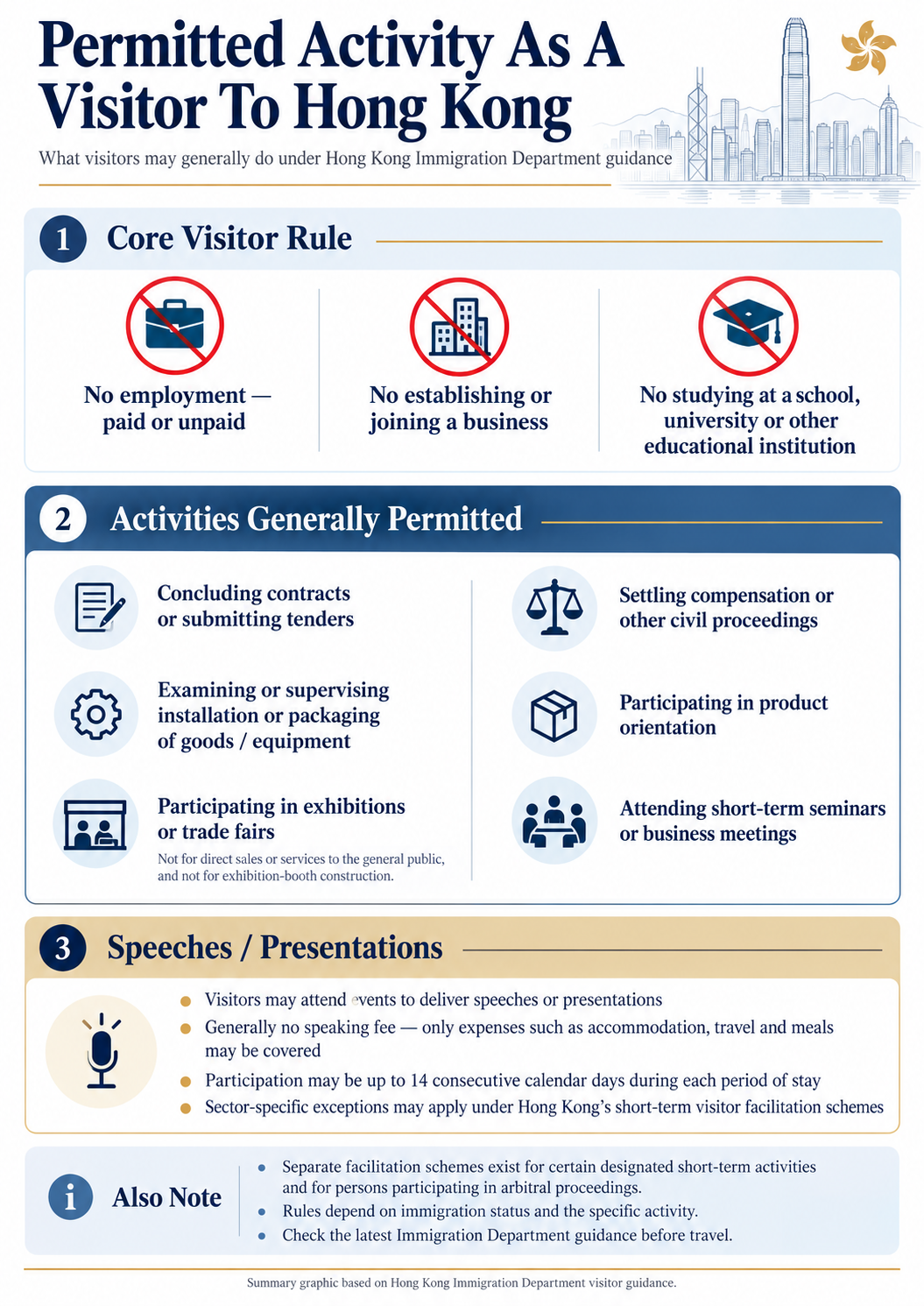
Under Hong Kong immigration law, prospective entrepreneurs routinely confront an operational dilemma when attempting to establish a local commercial enterprise while physically present in the territory under visitor permissions. In Establish A Business In Hong Kong – Permitted Activity As A Visitor (examined alongside his foundational guide on The Catch 22 for Foreign National Entrepreneurs), Stephen Barnes, the Hong Kong Visa Geeza, outlines the delicate regulatory boundary between lawful preparatory steps and unlawful operational management.
Under Section 41 of the Immigration Ordinance, ordinary visitors are strictly prohibited from taking up paid or unpaid employment, as well as establishing or joining in any business without the prior consent of the Director of Immigration. The Immigration Department accommodates preliminary exploratory activities: an intending founder may arrive as a visitor to conduct feasibility research, attend meetings with professional service providers, open a corporate bank account, and complete company formation formalities at the Companies Registry. However, the moment the individual crosses into active operational control—such as executing commercial leases, hiring local staff, managing employees, or negotiating customer contracts on behalf of the newly incorporated entity—they commit a criminal breach of visitor conditions.
Stephen Barnes – The Hong Kong Visa Geeza
To navigate this “Catch 22” without facing prosecution or prejudicing their subsequent Investment as Entrepreneur application, founders must maintain strictly passive governance—such as appointing resident authorized signatories, local directors, or legal counsel—until formal entry clearance under the General Employment Policy is approved. To examine how contemporary statutory mechanisms facilitate short-term specialist inputs without allowing foreign founders to bypass the entrepreneur visa regime, Stephen Barnes provides the definitive analysis in Practice Update: The 2026 Immigration Facilitation Scheme – Short-Term Work for Visitors to Hong Kong.
The essential operational reality detailed in the Practice Update is that while the regularized and expanded Short-Term Visitor Facilitation Scheme—spanning 18 designated sectors as of 1 October 2026—provides a tailored statutory exception to visitor employment restrictions, it is strictly non-proprietary and offers zero legal cover for foreign entrepreneurs setting up their own businesses. Under the facilitation arrangements, qualifying international talent invited by one of roughly 490 government-endorsed host organisations can lawfully undertake specified professional activities—and receive remuneration where approved—for up to 14 consecutive calendar days per visit without securing a full employment visa under the General Employment Policy. Crucially, as Stephen Barnes emphasizes across both publications, an entrepreneur cannot issue an institutional invitation to themselves through their own newly incorporated vehicle, nor does the scheme permit unendorsed commercial or operational groundwork. Proprietary business management remains strictly governed by the Investment as Entrepreneur approvability test, which now requires substantiating substantial capital deployment, dedicated commercial premises, and local job creation. Foreign founders must maintain total statutory discipline: general visitors must limit their onshore activities to passive corporate structuring and exploratory meetings, while substantive operational execution must wait for full entrepreneur visa approval rather than relying on short-term institutional facilitation mechanisms.
On the 6th of August 2015, I was invited by the good guys at WYND to give a talk about the Hong Kong visas that are the most realistically achievable to live, work or establish a business in Hong Kong, all things considered.
On the 6th of August 2015, I was invited by the good guys at WYND to give a talk about the Hong Kong visas that are the most realistically achievable to live, work or establish a business in Hong Kong, all things considered.
PRACTICE UPDATE: How the content must now be read in light of current ImmD policy:
Historically, this policy-level overview explored the philosophical and statutory underpinnings of Hong Kong’s major immigration entry routes—spanning employment, investment as entrepreneur, dependant, and capital/talent entry frameworks. The Geeza unpacked how the Immigration Department interpreted its overarching statutory mandate to balance open-door talent acquisition with the protection of the local workforce. In that era, Hong Kong’s immigration policy was celebrated for its pragmatic flexibility and commercial accommodation: the policy machinery was intentionally designed to encourage foreign commercial initiative, welcoming entrepreneurs, sole practitioners, and boutique consultancies. Case officers applied a holistic, discretionary standard of “substantial contribution,” routinely approving independent founders who arrived with modest seed capital of a few hundred thousand dollars, secured a flexible desk in a serviced office or co-working space, and presented a forward-looking operational plan to phase in local hiring over a two- to three-year ramp-up period.
The game has changed from an elastic, founder-friendly policy framework into an uncompromising two-tier institutional architecture. ImmD has effectively purged administrative discretion and narrative leniency from its independent business entry policy. Under post-April 2026 administrative practice aligned with TTPS Category A operational substance (~HKD 2.5M enterprise scale), immigration policy bifurcates commercial entrants into two rigidly audited channels: heavily capitalized corporate operations and state-sanctioned incubator participants. For independent founders operating outside the government’s official incubation ecosystem, immigration policy now demands immediate, empirical corporate hardware audited on day one: HKD 1.5M–2.0M in deployed corporate bank liquidity sitting in a local bank account, an executed commercial lease for exclusive physical premises (“four walls”) disqualifying serviced and co-working desks entirely, and active Mandatory Provident Fund (MPF) payroll contributions for 2–3 local Hong Kong permanent residents.
Consequently, the philosophical policy promise of an accessible, low-friction immigration pathway for self-directed entrepreneurs is completely defunct. Hong Kong’s macro business immigration policy now funnels all early-stage and seed-stage ventures exclusively through accredited institutional gatekeepers: formal admission into an officially recognized government incubator (such as Cyberport, HKSTP, or the Design Incubation Programme) is the sole statutory mechanism that waives these crushing hardware mandates. Any prospective founder attempting to rely on the historical policy ethos of commercial openness without meeting either the full institutional audit or holding an accredited incubator endorsement faces swift and summary refusal.
On the 6th of August 2015, I was invited by the good guys at WYND to give a talk about the Hong Kong visas that are the most realistically achievable to live, work or establish a business in Hong Kong, all things considered.
PRACTICE UPDATE: How the content must now be read in light of current ImmD policy:
Historically, this foundational overview introduced the four primary, “realistically achievable” immigration mechanisms for foreign nationals seeking lawful status to live, work, or establish a commercial presence in Hong Kong: the General Employment Policy (GEP) for employment, the Investment as Entrepreneur visa, the Dependant visa, and the Quality Migrant Admission Scheme (QMAS). The Geeza framed these four streams as practical, accessible pathways that an ordinary, capable foreign professional or entrepreneur could realistically navigate. The central theme was administrative flexibility and commercial accommodation: securing permission to live and build an enterprise in Hong Kong did not require an applicant to be a multinational executive or hold millions in capital. Prospective entrepreneurs were told that setting up shop was commercially attainable, with case officers exercising wide discretion to grant investment permissions to applicants who arrived with modest seed funding of a few hundred thousand dollars, operated out of a cost-effective serviced office or co-working space, and projected gradual local job creation over a two- to three-year ramp-up period.
The game has changed from an accessible, four-pillar framework into an intensely audited system where the independent business establishment pillar is locked behind heavy empirical barriers. Promoting the independent entrepreneur visa as “realistically achievable” for an early-stage founder or lean SME is now flatly inaccurate. Under post-April 2026 administrative practice aligned with TTPS Category A operational substance (~HKD 2.5M enterprise scale), ImmD has excised qualitative discretion and commercial storytelling from the entrepreneur assessment. Today, any foreign national seeking to live and work in Hong Kong through their own commercial vehicle must substantiate day-one corporate hardware: HKD 1.5M–2.0M in deployed corporate bank liquidity, an executed commercial lease for exclusive physical premises (“four walls”) disqualifying serviced offices and co-working spaces entirely, and active Mandatory Provident Fund (MPF) payroll contributions for 2–3 local Hong Kong permanent residents.
Consequently, the realistic pathways to Hong Kong residency have been starkly bifurcated. Unless an early-stage founder has secured documented, formal admission into an officially accredited government incubator (such as Cyberport, HKSTP, or the Design Incubation Programme)—which remains the sole statutory safe harbor waiving these massive empirical prerequisites—the entrepreneur stream is completely out of reach. For independent professionals lacking institutional incubation backing or millions in deployable corporate liquidity, the only truly “achievable” routes remaining are conventional employer-sponsored GEP employment or unencumbered status via a Dependant visa; attempting to launch a lean venture independently on the historical assumption that the entrepreneur stream is readily achievable will result in swift and summary refusal.