
Cyberport Immigration Talk: On Thursday this week (April 28) at Cyberport, I am giving a presentation on visa considerations for business owners along with Chris Sykes from Dragon Law.
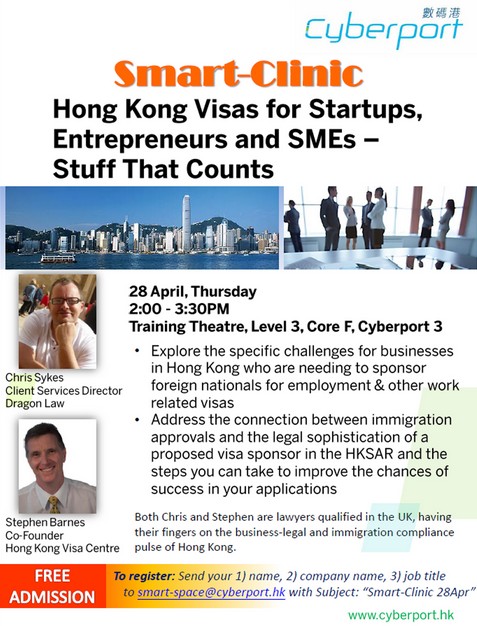
Our joint session will look at both immigration and labour law issues frequently faced by those in business for themselves and you’re invited. It’s 100% free.
The Hong Kong Director of Audit issued Audit Commission Report Number 66 on the 5th of April and has made recommendations, which the government has accepted, to change certain aspects of how ImmD undertake their duties.
The Report is a mine of information (and runs to 86 pages long) but here follow some of the changes afoot:
Admission Schemes for talent, professionals and non-local graduates
(1) monitor GEP and ASMTP applications with long processing times
(2) issue guidelines to set out clearly the required procedures for considering availability of local employees and market level of remuneration in processing GEP and ASMTP applications
(3) incorporate the talent list into the QMAS once it is available
(4) tighten control over the verification of the authenticity of supporting documents submitted by IANG applicants/entrants
Admission Schemes for investors
(5) step up monitoring of the processing time of GEP entrepreneur applications
(6) tighten up control of extensions of stay and consistency of business review
(7) tighten control over breaches of Scheme Rules of the CIES
I gave a talk entitled 10 Steps To A Successful Hong Kong Entrepreneur Visa Application at WYND earlier this evening.
PRACTICE UPDATE: How the content must now be read in light of current ImmD policy:
Historically, this cornerstone guide served as the flagship, comprehensive primer on the Hong Kong Investment as Entrepreneur visa under the General Employment Policy, walking prospective founders step-by-step through the mechanics of preparing, assembling, and submitting an approvable application. The Geeza dismantled the widespread myth that launching a commercial enterprise in Hong Kong required multimillion-dollar investments or corporate backing, reassuring applicants that immigration policy was intentionally designed to encourage commercial initiative. Case officers operated with broad, pragmatic discretion, welcoming foreign entrepreneurs who arrived with modest seed funding of a few hundred thousand dollars, secured a flexible desk in a serviced office or co-working space to protect cash flow, and articulated a credible narrative demonstrating how the business would reach operational break-even and gradually hire local staff over a two- to three-year ramp-up period.
The game has changed from an accessible, founder-friendly application process into an uncompromising institutional compliance audit. ImmD has completely retired its historical tolerance for lean, bootstrapped, or aspirational business concepts. Under post-April 2026 administrative practice aligned with TTPS Category A operational substance (~HKD 2.5M enterprise scale), securing an entrepreneur visa demands immediate, empirical hardware audited on day one: HKD 1.5M–2.0M in deployed corporate bank liquidity sitting in a local corporate bank account, an executed commercial lease for exclusive physical premises (“four walls”) disqualifying serviced offices and co-working desks entirely, and active Mandatory Provident Fund (MPF) payroll contributions for 2–3 local Hong Kong permanent residents. Unless an applicant has secured formal admission into an officially accredited government incubator (such as Cyberport or HKSTP)—the sole remaining mechanism to waive these empirical prerequisites—submitting an application based on the traditional playbook of modest capital and forward-looking promises will result in swift and summary refusal.
I am hugely privileged to have a talented young filmaker as a nephew.
Last week, Alex Barnes joined the Hong Kong Visa Centre / Video Cha Cha and will be documenting a whole new array of content for our immigration business as well as at least 2 other projects which set out the ongoing story of our business here in Hong Kong.
Alex has produced three videos thus far which documents his arrival in Hong Kong.
Towards the end of last year I was asked to talk about “marketing” at Entrepreneur Conf. at KPMG. I chose the title How To Create A Never Ending Stream of Customers By Building A Monopoly for a very good reason.
Q – Would you ask a public forum for advice on how to get your teenage daughter off drugs?
Q – Would you ask a public forum for advice on how to answer a tax question from the HK IRD?
Q– Would you ask a public forum about how to make an application to the court to secure custody for your child?
In the main, of course, the answer is no.
You would seek the advice of an expert.
These questions are simply too important to be dealt with via the well meaning but ultimately emperically derived experience of strangers who have no accountability for the advice that they offer up.
The same applies to Hong Kong immigration questions too.
Down the years I have tried to answer a great many Hong Kong visa and immigration questions posed on public forums but mostly the webmasters refuse to post my answers because they contain links to really good advice on our websites.
They are concerned that the quality of our content will direct visitor traffic away from their forums – which is understandable.
However this means that the advice offered up on their websites is of massively variable quality.
There is some shockingly bad advice posted on public forums, but also some accurate advice too.
The problem is, which is which?
Just like advertising, only 50% of it works – it’s just that nobody actually knows which half!
So do Hong Kong visa and immigration public forums actually help?
My response is to provide an alternate opportunity to access expert immigration advice and provide accurate answers via PodCast or otherwise in a video format – also pointing out the folly of some of the suggested answers to the questions posed.
Let’s at least get some quality advice circulating.
In the Q&A session which followed the fireside chat I was asked by Josh Steimle how you might be able to get a Hong Kong work visa application approved by finagling an interim intercompany transferee situation.