
13
Oct 2026PRACTICE UPDATE: Hong Kong’s IANG Visa – From Graduate Retention to Economic Participation
Posted by The Visa Geeza / in IANG, Musing / No responses
Practice Direction: Hong Kong’s IANG Visa – From Graduate Retention to Economic Participation

A Major Strategic Shift in the Immigration Arrangements for Non-local Graduates
For many years, Hong Kong’s Immigration Arrangements for Non-local Graduates (IANG) have provided one of the territory’s most accessible pathways from education into professional employment.
Unlike traditional employment visa arrangements, the IANG recognises that a qualifying graduate should have the opportunity to establish a career in Hong Kong without necessarily securing a job before making an initial application.
This flexibility has made the scheme an important component of Hong Kong’s strategy to attract international students, retain educated talent and develop its professional workforce.
However, the policy environment surrounding the IANG has evolved considerably.
The extension of the scheme to qualifying graduates of university campuses in the Guangdong-Hong Kong-Macao Greater Bay Area, improvements to permitted periods of stay and revised extension procedures all reflect a more integrated approach to talent development.
At the same time, the Immigration Department continues to distinguish between a graduate’s initial entitlement to seek admission and the substantive requirements governing continued residence.
The essential distinction is that a qualifying academic background can open the door to Hong Kong, but continued residence ordinarily requires a credible employment or business connection with the territory.
This Practice Direction examines how those developments should influence immigration planning for international graduates, employers and entrepreneurs.
The Expansion of IANG Beyond Hong Kong’s Traditional University System
Historically, the IANG was principally associated with non-local students who completed qualifying full-time, locally accredited programmes in Hong Kong.
The Government subsequently extended the arrangements to qualifying graduates of higher education institutions jointly established by Mainland and Hong Kong universities in Mainland cities of the Greater Bay Area.
This development is strategically significant.
It recognises that Hong Kong’s future professional workforce will not necessarily be educated exclusively within the territory’s geographical boundaries.
Increasingly, universities, research institutions, technology businesses and professional services firms operate within a wider Greater Bay Area ecosystem.
By extending IANG eligibility to qualifying GBA campus graduates, Hong Kong has created an additional pathway through which individuals educated within that regional environment may enter its employment market.
However, applicants must establish that their institution and programme meet the specific requirements.
Graduating from any university situated within the Greater Bay Area does not automatically establish eligibility.
Recent and Non-Recent Graduates: An Important Distinction
The IANG continues to distinguish between recent and non-recent graduates.
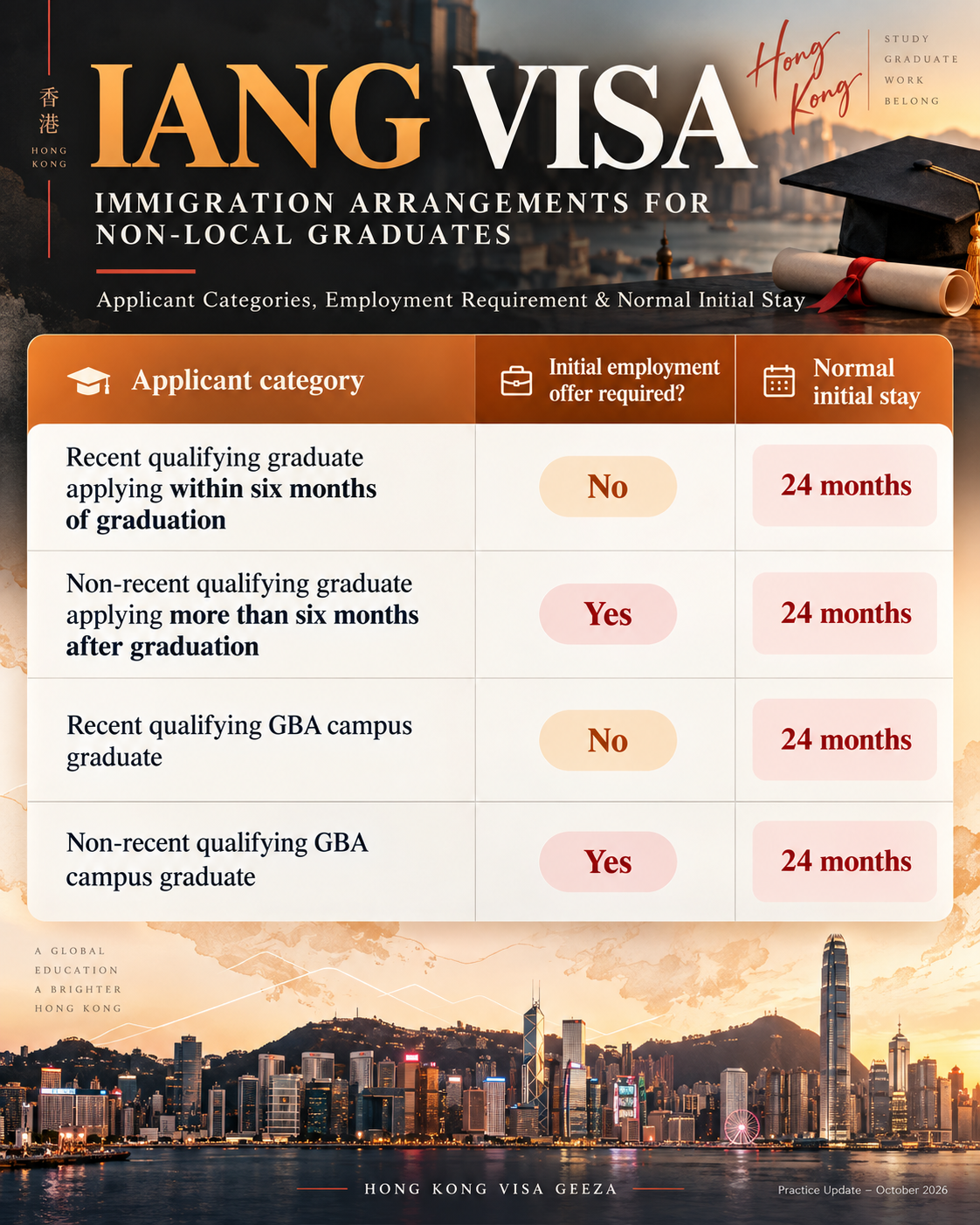
For recent graduates, the ability to obtain immigration permission without a prior employment offer remains one of the scheme’s most valuable advantages.
It provides time to investigate employment opportunities, establish professional networks and consider entrepreneurial activities.
Non-recent graduates, by contrast, must ordinarily demonstrate that they have secured qualifying employment at a level commonly taken up by degree holders and with remuneration consistent with the market.
The distinction is therefore not simply administrative.
It affects the evidence that applicants must produce and the way in which they should prepare their immigration applications.
The Revised 2+3+3 Framework
An important enhancement to the IANG was the replacement of the previous 1+2+2+3 pattern of stay with a more favourable 2+3+3 arrangement.
Under the current framework, successful applicants are normally granted an initial period of 24 months.
Qualifying extensions may then be granted for periods of up to three years, subject to the applicable conditions and the applicant’s circumstances.
This provides greater stability for graduates seeking to establish their professional careers.
However, the availability of a longer initial period should not be confused with an unconditional right to remain in Hong Kong throughout subsequent extensions.
The initial permission provides an opportunity to develop the employment or business circumstances necessary to support continued residence.
The Extension Stage: Where Economic Participation Becomes Critical
The most important practical issue for IANG entrants arises when their initial permission approaches expiry.
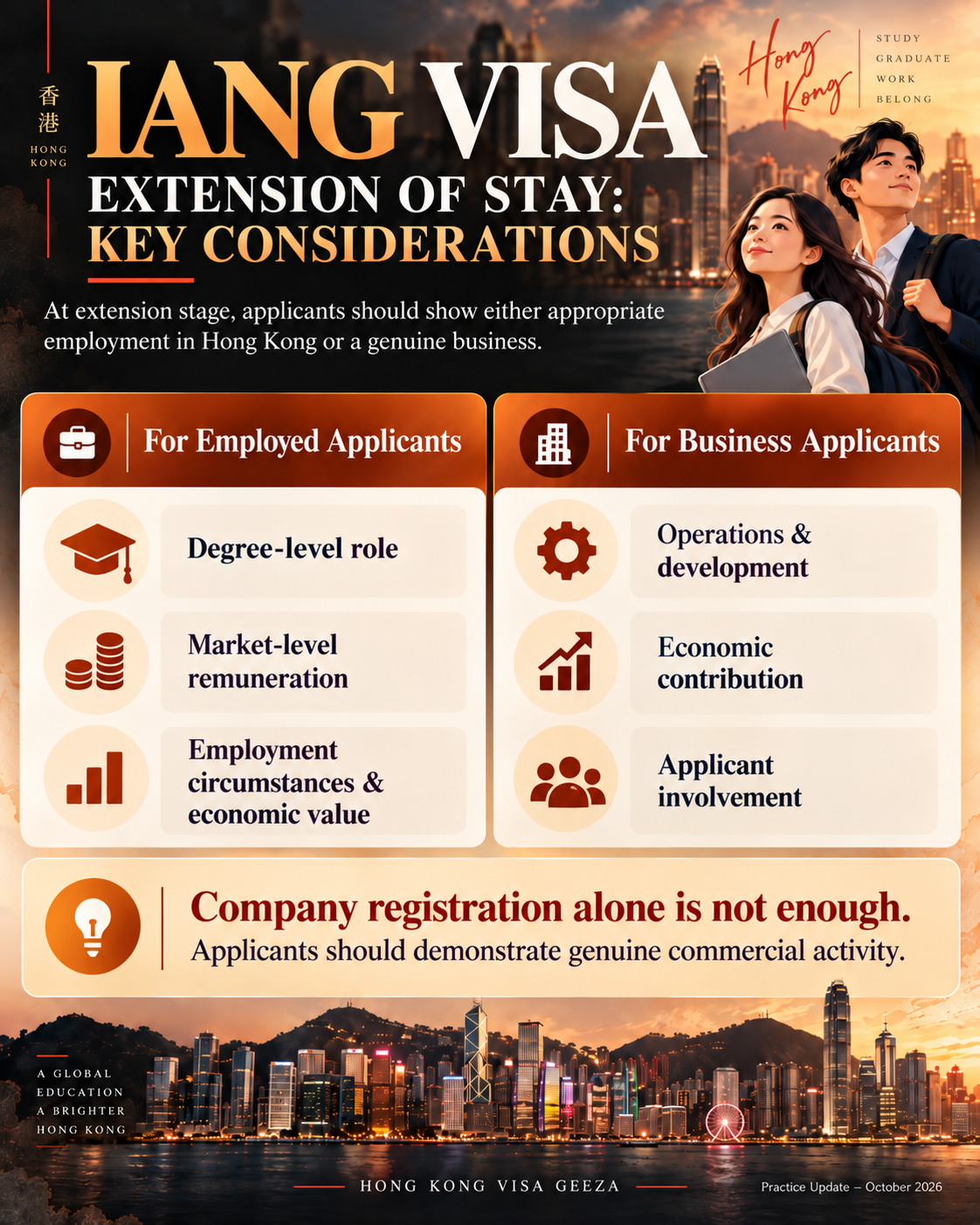
At this stage, the Immigration Department ordinarily expects applicants to demonstrate that they have taken up appropriate employment in Hong Kong or established or joined a genuine business.
For employed applicants, the Department considers whether the position is appropriate for a degree holder and whether the remuneration package is consistent with prevailing market conditions.
The Department may also consider the applicant’s employment circumstances and the economic benefits associated with the position.
For applicants who have established or joined a business, the assessment may include the enterprise’s operations, development, economic contribution and the applicant’s involvement.
This is particularly relevant for graduates who initially entered Hong Kong without employment and subsequently moved into entrepreneurship.
A registered company, by itself, should not be assumed to establish sufficient grounds for an extension.
Applicants should be prepared to demonstrate genuine commercial activity.
Entrepreneurial Graduates: The Importance of Business Substance
Hong Kong’s innovation economy increasingly encourages graduates to establish technology businesses, professional consultancies and other commercial enterprises.
The IANG offers flexibility for qualifying graduates to pursue these opportunities.
Nevertheless, entrepreneurial applicants should understand that the extension process requires more than evidence of company incorporation.
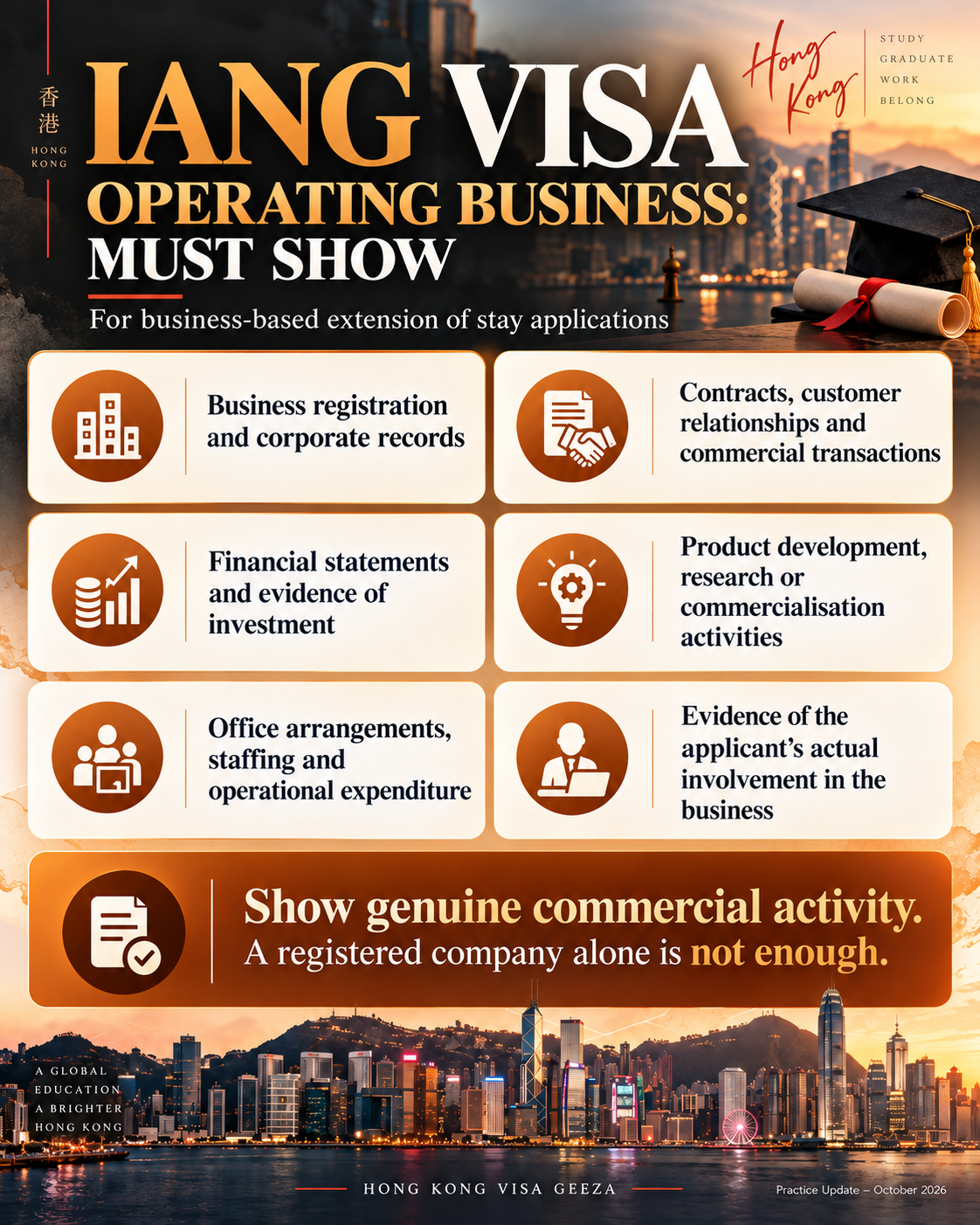
Depending upon the circumstances, useful evidence may include:
* Business registration and corporate records.
** Contracts, customer relationships and commercial transactions.
*** Financial statements and evidence of investment.
**** Product development, research or commercialisation activities.
***** Office arrangements, staffing and operational expenditure.
****** Evidence of the applicant’s actual involvement in the business.
An early-stage enterprise may not yet be profitable, but it should still be capable of demonstrating credible business activity and development.
The Immigration Department assesses the circumstances of each application rather than applying a universal published minimum-turnover requirement to every IANG entrepreneur.
Greater Bay Area Integration and Hong Kong’s New Economic Direction
The significance of the expanded IANG arrangements becomes clearer when viewed alongside Hong Kong’s wider economic development strategy.
Hong Kong’s first Five-Year Plan for 2026–2030 places considerable emphasis on innovation, technology, research, advanced industries and closer economic integration with Mainland China.
The Greater Bay Area is particularly important to this strategy.
Hong Kong’s role as an international financial, commercial and professional services centre is increasingly being developed alongside the manufacturing, technology and research capabilities of neighbouring cities, particularly Shenzhen.
The extension of IANG eligibility to qualifying GBA campus graduates fits naturally within that broader direction.
It creates additional opportunities for graduates educated within the regional university ecosystem to participate in Hong Kong’s economy.
Nevertheless, applicants should distinguish this strategic policy context from the formal eligibility requirements.
The Five-Year Plan does not automatically create new IANG entitlements, nor does it replace the Immigration Department’s published admission and extension criteria.
The 2026 Extension Application Window
Another practical development concerns the timing of extension applications.
Under the current arrangements, IANG entrants may submit extension applications within three months before the expiry of their existing limit of stay.
This provides additional time to assemble documentation and address potential issues.
However, it is important to appreciate that filing an extension application does not automatically authorise an applicant to remain in Hong Kong beyond their existing permitted stay.
Applicants should monitor expiry dates carefully and comply with Immigration Department instructions while their applications are being considered.
The longer application window should therefore be used for proper preparation, not as a substitute for it.
The Top-Tier Employment Stream
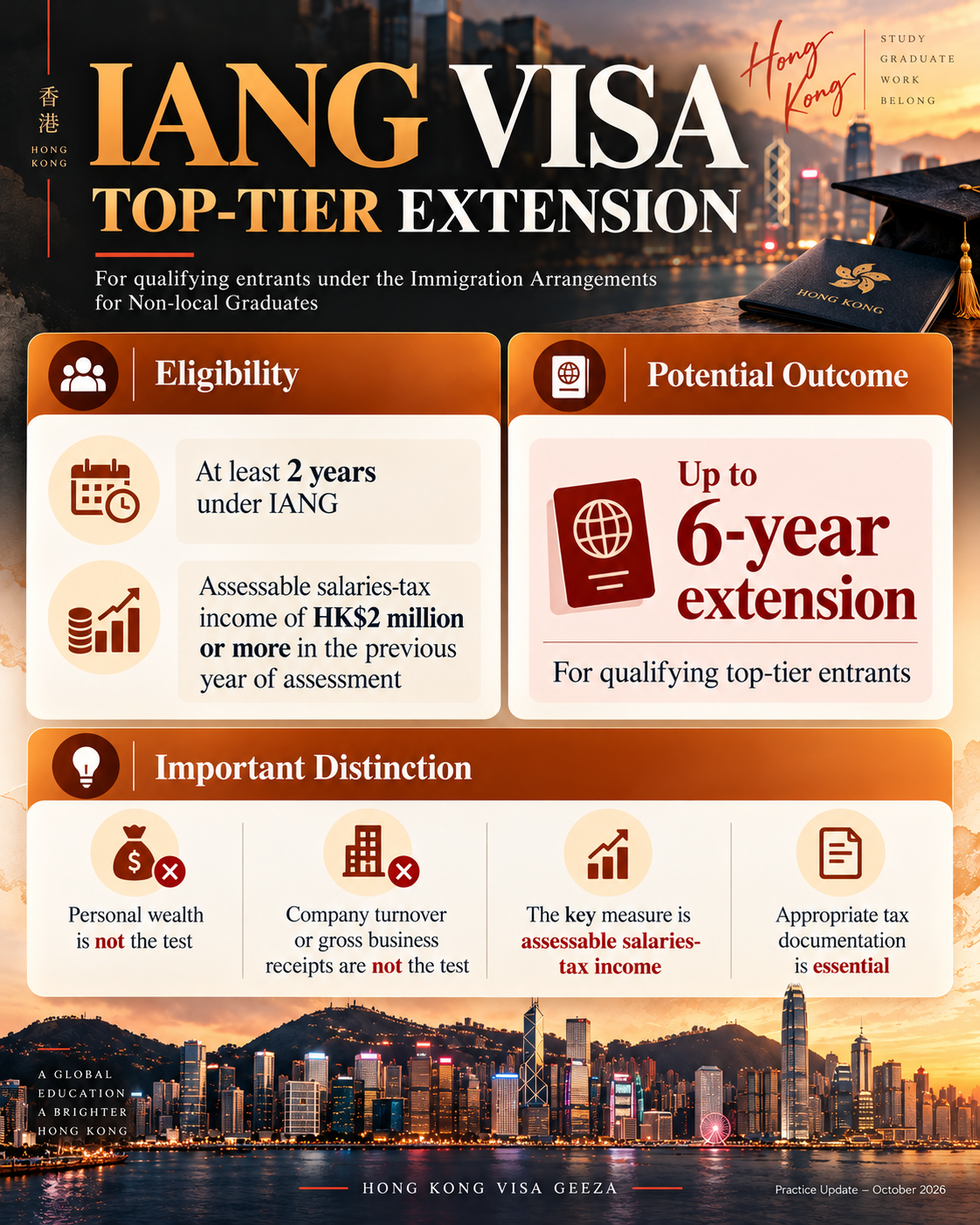
The IANG also offers a top-tier extension arrangement for qualifying entrants.
Individuals who have been permitted to remain in Hong Kong under the scheme for at least two years and have assessable salaries-tax income of not less than HK$2 million in the previous year of assessment may qualify for consideration for a six-year extension.
This arrangement provides an additional incentive for economically successful graduates to remain in Hong Kong.
However, applicants should not confuse personal wealth, company turnover or gross business receipts with the specific assessable salaries-tax income required under the arrangement.
Appropriate tax documentation is therefore essential.
Practical Guidance for IANG Applicants
The developments outlined above suggest several important considerations.
Plan beyond the initial visa. Graduates should use their initial period of stay to establish a credible employment or business position.
Check academic eligibility carefully. This is particularly important for GBA campus graduates and applicants whose qualifications involve collaborative or cross-border programmes.
Maintain employment records. Contracts, remuneration evidence, employer correspondence and tax documentation may become important at extension stage.
Document entrepreneurial activities. Graduates establishing businesses should maintain evidence of genuine commercial operations and progress.
Understand the recent-graduate deadline. The six-month distinction can materially affect whether an initial employment offer is required.
Prepare extension applications early. The three-month application window provides useful flexibility, but substantive eligibility must still be established.
The Wider Implications for Hong Kong Immigration Practice
The evolution of the IANG illustrates an important feature of Hong Kong’s developing talent strategy.
The Government is not simply seeking to attract highly educated individuals.
It is seeking to create conditions in which those individuals can establish careers, develop businesses and contribute to the territory’s long-term economic development.
The inclusion of qualifying Greater Bay Area graduates broadens the geographical reach of that strategy.
The longer permitted periods of stay provide additional stability.
And the extension framework ensures that continued residence remains connected to genuine employment or business activity.
For international graduates, the message is clear:
Your qualification may establish your eligibility to enter Hong Kong under the IANG. Your subsequent employment or business activities will ordinarily determine the strength of your application to remain.
Understanding that distinction from the outset is essential to effective immigration planning.
More Stuff You May Find Useful or Interesting
IANG Work Visa for Non-Local Graduates: The Ultimate Guide
According to Stephen Barnes in Practice Update: Hong Kong’s IANG Visa, the Immigration Arrangements for Non-local Graduates have shifted from a traditional post-study retention route into a cross-border regional talent channel encompassing qualifying campuses across the Greater Bay Area under Hong Kong’s 2026–2030 Five-Year Plan. In contrast to the baseline procedural overview set out by the Hong Kong Visa Geeza at the historical IANG Work Visa Information Archive, which focused primarily on graduate classification criteria and immediate entry mechanisms, the updated directive treats academic qualifications merely as an entry mechanism rather than an enduring entitlement: “The essential distinction is that a qualifying academic background can open the door to Hong Kong, but continued residence ordinarily requires a credible employment or business connection with the territory.”
Examining the operational framework and extension procedures reveals how policy continuity intersects with heightened scrutiny over time. The historical overview in the archive and the modern directive both track the 2+3+3 pattern of stay, but the updated Practice Direction embeds this within an expanded 3-month pre-expiry application window and an accelerated 6-year Top-Tier extension for graduates earning at least HK$2 million in assessable salaries-tax income. As Stephen Barnes outlines regarding this operational baseline: “Under the current framework, successful applicants are normally granted an initial period of 24 months. Qualifying extensions may then be granted for periods of up to three years, subject to the applicable conditions and the applicant’s circumstances.”
Substantively, the regulatory emphasis has evolved from highlighting procedural flexibility—such as changing employers without prior Immigration Department consent—to enforcing rigorous standards of economic contribution, particularly for self-employed graduates. While the legacy guide framed the scheme around open employment mobility, the modern Practice Direction makes clear that entrepreneurial applicants seeking to extend their stay cannot rely on bare corporate formalities or paper entities. Stephen Barnes defines this strict evidentiary hurdle: “A registered company, by itself, should not be assumed to establish sufficient grounds for an extension. Applicants should be prepared to demonstrate genuine commercial activity.”
What Does the Immigration Department Look for When Establishing the Bona Fides of an IANG Employer?
According to Stephen Barnes in Practice Update: Hong Kong’s IANG Visa, the Immigration Arrangements for Non-local Graduates have transitioned from a mechanism for post-study talent retention into an active economic participation scheme integrated within the Greater Bay Area under Hong Kong’s 2026–2030 Five-Year Plan. In contrast to the practical inquiry addressed by the Hong Kong Visa Geeza in Establishing the Bona Fides of a Hong Kong Employer as a Suitable and Credible Sponsor, which focused on whether specific corporate balance-sheet metrics govern employer sponsorship, the updated Practice Update emphasizes that continuous lawful stay requires an authentic economic anchor: “The essential distinction is that a qualifying academic background can open the door to Hong Kong, but continued residence ordinarily requires a credible employment or business connection with the territory.”
Regarding the operational scrutiny of sponsoring entities, the legacy guidance and the updated Practice Direction converge on the principle that the Immigration Department looks beyond formal financial thresholds to evaluate organizational reality. While the historical case response clarifies that profitability is not a mandatory prerequisite provided the sponsor is sizable, established, or supported by a comprehensive business plan if under twelve months old, the updated Practice Direction frames this within the modern 2+3+3 pattern of stay and an expanded 3-month renewal filing window. As Stephen Barnes explains regarding this operational baseline: “Under the current framework, successful applicants are normally granted an initial period of 24 months. Qualifying extensions may then be granted for periods of up to three years, subject to the applicable conditions and the applicant’s circumstances.”
Substantively, the regulatory concern across both analyses centers on preventing artificial or nominal arrangements designed solely to preserve residence. The legacy guidance cautioned against contrived job offers concocted by associates to bypass immigration scrutiny, while the modern Practice Direction applies an identical standard of commercial reality to entrepreneurial graduates transitioning from employment into self-directed ventures. Highlighting the necessity of demonstrable trading over paper formalities, Stephen Barnes confirms the evidentiary threshold: “A registered company, by itself, should not be assumed to establish sufficient grounds for an extension. Applicants should be prepared to demonstrate genuine commercial activity.”
How Easy Is It to Secure an IANG Work Visa on the Basis of Freelance Employment?
According to Stephen Barnes in Practice Update: Hong Kong’s IANG Visa, the Immigration Arrangements for Non-local Graduates have transitioned from a mechanism for post-study retention into an active economic participation scheme integrated across the Greater Bay Area under Hong Kong’s 2026–2030 Five-Year Plan. In contrast to the specific advisory scenario examined by the Hong Kong Visa Geeza at How Easy Is It To Secure A Work Visa Issued Under The Immigration Arrangements For Non-Local Graduates On The Basis Of Freelance Employment?, which addressed whether an entrant can break away from corporate sponsorship to pursue freelance consulting, the updated Practice Update firmly establishes that continuing residence cannot rest on academic status alone: “The essential distinction is that a qualifying academic background can open the door to Hong Kong, but continued residence ordinarily requires a credible employment or business connection with the territory.”
Examining the mechanics of ongoing stay, both sources highlight a critical divergence between an entrant’s daily operational freedom and their formal legal obligations at extension milestones. The legacy analysis observes that an IANG holder who departs an employer mid-visa can freelance during their unexpired permission—or even cross the seven-year continuous residence threshold for the Right of Abode without triggering an active employment inquiry—yet warns that seeking a renewal on the basis of self-employment historically invoked the demanding “substantial contribution” approvability test of a full investment visa. In contrast, the modern directive replaces ad-hoc renewals with an expansive 2+3+3 pattern of stay and an expanded 3-month filing window, offering greater runway for legitimate career progression. As Stephen Barnes outlines regarding this operational baseline: “Under the current framework, successful applicants are normally granted an initial period of 24 months. Qualifying extensions may then be granted for periods of up to three years, subject to the applicable conditions and the applicant’s circumstances.”
Substantively, the regulatory threshold for independent professionals and business founders has evolved from ambiguous hurdles into a clear standard of commercial reality. While the legacy advisory cautioned that sustaining freelance activity at renewal was an uphill battle without a sizable business structure, the modern Practice Direction clarifies that immigration authorities assess genuine business activity rather than demanding arbitrary turnover figures, while strictly disqualifying nominal or paper arrangements. As Stephen Barnes defines the evidentiary baseline for self-employed graduates: “A registered company, by itself, should not be assumed to establish sufficient grounds for an extension. Applicants should be prepared to demonstrate genuine commercial activity.”
Hong Kong Visas – Immigration Arrangements for Non-local Graduates: A Practical Guide
According to Stephen Barnes in Practice Update: Hong Kong’s IANG Visa, the Immigration Arrangements for Non-local Graduates have transitioned from a localized retention channel into an active economic participation scheme integrated across the Greater Bay Area under Hong Kong’s 2026–2030 Five-Year Plan. In contrast to the specific advisory scenario examined by the Hong Kong Visa Geeza at How Easy Is It To Secure A Work Visa Issued Under The Immigration Arrangements For Non-Local Graduates On The Basis Of Freelance Employment?, which addresses whether an entrant can break away from corporate sponsorship to pursue freelance consulting, the updated Practice Direction firmly establishes that continuing residence cannot rest on academic status alone: “The essential distinction is that a qualifying academic background can open the door to Hong Kong, but continued residence ordinarily requires a credible employment or business connection with the territory.”
Examining the mechanics of ongoing stay, both sources highlight a critical divergence between an entrant’s day-to-day operational freedom and their formal legal obligations at extension milestones. The legacy analysis and accompanying podcast recording observe that an IANG holder who departs an employer mid-visa can freelance during their unexpired permission—or even cross the seven-year continuous residence threshold for the Right of Abode without triggering an active employment inquiry—yet warns that seeking a renewal on the basis of self-employment historically invoked the demanding “substantial contribution” approvability test of a full investment visa. In contrast, the modern directive replaces ad-hoc renewals with an expansive 2+3+3 pattern of stay and an expanded 3-month filing window, offering greater runway for legitimate career progression. As Stephen Barnes outlines regarding this operational baseline: “Under the current framework, successful applicants are normally granted an initial period of 24 months. Qualifying extensions may then be granted for periods of up to three years, subject to the applicable conditions and the applicant’s circumstances.”
Substantively, the regulatory threshold for independent professionals and business founders has evolved from ambiguous hurdles into a clear standard of commercial reality. While the legacy advisory cautioned that sustaining freelance activity at renewal was an uphill battle without a sizable business structure, the modern Practice Direction clarifies that immigration authorities assess genuine business activity rather than demanding arbitrary turnover figures, while strictly disqualifying nominal or paper arrangements. As Stephen Barnes defines the evidentiary baseline for self-employed graduates: “A registered company, by itself, should not be assumed to establish sufficient grounds for an extension. Applicants should be prepared to demonstrate genuine commercial activity.”
Visas to Live, Work or Establish a Business in Hong Kong – IANG
According to Stephen Barnes in Practice Update: Hong Kong’s IANG Visa, the Immigration Arrangements for Non-local Graduates have evolved from a standalone academic-to-employment bridge into an active instrument of regional economic integration aligned with the Greater Bay Area and Hong Kong’s 2026–2030 Five-Year Plan. In contrast to the tactical route presented by the Hong Kong Visa Geeza in Visas To Live, Work or Establish A Business In Hong Kong – IANG, which framed enrolment in a local master’s degree as a strategic backdoor to secure a two-year commercial runway without prior work experience, the updated Practice Direction makes clear that entry rights must not be mistaken for ongoing residence entitlements: “The essential distinction is that a qualifying academic background can open the door to Hong Kong, but continued residence ordinarily requires a credible employment or business connection with the territory.”
On procedural structure and duration of stay, both sources highlight the immense strategic advantage of the initial post-graduation grant, though within different regulatory perspectives. The historical guide highlights that eligible graduates receive an open, no-questions-asked 24-month permission allowing them to operate freely or establish a venture before seeking subsequent extensions, while the modern directive integrates this initial grant into the 2+3+3 pattern of stay, supplemented by an expanded three-month pre-expiry application window and a dedicated six-year Top-Tier extension stream. As Stephen Barnes outlines regarding this operational baseline: “Under the current framework, successful applicants are normally granted an initial period of 24 months. Qualifying extensions may then be granted for periods of up to three years, subject to the applicable conditions and the applicant’s circumstances.”
Substantively, the regulatory benchmark governing entrepreneurial graduates has matured from an ambiguous “substantial contribution” investment test into an objective assessment of operational commercial reality. Where the legacy analysis noted that founders extending their IANG stay under their own enterprise had to demonstrate substantial economic contributions—effectively mirroring the steep approvability bar of a business investment visa—the updated Practice Direction removes arbitrary turnover prerequisites while aggressively penalizing nominal corporate shells. Establishing the evidentiary standard for graduate founders seeking extensions, Stephen Barnes concludes: “A registered company, by itself, should not be assumed to establish sufficient grounds for an extension. Applicants should be prepared to demonstrate genuine commercial activity.”
VisaGeeza.Ai – Making Hong Kong Immigration A Lot Easier

VisaGeeza.Ai – 13 Years In The Making
Check Out VisaGeeza.Ai
All Our Know-How : All Our Experience : Fully Interactive
100% FREE!
Please select the social network you want to share this page with:


